

Schneider Electric has developed its business around managing energy and electricity through integrated hardware and software solutions and improving operational efficiency and productivity through automation. It supports energy management and process automation across electricity-consuming sectors, including homes, buildings, factories, data centers, oil refining, shipbuilding and heavy industry.
Media demonstration tour at Data Center Korea 2026
Schneider Electric participated in Data Center Korea 2026, which opened at the aT Center in Yangjae, Seoul, on November 4, showcasing integrated solutions spanning power supply, cooling and digital operations for AI data centers.
At the exhibition, which runs through November 6, Schneider Electric presented its infrastructure portfolio connecting the grid to the chip and the chip to cooling equipment under the theme “Powering Every Layer of AI Datacenters.”
To address growing electricity demand and cooling loads as AI workloads expand, the company connected power, cooling and operational systems and presented ways to improve data center reliability, efficiency and scalability.
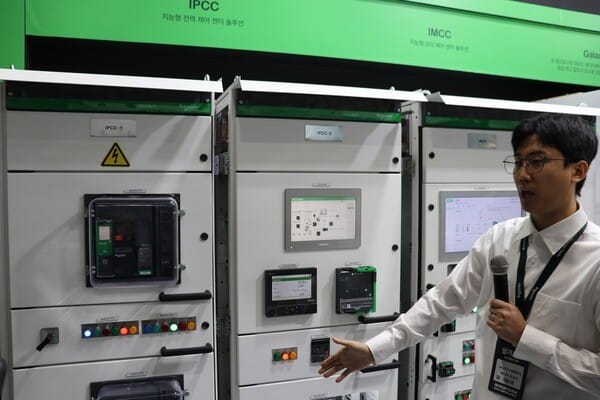
The booth comprised three zones: Grid-to-Chip, Chip-to-Chiller, and Operation & Maintenance. The Grid-to-Chip zone featured IPCC/IMCC intelligent power distribution and motor control solutions, the Galaxy VXL UPS, MCSeT with EvoPacT high-voltage switchgear, rack power distribution units (rPDUs), and the PowerLogic Source Controller.
The Chip-to-Chiller zone introduced the MCDU-25 coolant distribution unit and an AI POD miniature, while the Operation & Maintenance zone presented EPMS and BMS, condition-based maintenance solutions, and Connected Asset Monitoring.
On November 4, the opening day, Schneider Electric held a media demonstration tour for journalists. The tour demonstrated five solutions: IPCC/IMCC, Galaxy VXL, MCSeT with EvoPacT, MCDU-25, and EPMS/BMS. Representatives from the respective business divisions explained each solution’s main functions and role in data centers.
Switchboards combine measurement, self-diagnostics and wireless communication
IPCC and IMCC are based on Schneider Electric’s own BlokSeT switchboards. IPCC is a low-voltage distribution switchboard based on BlokSeT Type D that protects the electrical system. IMCC is a withdrawable motor control center (MCC) based on BlokSeT Type Mw that controls and monitors operating motors.
Schneider Electric scaled down panels used in data centers and industrial plants to create a demonstration panel comprising two IPCC sections and one IMCC section. The demonstration panel was configured to supply 380 V three-phase power separately to two air circuit breakers (ACBs). Because data centers require a continuous 24-hour electricity supply, they often use KEPCO power as Source 1 and emergency generator power as Source 2.
In the demonstration panel, PowerLogic T300 diagnoses a problem with Source 1 and automatically transfers the supply to Source 2. PowerLogic T300 is a remote terminal unit (RTU) for distribution automation that supports automatic transfer switching (ATS), including transfer arrangements linked to an emergency generator. Actual installations allow a transfer interval of around 30 to 50 seconds to accommodate generator startup, but Schneider Electric shortened the interval for the demonstration to show the transfer and restoration sequence.
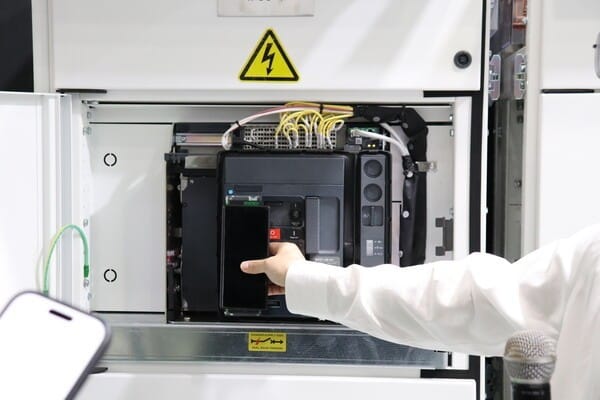
The Masterpact MTZ used as the ACB offers energy sensing, circuit breaker condition self-diagnostics, and NFC and Bluetooth wireless communication in addition to basic protection. Placing the back of a phone against the circuit breaker retrieves breaker information through NFC. After activating Bluetooth and entering the six-digit code displayed on the screen into Schneider Electric’s dedicated app, users can check current and voltage for each phase and LSIG protection settings on the phone.
The maintenance screen also displays circuit breaker contact wear. A Schneider Electric representative explained that a site using 90% contact wear as its replacement criterion could use the actual wear reading to identify when preventive maintenance is needed.
A PowerLogic ION9000 power quality meter and a PowerLogic P5 protection relay were installed in the center of the panel. ION9000 is a high-performance power quality meter for critical loads, main supplies, and high- and low-voltage systems, providing electrical system power quality analysis, while P5 handles system protection. Power received by IPCC is supplied to IMCC through a molded-case circuit breaker (MCCB).
IMCC incorporates the TeSys Tera and EOCR-ISEM2 motor management products. When a motor runs, the screen displays real-time current trends, motor health, line-to-line voltage and phase current values. A warning alarm appears if a motor abnormality occurs.
EOCR-ISEM2 is the latest model in Schneider Electric’s EOCR series, which has a 40-year history, adding communication, control and self-diagnostic functions to motor protection. The accompanying EOCR Edge software provides integrated management of EOCR devices and MCCs, analyzing current trends in real time to flag abnormalities before an incident. EOCR Edge can connect tens to hundreds of motors, allowing users to identify which site has a failed motor.
A Schneider Electric representative explained: “It was not possible at sites to determine the service life of a contactor connected to a motor, but EOCR Edge allows users to check the number of switching operations and determine when replacement is needed. Using motor health data and contactor switching counts helps users quickly identify and address the cause of a motor abnormality and also offers advantages for predictive maintenance.”
Modular UPS allows power module replacement without protective equipment
Galaxy VXL is a three-phase uninterruptible power supply (UPS) rated at 500 to 1,250 kW at 400 V, developed for large-capacity data centers. It handles loads of up to 1,250 kW while occupying just 1.2 square meters. Each power module provides 125 kW, and installing four to 10 modules configures the capacity from 500 kW to 1,250 kW.
Power modules can be added as demand grows, and the modular design also provides N+1 internal redundancy. A long LED indicator at the top allows users to check UPS status from a distance through green, yellow and red signals, while a dust filter is fitted to the door as standard.
Schneider Electric highlighted Live Swap as a distinguishing feature of Galaxy VXL. The commonly used term hot swap refers to the ability to perform maintenance while a UPS is operating.
Galaxy VXL goes further by reducing the arc flash energy level during power module replacement to below 1.2 cal/cm², earning Live Swap certification. Power modules can be added or replaced without shutting down, maintaining operational continuity during expansion and maintenance.
Galaxy VXL provides efficiency of up to 99% in eConversion mode and up to 97.5% in double-conversion mode. A Schneider Electric representative said that conventional eco mode delivers 99% efficiency but remains at Class 3 under IEC 62040-3, the UPS output performance standard, whereas eConversion mode delivers Class 1 performance under the same standard.
Galaxy VXL also responds to fluctuations in AI loads. When AI loads change rapidly as GPU loads increase, battery charging and discharging absorb the fluctuations. During generator-mode operation, sudden changes in output load also cause sudden changes in input current. Battery charging and discharging then limit input current to stabilize the upstream electrical system.
A Schneider Electric representative emphasized: “Previously, workers had to wear personal protective equipment (PPE) when replacing power modules because of the arc flash risk, but Galaxy VXL allows power modules to be replaced without wearing PPE. This improves worker safety while allowing modules to be replaced more quickly when a failure occurs.”
Sensors monitor breaker wear and partial discharge in real time
MCSeT with EvoPacT combines MCSeT high-voltage switchgear with the EvoPacT HVX digital vacuum circuit breaker to address high-density power demand in data centers. A Schneider Electric representative said the circuit breaker design was the biggest change from the previous MCSeT model and described the new breaker’s service life as at least three to four times that of its predecessor.
The circuit breaker incorporates sensors that were not previously included. They measure breaker opening speed and wear in the vacuum interrupter (VI). In withdrawable products commonly used in South Korea, a truck sensor accurately detects the circuit breaker’s position during withdrawal and insertion to check for abnormalities.
Various sensors are also installed inside the switchgear. Temperature sensors monitor busbar heating, while separate sensors track internal temperature and humidity in real time. When a current of at least 5 A flows, these sensors operate on a semi-permanent basis without batteries, allowing monitoring to continue without the inconvenience of opening and closing the switchgear during operation.
The equipment also provides partial discharge monitoring. Partial discharge has various causes and forms, can occur on surfaces or internally, and is difficult to predict. A Schneider Electric representative noted that many domestic customers had relied on periodic inspections because of concerns about partial discharge in high-voltage products.
Schneider Electric’s partial discharge monitoring solution evaluates voltage and phase differences for each phase every 30 seconds and converts them into matrix-form data. It identifies and analyzes patterns in the data to report in real time which phase has what type of problem.
A Schneider Electric representative said: “Data from installed sites show that digital solutions can reduce maintenance interventions resulting from unplanned failures by around 75% and planned maintenance by around 40%. This can reduce total cost of ownership (TCO) by more than 20%.”
CDU targets high-density environments exceeding 50 kW per rack
MCDU-25 is a Motivair coolant distribution unit (CDU) used in direct-to-chip (D2C) liquid cooling configurations for AI data centers. In February 2025, Schneider Electric completed its acquisition of a 75% stake in Motivair, a specialist in liquid cooling and thermal management for high-performance computing. It plans to acquire the remaining 25% in 2028. A Schneider Electric representative said the Motivair acquisition had given the company most of the liquid cooling product lineup.
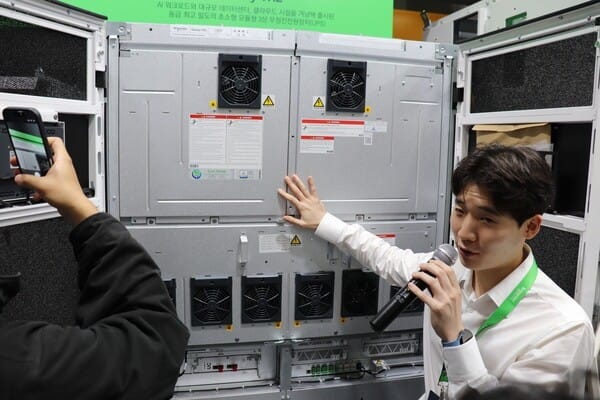
MCDU-25 separates the facility-side primary cooling water system, the Facility Water System (FWS), from the IT-side secondary cooling loop, the Technology Cooling System (TCS), and supplies coolant to the TCS line. It acts as an intermediary, transferring heat generated by chips to the primary-side chiller.
Separating the primary and secondary sides maintains secondary-side water quality, while a stable supply of coolant to the secondary side removes heat from the chips. The water temperature in the IT-side secondary cooling loop is maintained above the dew point inside the data center to prevent condensation.
The unit contains two redundant pumps. One normally operates, and both run together when more capacity is needed. Pump speed is controlled to remove as much heat as the chips require, saving energy by running the pumps only as much as necessary.
The upper feeder replenishes coolant when more secondary-side flow is needed, while a rear valve adjusts the FWS-side temperature. The exhibited product was rated at approximately 700 kW, the smallest model in the lineup. Heat exchanger and pump capacities increase with the unit’s capacity.
A Schneider Electric representative explained: “As AI increases the heat generated per GPU rack, conventional air cooling can no longer provide cooling when rack density exceeds 50 kW. With liquid cooling becoming necessary, the CDU is the equipment that plays a central role in D2C, which is currently becoming established as the standard approach.”
Power SCADA-based BMS integration and digital twin simulation
The EPMS/BMS demonstration introduced Schneider Electric’s software portfolio. Based on power SCADA and building management SCADA, Schneider Electric offers EcoStruxure Building Operation for building management, EcoStruxure Power Operation (EPO) based on power SCADA, EcoStruxure Power Monitoring Expert (EPMS) for power and energy management, and the digital twin-based simulation platform ETAP.
EPMS analyzes the causes and direction of power disturbances and potential load losses, and groups events and alarms to support filtering, searching and classification. It also provides analytical tools to calculate, model, forecast and track energy performance indicators. BMS analyzes data collected from sensors and controllers to assess building operating conditions and monitors, manages and optimizes building systems within a single environment.
Schneider Electric provides data center solutions through EPO, which is based on power SCADA. Rather than implementing BMS on a separate platform, the company configures it on the EPO platform, combining power and building management on a single platform.
EPO also improves system reliability by allowing separate redundancy for power servers and building servers. Its role-based access control (RBAC) function can assign control permissions according to user level. A Schneider Electric representative cited analytical functions and the resulting reports, provided in accordance with international standards, as a differentiator from competitors.
EPO also incorporates ETAP-based digital twin simulation. In 2022, Schneider Electric announced an integration connecting EPO in real time with ETAP’s electrical digital twin. Operators can first use ETAP simulations to check the real-world consequences of control actions they intend to execute through power SCADA or building management SCADA.
A Schneider Electric representative explained: “Running a simulation before an operator issues a command to a circuit breaker allows the outcome of the operation to be checked virtually, with a result such as a bus overload appearing in a pop-up window. Because the final control command is issued after these outcomes are understood in advance, data center facility operations can be made more reliable.”
Modular data centers and condition-based maintenance also exhibited
Alongside the demonstration tour products, Schneider Electric exhibited modular infrastructure and maintenance solutions. EcoStruxure Pod Data Center, presented through an AI POD miniature, is a prefabricated modular structure accommodating power, cooling and network infrastructure, supporting shorter construction periods and consistent construction quality.
The rPDUs, APDU10350ME and APDU11450ME, and the PowerLogic Source Controller handle power control and rack-level power distribution. For operations, a temperature and humidity sensor demonstration, condition-based maintenance solutions, and Connected Asset Monitoring presented ways to use operational data to identify abnormalities and determine appropriate inspection and maintenance timing.
Schneider Electric has also accumulated supply references in South Korea’s data center sector. It supplied ultra-high-efficiency UPS equipment and cooling systems to the Korea Institute of Science and Technology Information (KISTI) Supercomputing Center to support energy cost reductions, and introduced DCIM at the Busan Bank data center to help optimize energy use and improve operational efficiency.
As AI data center construction continues in South Korea, industry attention is turning to the role Schneider Electric could play in the domestic market with its portfolio spanning the power grid, cooling equipment and operational software.
Original Korean article: fajournal.com
English brief by Korea Wind Intelligence, koreawindintel.com

















