

Samsung SDS is expanding its artificial intelligence business around data centers, enterprise workflow automation and robots on manufacturing sites. In logistics, it is pursuing mergers and acquisitions to improve transport efficiency and profitability.
During its third-quarter earnings conference call on October 29, Samsung SDS said it expects revenue related to AI transformation, or AX, in 2026 to more than double from 2025. It said it has set a double-digit growth target for IT services revenue in 2027.
In AI infrastructure, it will launch a graphics processing unit, or GPU, service based on Nvidia Vera Rubin in March 2027. It expects its data center design, build and operate, or DBO, business to generate annual revenue of more than 1 trillion won if its cumulative capacity reaches 500 megawatts, or MW, in 2031.
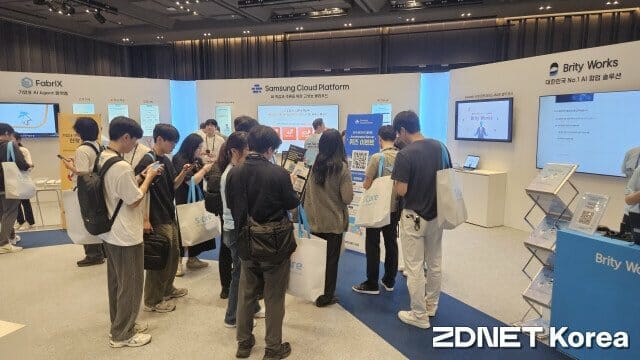
It is also expanding AI services for businesses and public institutions. FabriX 2.0 will support enterprise AI use and cost management, while the company aims to secure more than 500,000 public-sector Brity Works users in 2027. Alongside expanding AI security services, it will launch a platform in 2027 that integrates the management of robot training and operation.
In logistics, it will improve air transport efficiency through its agreement to acquire Woojung Air and cooperation with China Southern Airlines Logistics. However, it expects logistics revenue in 2027 to remain at the 2026 level or increase slightly, taking market and exchange-rate uncertainty into account.
Samsung SDS increased both revenue and operating profit in the third quarter, supported by growth in its cloud and logistics businesses. Revenue rose 11.2% year on year to 3.7725 trillion won, while operating profit increased 3.7% to 241 billion won.
External cloud revenue rises 92% as growth targets increase for 2027
Third-quarter IT services revenue rose 5.3% year on year to 1.681 trillion won. Within that total, cloud revenue increased 18% to 796.1 billion won, while cloud revenue from external customers rose 92%. Cloud's share of IT services revenue expanded to 47%.
AX projects in finance and the public sector, along with enterprise resource planning, or ERP, projects in shipbuilding, supported growth. Samsung SDS expects fourth-quarter IT services revenue to grow at a double-digit rate year on year, supported by related demand and expansion of its public-sector GPU business. Revenue from global AI services that could not be recognized in the third quarter because of differences in contract and settlement timing will also be recognized together in the fourth quarter.
In 2027, the company will target large financial and public-sector projects and investment by affiliates. It identified demand for high-performance computing associated with semiconductor production facility expansion and the development of next-generation systems for financial companies as business opportunities. It plans to release detailed annual guidance during its fourth-quarter earnings announcement in January 2027.
Kim Tae-ho, executive vice president in charge of management support at Samsung SDS, said, “Our revenue target for 2027 is double-digit growth or higher in the IT division.”
Expanding data center construction and operation and preparing next-generation GPU services
Samsung SDS has been selected as the preferred bidder for a data center DBO project exceeding 200 MW being pursued by Pacific Asset Management. It will work with asset managers and other partners to secure power in the Seoul metropolitan area. It plans to use power secured by partners and build project experience before expanding into large-scale projects.
DBO is one of the company's AI infrastructure business models, alongside a capital expenditure, or CAPEX, model involving direct construction and operation of facilities, and an equity investment model involving cooperation with partners. Samsung SDS plans to expand its AI infrastructure capacity to more than 800 MW by 2031 through the three models combined.
Its B300 service under the Ministry of Science and ICT's GPU installation and operation project will begin at the end of 2026. The company expects its Vera Rubin-based GPU service, scheduled to launch in March 2027, to be the first deployment in Asia.
It is also preparing early services ahead of the National AI Computing Center, which is under construction with completion targeted for 2028. Its goal is to provide computing resources from April 2027 using part of the west building at its Dongtan data center.
Overseas, it is participating in an investment in Helix Digital Infrastructure. It plans to gain experience in global AI infrastructure projects and establish customer networks, while exploring cooperation opportunities when overseas companies enter South Korea.
Expanding public-sector AI use and integrating cost and access management through FabriX
Samsung SDS plans to increase public-sector users of its AI collaboration solution Brity Works from the current 330,000 to more than 500,000 in 2027. It also aims to more than double public-sector revenue in 2026.
About 180,000 people at 14 central government ministries currently use Brity Works. Samsung SDS aims to secure 250,000 central government users by the end of 2026 and expand its customer base to local governments, education offices, public corporations and public institutions in 2027.
It has also strengthened workflow automation features to win public-sector contracts. Brity Cowork, an AI assistant added to Brity Works on October 21, performs multistep tasks ranging from information searches and analysis to document preparation and email forwarding. The company also plans to provide features tailored to administrative work, including drafting official documents and materials for responses to the National Assembly and audits.
FabriX 2.0, scheduled for release during the week of October 29, supports the use and management of multiple AI models and agents in one place. Businesses can manage usage, costs, performance and access permissions together, and reduce duplicate development by sharing agents they have already developed.
It also provides an AI Gateway feature that selects an AI model according to the nature of a query and its cost. Samsung SDS plans to gradually expand FabriX users at affiliates from about 90,000 currently to more than 260,000.
Security business growth forecast at 17%, with about 10 robot demonstration projects underway
Samsung SDS is expanding security services in response to a series of security incidents and the spread of AI adoption. It expects its security business to grow about 17% year on year in 2026 and post an operating margin of 17%.
It is strengthening cooperation through participation in security programs run by OpenAI, Google and Anthropic, and using AI models suited to customers' environments to check for vulnerabilities. It supports expert validation, remediation and follow-up checks, while expanding its service scope to include AI agent authentication.
In manufacturing, it is pursuing a robotics transformation, or RX, business. Samsung SDS is developing a robot platform based on its experience installing manufacturing execution systems, or MES, and automation systems at about 1,000 manufacturing sites belonging to affiliates and for about 430 external customers.
It currently has about 10 robot demonstration projects underway at Samsung affiliate sites. Based on the validation results, it plans to expand the number of sites and affiliates involved and move into trial operation on actual production lines.
Logistics revenue exceeds 2 trillion won as Woojung Air acquisition aims to improve transport efficiency
Third-quarter logistics revenue rose about 16% year on year to 2.0915 trillion won. Operating profit increased about 13% to 39.6 billion won. In addition to higher freight rates and increased cargo volumes from major customers, customer acquisition through Cello Square helped revenue from external customers increase 46%.
Woojung Air, which Samsung SDS has signed an agreement to acquire, is a logistics company specializing in air cargo consolidation, combining freight from multiple customers for transport. Samsung SDS plans to combine Woojung Air's operating capabilities with its existing customer base and global cargo volumes to integrate the handling of cargo originating in South Korea and cargo originating elsewhere in Asia and transiting through Incheon.
Through cooperation with China Southern Airlines Logistics, it will also increase cargo capacity from China and Vietnam to the Americas and Europe. It plans to jointly develop new markets in the Middle East and Southeast Asia and improve service quality by connecting transport information.
Oh Gu-il, head of the logistics business division at Samsung SDS, said, “We plan to improve both growth and profitability in air logistics by increasing the cost competitiveness of existing volumes while expanding our customer base and routes.”
Samsung SDS will continue strategic investment and the identification of new businesses while strengthening the competitiveness of existing operations. It plans to address enterprise AX demand by connecting AI infrastructure, platforms and services, and develop new businesses such as robotics as sources of growth.
Lee Jun-hee, CEO of Samsung SDS, said, “We will execute our AI infrastructure business roadmap as planned and combine our capabilities in AI services and AI platform solutions to support and further accelerate our customers' AX.”
Original Korean article: ZDNet Korea
English brief by Korea Wind Intelligence, koreawindintel.com

















