

Competition in the artificial intelligence (AI) industry is expanding beyond semiconductors and software into power and cooling infrastructure. Even with high-performance semiconductors, AI systems are difficult to operate properly without a stable supply of sufficient electricity and timely removal of the heat they generate.
Data centers are where these changes are concentrated. As servers for training AI models and providing services are brought together, the ability to integrate power supply, cooling, communications and safety management equipment is becoming more valuable. Business opportunities are consequently expanding into transformers, power distribution equipment, uninterruptible power supplies (UPS), cooling equipment, and operations and maintenance.
Growing data center electricity demand makes grid connections as important as generation
According to a report published by the International Energy Agency (IEA) in 2026, global data center electricity consumption is expected to increase from approximately 485 terawatt-hours (TWh) in 2025 to about 950 TWh in 2030. This projection covers all data centers, not just dedicated AI facilities, and represents about 3% of global electricity demand in 2030.
However, rising electricity demand does not guarantee the success of every data center business. In actual projects, the key issue is whether the required amount of electricity can be supplied when needed. Even where generation facilities exist, insufficient capacity in local transmission lines and substations can disrupt data center operating schedules.
The IEA points out that grid constraints are becoming a major bottleneck delaying connections for new demand and generation and storage facilities. Planning, permitting and building electricity grids can take longer than constructing data centers, making coordination between project schedules important.
This trend also affects the criteria used to assess data center locations. In addition to land prices and telecommunications access, the timing of electricity availability, capacity for expansion and cooling conditions need to be examined from the outset.
Transformers, distribution equipment and UPS: Growing importance of reliable power delivery
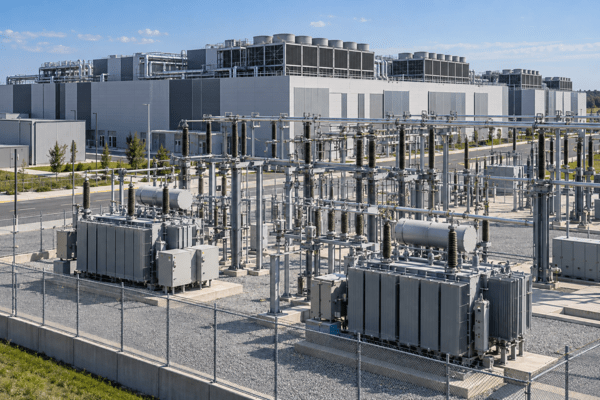
Electricity entering a data center must be converted and distributed for use by servers. This process requires various types of equipment, including transformers, circuit breakers, switchboards, power conversion equipment and UPS systems.
In particular, a higher concentration of high-performance AI servers requires more electricity to be delivered within a limited space. Alongside functions that respond to outages or abnormal voltage, designs that reduce power losses and heat generation are becoming important.
The IEA assesses that rising AI server power density could place pressure on supply chains for key power technologies, including transformers and power electronics. It also identifies the ability to respond to rapid changes in electricity demand during AI training and service operations as a challenge.
Given these conditions, opportunities for South Korean power equipment companies could expand from product supply into design support, commissioning and preventive maintenance. The ability to configure equipment for customers' electricity use patterns and facility sizes, and to manage it reliably over the long term, is expected to become a competitive factor.
Cooling options expand from air to liquid
Increasing AI server density also requires changes in cooling methods. Conventional air cooling removes heat from servers by circulating air. However, as heat generation per unit of area increases, airflow and the arrangement of cooling equipment alone may not always be sufficient.
Cooling technologies that use liquids are consequently attracting attention. Examples include direct liquid cooling, which circulates coolant through cold plates attached to semiconductors, and immersion cooling, which submerges equipment in an electrically insulating liquid.
However, not all facilities will adopt the same approach. Designs that combine air and liquid cooling are also possible, depending on server configurations, power density, existing building structures and maintenance methods.
A liquid cooling report released by 4E, the IEA's energy efficiency technology collaboration programme, identifies energy-saving potential alongside barriers to adoption, including initial costs, a lack of standardization and concerns about long-term reliability. Cooling methods should be selected based on performance and cost under actual operating conditions rather than the novelty of the technology.
Opportunities extend beyond cooling equipment to piping, sensors, controls and maintenance
The expansion of liquid cooling could provide business opportunities not only for cooling equipment manufacturers but also for companies producing heat exchangers, pumps, valves, piping, connectors and sensors.
In direct liquid cooling, coolant distribution units (CDUs) play an important role in transferring heat between server-side cooling circuits and facility-side cooling equipment, while managing flow rates, temperatures and other conditions. Leak detection, coolant condition management and verification of material compatibility between components are also necessary for stable operation.
Given this structure, small and medium-sized companies can approach the market by improving the reliability of specific components or reducing inspection and replacement times. Because equipment failures can interrupt services, companies need to demonstrate on-site response capabilities as well as performance specifications.
For South Korean companies, a strategy that connects capabilities in air conditioning, heat exchange and precision manufacturing with data center demand could be effective. However, rather than supplying products used in existing industries without modification, they need to meet customers' operating conditions and quality verification procedures.
Efficiency is not determined by cooling equipment alone
Improving data center energy efficiency requires examining servers, cooling and power equipment together. Even after high-efficiency cooling equipment is installed, the expected benefits can be difficult to achieve if airflow is poor or equipment operates excessively relative to actual loads.
The US Department of Energy's data center design guidelines also comprehensively address IT systems and operating environments, airflow, cooling and electrical equipment, and waste heat recovery. This means that improving individual equipment efficiency and optimizing the efficiency of the entire facility are both necessary.
Operating performance is also difficult to judge using a single indicator. Alongside power usage effectiveness (PUE), actual electricity consumption, computing work performed, water use and operational reliability need to be assessed together.
Management software and control technologies that collect temperature, power and flow data and adjust equipment operation could also become business opportunities. However, the effects of automatic control must be verified through actual savings and operational stability.
Long-term operations require scrutiny of operating costs and customer demand
Data center viability is significantly affected not only by construction costs but also by electricity charges and maintenance costs incurred over long periods. Even after a building is completed, the investment burden can increase if customer acquisition is delayed or utilization falls short of expectations.
The pace of change in AI server technology also needs to be considered. Power requirements and cooling conditions may change with successive server generations, so initial designs need sufficient flexibility to accommodate expansion and equipment replacement.
Developers therefore need to examine secured power capacity and supply timing, expected utilization, customer contracts and the cost of converting cooling equipment together. Infrastructure suppliers also need to verify actual orders and construction progress rather than assessing demand solely from announced project sizes.
South Korea's challenge: Connecting equipment strengths with integrated services
For South Korea to expand its opportunities in this market, it needs to connect capabilities in power equipment, air conditioning, construction, communications and operations. Beyond supplying equipment separately, a system is needed to coordinate power and cooling conditions from the design stage and support maintenance after operations begin.
Shared demonstration facilities are also important. South Korean component and equipment companies need to be able to verify performance and reliability in environments that simulate actual server loads, making it easier to meet customer evaluation requirements. This also needs to be supported by training specialists who understand electrical and mechanical systems as well as controls and communications.
Communication with local communities is necessary during site selection. Explaining specific issues such as electricity supply, water availability, noise and emergency generator operation, and developing management measures, can improve a project's sustainability.
Competition in AI-era infrastructure does not end with installing more servers. The key capabilities are supplying the required electricity reliably, removing heat efficiently and operating economically over the long term. Whether South Korean companies can translate these needs into reliable products and services is expected to determine the basis for growth in the data center, cooling and power equipment industries.
Original Korean article: koreapost.co.kr
English brief by Korea Wind Intelligence, koreawindintel.com

















