

SK, GS, Naver and others plan 550 trillion won in investment, with 8.4 GW initially and 18.4 GW later
AI data centers take 2 to 3 years to build, but grids take 5 to 10 years, creating a bottleneck
Government plans to use nuclear power, renewable energy, LNG and ESS, with development outside the capital region also a key task
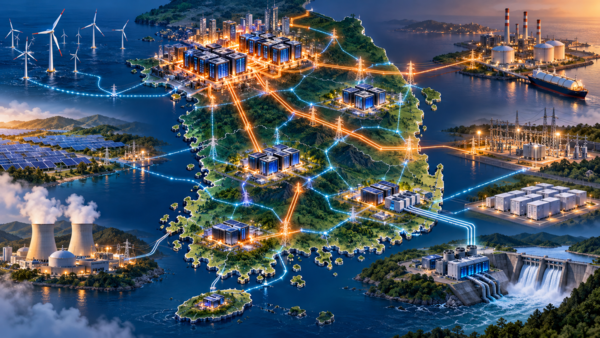
Graphics processing units (GPUs) are not the only requirement for running artificial intelligence (AI). Operating thousands to tens of thousands of high-performance semiconductors 24 hours a day, along with the cooling equipment needed to keep them cool, requires enormous amounts of electricity.
This is why AI competition is expanding beyond models and semiconductors into competition to secure electricity.
According to the government's three major megaprojects for South Korea's development leap, announced in June 2026, SK, GS, Naver and others are pursuing large-scale AI data center development involving a total of 550 trillion won, including investment to be raised.
The initial phase alone would provide 8.4 GW of capacity: 5 GW from SK, 2.4 GW from GS and 1 GW from Naver. The government presented a plan to subsequently expand the project pursued with SK to 15 GW by 2035, bringing total AI data center capacity to 18.4 GW.
The 18.4 GW figure is not the amount of electricity currently being consumed by data centers in South Korea. It is the combined power capacity of data centers proposed for future development.
Nevertheless, if data centers with capacities of several GW are built in succession, securing transmission and substation networks to deliver electricity where it is needed will become as important as generating it at power plants.
A defining characteristic of AI data centers is their high power density.
The International Energy Agency (IEA) projected that global data center electricity consumption would nearly double from about 485 TWh in 2025 to about 950 TWh in 2030. It expected electricity consumption at AI-focused data centers, in particular, to approximately triple over the same period.
The issue extends beyond individual AI servers. As the number of server racks packed with high-performance GPUs increases, the electricity required within the same space is also rising rapidly.
According to the IEA, AI server power density increased elevenfold between 2020 and 2025. A projection also suggested that, in 2027, a single server rack in a high-performance data center could require roughly as much power as 65 households at peak demand.
The problem is that data centers and power grids are built at different speeds.
At a preliminary briefing for its work report in August 2026, the government explained that GW-scale data centers typically take about 2 to 3 years to build, while the supporting power grid can take at least 5 to nearly 10 years.
This means a data center could be completed before the transmission network and substation equipment needed to supply it with electricity are ready. The government also views this as a gap between the development of the AI ecosystem and the power grid, and is pursuing measures to secure high-voltage transmission networks of 345 kV or above in advance.
As the AI industry grows, the location of data centers is also becoming increasingly important.
Existing data centers have favored the capital region, where businesses and users are concentrated and telecommunications infrastructure is well developed. However, the concentration of large data centers in the capital region has also increased pressure on transmission and distribution networks.
Since 2023, the government has strengthened rules allowing electricity supply to be deferred or restricted if a new large data center threatens power system stability, while encouraging locations outside the capital region.
Power system impact assessments are now also conducted for large electricity-consuming facilities above a specified size.
Under the Special Act on the Promotion of Distributed Energy, large electricity-consuming facilities must assess their effects on the smooth flow of electricity, power quality and reliable supply before proceeding with development. Facilities seeking a power supply of 10 MW or more are a principal category covered by the act's enforcement decree.
However, to encourage AI data centers to locate in regions outside the capital area, the government is also reviewing exemptions from power system impact assessments, or simplified procedures, where sufficient power supply capacity is available outside the capital region.
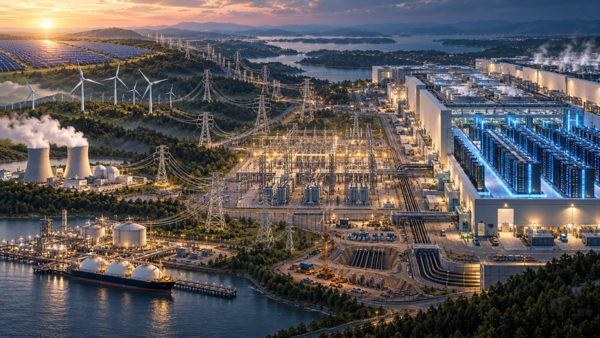
At the Regulatory Rationalization Committee meeting on October 23, the government also said that AI data center developers identify permitting and securing electricity as among their greatest difficulties. It said it would review a consolidated permitting system and criteria for exemptions from power system impact assessments outside the capital region.
This raises the issue of where the electricity needed for 18.4 GW of data centers would come from.
The government's proposed answer is an approach that does not rely on a single generation source.
The government plans to combine renewable energy, nuclear power and some fossil-fuel generation according to AI data center locations and grid conditions. It also plans to expand flexibility resources that can respond to changes in electricity demand, including energy storage system (ESS) resources and pumped-storage hydropower.
It has also outlined a policy of accelerating the deployment of 100 GW of renewable energy capacity by 2030, while using nuclear power, small modular reactor (SMR) technology and LNG-fired generation alongside it.
However, expanding generation capacity alone will not resolve the problem.
Transmission lines and substations are needed to deliver electricity from power plants to data centers. In particular, when large-scale demand is concentrated in a specific region, insufficient local grid capacity may prevent electricity supply even if nationwide generation is adequate.
The IEA also identifies delays in grid connections, alongside electricity generation, as a major bottleneck in AI data center expansion.
As of 2026, projects totaling more than 2,500 GW worldwide are waiting for grid connections, including renewable energy, storage and large electricity-consuming facilities such as data centers. The IEA estimated that meeting expected electricity demand in 2030 would require grid investment to rise by about 50% from its current level of approximately $400 billion annually.
Electricity constraints also affect data center locations and regional economies.
AI data centers are expected to bring large-scale investment, tax revenue and related businesses, but they also consume large amounts of electricity and water. If data centers use substantial amounts of locally generated electricity and require additional transmission and substation equipment, issues of cost allocation and community acceptance may also arise.
In response, the government is expanding a distributed electricity system that brings generation and consumption regions closer together. It is also pursuing regional electricity pricing that accounts for factors including regional transmission and distribution costs. The current distributed energy law also provides a basis for applying different electricity rates by region.
The criteria for competition over AI data centers are also changing.
Where land, telecommunications networks and proximity to users were important location factors for conventional data center businesses, the ability to reliably secure large amounts of electricity when needed is becoming a core condition for AI data center projects.
This also explains why the government separately identified securing electricity and water as key infrastructure tasks for the three major megaprojects alongside the 550 trillion won investment plan.
Ultimately, competition among AI data centers in South Korea is unlikely to be determined solely by how many buildings are constructed.
For the plan to expand from an initial 8.4 GW to 18.4 GW over the longer term to materialize, generation facilities, transmission networks, substations, ESS and cooling equipment must all expand in step with data center construction.
A plan for large-scale data centers to support the AI industry has been presented. The key issue is now when, where and from which sources electricity can be supplied to the GPUs inside them.
Original Korean article: ppss.kr
English brief by Korea Wind Intelligence, koreawindintel.com

















