

Failure to secure grid access can disrupt construction and operation even when land is available. Hyundai Engineering & Construction is expanding into grid connection, while GS Engineering & Construction is expanding into distributed generation. Samsung C&T is entering an integrated market combining data centers and power generation.
Power access and grid connection
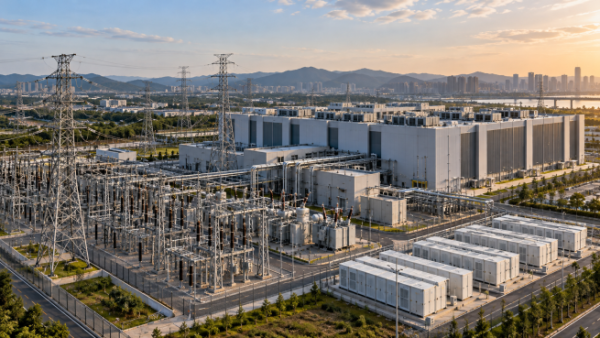
The expansion of AI data centers is extending construction companies' business activities beyond buildings into power infrastructure. Without timely access to large amounts of electricity, operation itself becomes difficult, making transmission and substation networks, energy storage systems (ESS) and distributed generation facilities critical to project success. Major builders are drawing on their engineering, procurement and construction (EPC) capabilities in industrial plants and power to pursue grid connection and power generation markets.
According to the construction industry on October 22, Hyundai Engineering & Construction recently signed a memorandum of agreement (MOA) with Australian energy network company AusNet, agreeing to expand existing cooperation on transmission and substation infrastructure into battery energy storage systems (BESS) and data center grid connection projects. The companies will also strengthen technical cooperation in EPC and the operation and management of related facilities.
Grid connection is the process of connecting a data center to transmission and distribution networks so that it can receive electricity. Even with land and building permits secured, insufficient capacity in the surrounding grid or delays in receiving electricity can disrupt construction and operating schedules. According to the Construction & Economy Research Institute of Korea, 279, or 53.4%, of 522 preliminary technical reviews for data centers in the Seoul metropolitan area between August 2024 and March this year concluded that power could not be supplied. In other words, more than half encountered grid constraints before even beginning the main project procedures.
Distributed generation and integrated investment
GS Engineering & Construction is preparing for distributed generation, which produces electricity near where it is consumed. Amun Energy, its joint venture with US company Amogy, signed a contract with Lotte Fine Chemical on October 8 for the supply of green ammonia for power generation. Using this fuel, it plans to build a 1 MW generation facility at the Yeongilman Industrial Complex in Pohang, conduct demonstration operations alongside electricity sales to tenant companies in 2027, and expand capacity to 10 MW in 2028. It is also reviewing an eventual expansion to as much as 40 MW.
Samsung C&T has joined an investment platform that develops data centers and power infrastructure together. Six Samsung affiliates, including Samsung C&T and Samsung Electronics, agreed on September 29 to invest a total of $1 billion in US-based Helix Digital Infrastructure. Helix provides integrated data center development and operation, power generation, and transmission and distribution facilities, and is pursuing power supplies with partners including US power company Vistra.
Samsung identified the data center and power generation EPC capabilities of Samsung C&T's construction division as a basis for cooperation. Helix and KKR also agreed to explore opportunities to use Samsung's construction, energy storage and cooling capabilities. The investment provides access to a market in which data centers and power infrastructure are developed together.
Related infrastructure and integrated management
Builders are interested in this market because a single data center generates related work beyond building construction. Meeting large electricity demand requires reinforcing transmission and substation facilities and the grid, as well as installing ESS and on-site generation facilities. Related infrastructure work also includes cooling and water supply facilities to handle heat from high-performance servers, wastewater treatment facilities and access roads. The ability to expand contract scope beyond the data center building to power, environmental and supporting infrastructure creates new business opportunities for builders with existing plant and infrastructure experience.
For major builders in particular, the ability to manage complex facilities as an integrated whole is another opportunity. Data centers combine buildings with electrical, mechanical and cooling systems, so performance depends on integrated commissioning of the entire system rather than the completion of individual facilities. This is why builders with complex EPC experience in power plants and industrial facilities can improve their competitiveness for contracts by combining project development, procurement, mechanical, electrical and plumbing work, and commissioning.
Son Tae-hong, head of the Construction Technology and Management Research Division at the Construction & Economy Research Institute of Korea, said, "AIDC, or AI data centers, is a conditional growth market in which prerequisites such as power access and permits must be met before demand translates into actual construction work." Son added, "Construction companies should respond by focusing on their ability to assess whether announced projects can actually begin construction, rather than on announced market size, and on their ability to manage mission-critical construction disciplines in an integrated manner."
Original Korean article: etoday.co.kr
English brief by Korea Wind Intelligence, koreawindintel.com

















