Ørsted has selected the Dangjin offshore wind installation support port in South Chungcheong Province as a hub for equipment for the Incheon offshore wind project. However, observers note that the port's annual capacity of around 500MW falls short of what is needed to handle the entire 1.47GW Incheon project.
Just six days after announcing the port partnership, Ørsted stated it would not participate in the government's second-half bidding for the Incheon project. Questions have arisen about whether the company signaled its intention to scale back the project from the outset through its choice of port, amid talk of a Korean withdrawal.
Dangjin port at 194,000 square meters, capacity of 500MW annually
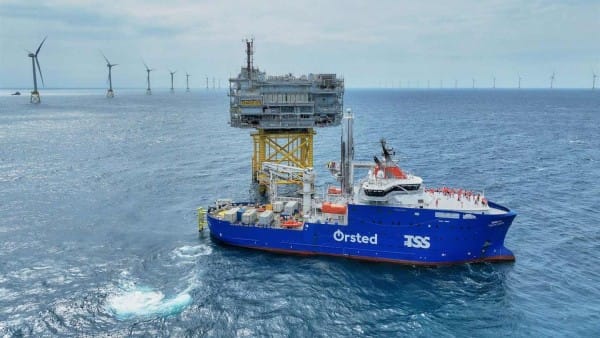
On August 18, 2026, Dangjin City and LX International signed a memorandum of understanding to develop an offshore wind installation support port in the Kodae district of the Asan National Industrial Complex in Songak-eup, Dangjin. The site covers 194,000 square meters, with a project cost of 300 billion won, developed through private investment.
The port will include vessel mooring facilities, an offshore wind equipment handling zone, and an operations building. Once completed, the port will have dedicated infrastructure capable of supporting the installation of offshore wind farms with an annual capacity of 500MW or more.
Smaller than Incheon New Port, only 5 percent of European scale
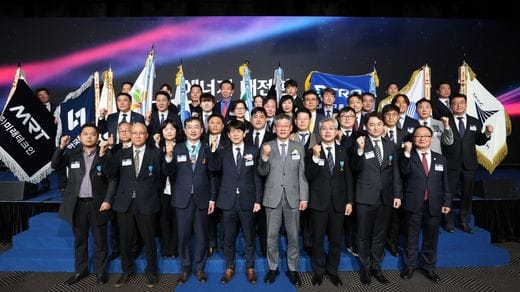
On August 20, 2026, Ørsted signed a memorandum of understanding with LX International to use the Dangjin installation support port as a hub for aggregating, storing, and assembling equipment for the Incheon offshore wind project. Ørsted's project, being pursued more than 70 kilometers offshore from the Incheon coast, comprises Phase 1 (870MW) and Phase 2 (600MW), totaling 1.47GW. With annual support capacity of 500MW, handling all equipment for the 1.47GW project would arithmetically require spreading installation over roughly three years.
The Dangjin port is smaller than the support pier planned for Incheon waters. The Ministry of Oceans and Fisheries has designated an Incheon New Port offshore wind support port with a site area of 314,400 square meters, yet even this is considered too small to support the 7GW offshore wind complex that Incheon City aims for.
The Dangjin offshore wind pier at 194,000 square meters represents only 62 percent of the Incheon New Port plan. The gap widens in global comparison. Denmark's Esbjerg port covers 3.92 million square meters, and the United Kingdom's Humber port covers 4.84 million square meters, making the Dangjin port only 5 percent and 4 percent of those scales respectively.
Construction in Dangjin, operations in Incheon, raising concerns about economic leakage
Ørsted explains that separately from the Dangjin installation support port, it is reviewing port facilities in the Incheon area to support operations and maintenance after the wind farm's completion.
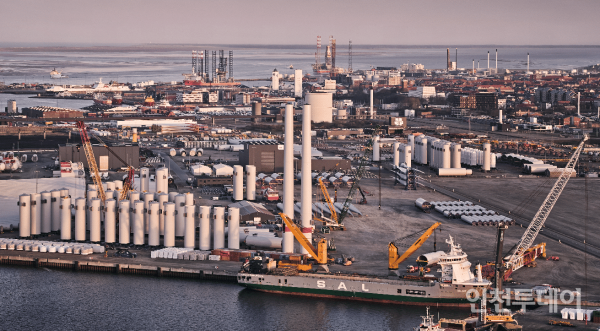
While the company describes this as separating the construction phase (Dangjin) from the operations phase (Incheon), concerns have been raised that major logistics and industrial benefits generated during the construction phase would shift to another region, despite building the wind farm in Incheon waters.
Moreover, Ørsted had previously signed a memorandum of understanding with Incheon City emphasizing regional economic activation and industrial development through building a regional offshore wind industry base and fostering supply chain industries. Yet the company has now chosen to place the core infrastructure of the construction phase in Dangjin, which it assessed as smaller than the support port it had deemed inadequate.
Bidding withdrawal six days after Dangjin port announcement
Six days after announcing the Dangjin partnership, on August 26, 2026, an email from Per Mejnert Kristensen, Ørsted's chief executive for Asia and the Pacific, to company employees became known through coverage by energy news outlet Recharge News.
Kristensen stated at the time that external factors over the past year had increased risks for the Incheon project while weakening its business case, and that given the current risk-return structure, the company could not meet the financial criteria needed for internal approval to participate in the fixed-price competitive bidding.
The following day, on August 27, 2026, Ørsted formally announced it would not participate in either Incheon Phase 1 or Phase 2 in the government's offshore wind fixed-price competitive bidding scheduled for the second half of the year. The government had selected five projects totaling 1.8GW in the first-half bidding in June and had planned to select a total of 4.0GW for the year including the second-half bidding, with Ørsted's participation in the second-half round widely expected.
However, Ørsted stated that the decision was part of refining its project implementation approach to maximize the competitiveness of the Incheon offshore wind project ahead of future bidding opportunities, and that it would continue to develop offshore wind projects in Korea.
KWI developer profile — Ørsted
2 projects in Korea totalling 1,470 MW. Compiled from the KWI database. Not part of the source article.
Incheon 1 Offshore Wind
|  |
Incheon 2 Offshore Wind
| |
Project data: KWI database — Electricity Business Licence records, EIA filings (ME2025C009, ME2025C010), Electricity Regulatory Commission minutes, and pre-EBL permit filings.
Original Korean article: Incheon Today
English brief by Korea Wind Intelligence, koreawindintel.com