Original Korean article: Electric Power
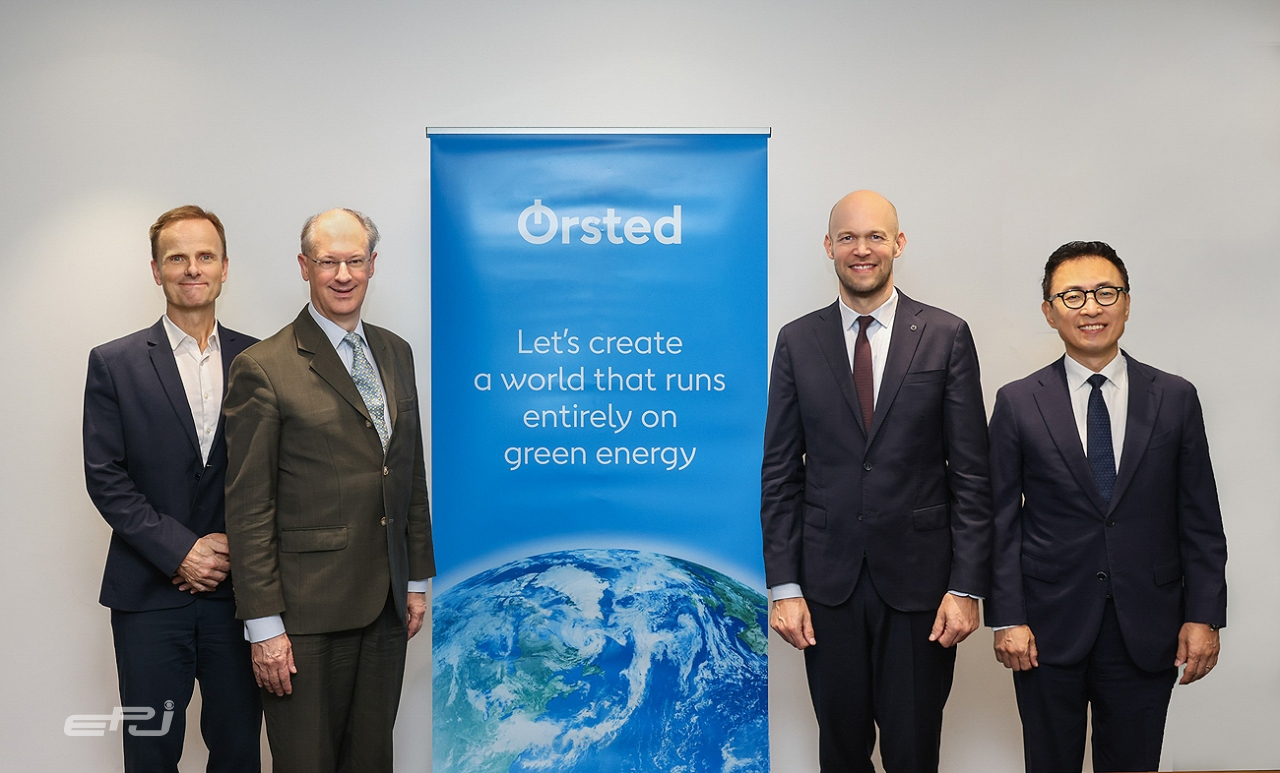
Rasmus Errboe, Chief Executive Officer of Ørsted, visited Korea and met with government officials and key stakeholders to review the progress of the company's domestic offshore wind projects.
On the occasion of the CEO's visit to Korea, Ørsted reconfirmed the long-term growth potential of the Korean offshore wind market and expressed its commitment to continue domestic operations centered on the Incheon Offshore Wind 1 and 2 projects, which are being pursued at a total scale of 1.47 GW.
During his visit, CEO Errboe met with Kim Jeong-ho, Chairman of the National Assembly's Committee on Climate, Energy, Environment and Labor, and senior officials from the Ministry of Climate, Energy and Environment to exchange views on Korea's energy transition policy and the direction of offshore wind industry development. He also met with Philip van Hooft, Chairman of the European Chamber of Commerce and Industry in Korea (ECCK), to discuss ways for European companies to participate in and cooperate on Korean projects.
1.47 GW Incheon Offshore Wind Development
The core project that Ørsted is pursuing domestically is the Incheon Offshore Wind 1 and 2 project. The two projects are located in waters approximately 70 kilometers off the Incheon coast, with scales of 870 MW and 600 MW respectively, and have obtained an Electricity Business License for a total of 1.47 GW. Currently, project development procedures are underway, including environmental impact assessment, site surveys, basic design of the wind farm, and preparation for bidding participation.
Upon final investment decision (FID), the projects are expected to be completed in the early 2030s. Upon completion, Ørsted anticipates that the projects will be able to supply renewable energy for approximately 1.4 million households.
In particular, the 1.47 GW project scale represents a significant share of the domestic offshore wind market. According to Ørsted, this corresponds to approximately 14 percent of the government's 2030 offshore wind target of 10.5 GW.
However, at the current stage, since FID has not yet been made, the environmental impact assessment, various permits and licences, bidding, and securing project viability in the future are expected to be key variables in whether the project proceeds to construction start and commercial operation.
Korea's Long-Term Potential
CEO Errboe stated that through this visit to Korea, he confirmed the long-term growth potential of the Korean offshore wind market.
Through meetings with government officials and key stakeholders, he confirmed Korea's commitment to expanding renewable energy and expressed his position to contribute to Korea's energy transition through cooperation with the government, domestic partner companies, and stakeholders.
This is interpreted as a message that Ørsted will continue its Korean operations on a medium to long-term basis despite changes in the business environment surrounding the domestic offshore wind market.
Another aspect that CEO Errboe emphasized during this visit is cooperation with the domestic offshore wind supply chain.
Ørsted explained that it has cooperated with the Korean supply chain for more than ten years and has introduced approximately 3.5 trillion won worth of Korean-made equipment and services into global offshore wind projects.
CEO Errboe expressed expectations that, based on the industrial capabilities and experience of the Korean supply chain, the role of Korean companies in Ørsted's global offshore wind projects can be further expanded in the future.
This is also meaningful from the perspective of the domestic offshore wind industry. If the scale of domestic projects expands, opportunities for domestic companies to participate can expand not only in wind turbines and major equipment but also in offshore structures, submarine cables, installation and transportation, and maintenance and repair.
Ørsted's experience in utilizing the Korean supply chain for global projects is evaluated as an important foundation for domestic companies' entry into overseas offshore wind markets.
Global Developers' Role in the Domestic Market
Ørsted's CEO visit to Korea is expected to provide an opportunity to gauge the role of global developers in the domestic offshore wind market and whether their investment will continue.
Recently, the domestic offshore wind market has seen expanded competition between domestic and foreign developers as large-scale project development has begun in earnest. In this process, the accumulated business experience, financial mobilization capability, and global supply chain utilization competence of global developers can serve as factors that enhance the project implementation capacity of the domestic market.
Philip van Hooft, Chairman of the ECCK, also evaluated the long-term investment and project implementation commitment of European companies such as Ørsted as an important asset for Korea's energy transition. He explained that he confirmed Ørsted's commitment to continuously develop its Korean operations despite changes in market conditions.
Ultimately, whether Ørsted's Incheon Offshore Wind 1 and 2 projects can proceed to final investment decision and construction start will be determined comprehensively by securing project viability, obtaining permits and licences, gaining community acceptance, and cooperation with the domestic supply chain.
Since Ørsted has clearly stated its position to continue expanding its Korean operations centered on the 1.47 GW Incheon Offshore Wind project, attention is also focused on how a cooperation structure between global developers and domestic companies will form in the future domestic offshore wind market.
KWI developer profile — Ørsted
2 projects in Korea totalling 1,470 MW. Compiled from the KWI database. Not part of the source article.
Incheon 1 Offshore Wind
|  |
Incheon 2 Offshore Wind
| |
Project data: KWI database — Electricity Business Licence records, EIA filings (ME2025C009, ME2025C010), Electricity Regulatory Commission minutes, and pre-EBL permit filings.