

"It is economical to build artificial intelligence (AI) data centers in one location as far as possible. But when power supply reaches its limits, it becomes necessary to distribute graphics processing units (GPUs) across multiple data centers and connect them through high-speed optical networks."
Bill Gartner, Cisco's senior vice president of Optical Systems and Optics, made these remarks on the direction of South Korea's AI data center development in an interview with ZDNET Korea following Cisco Live APJC 2026, held in Melbourne, Australia, from November 9 to November 11.
Gartner is an optical communications specialist who began a career at AT&T Bell Laboratories in the United States and served as vice president and general manager of Lucent Technologies' Optical Networking Systems division. Gartner later served as chief operating officer (COO) at major optical communications companies, including Meriton Networks and Mahi Networks, and now oversees Cisco's multibillion-dollar optical systems and optics business.

Gartner stressed that South Korea should consider both power supply conditions and the cost of connecting data centers as it develops large-scale AI infrastructure, including the National AI Computing Center. In particular, Gartner expected optical communications technologies that efficiently connect large-scale computing resources to become increasingly important as GPU performance improves rapidly.
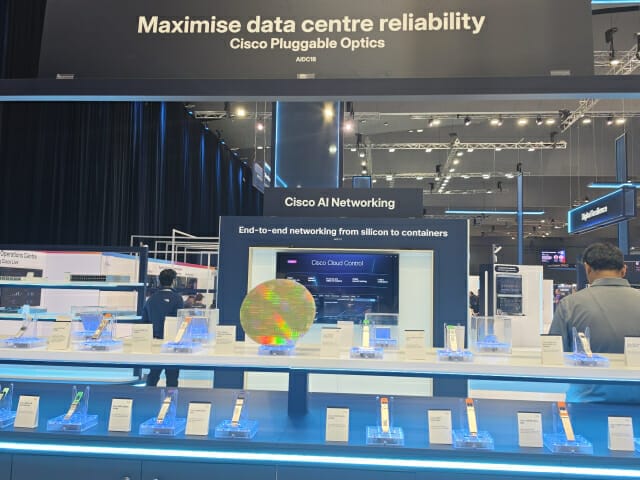
Gartner said, "Major US hyperscalers are also using pluggable optical communications technology when expanding their data centers. These technologies can reduce capital expenditure and power consumption, making them particularly useful in environments where access to power is constrained."
Connecting AI data centers 1,000 km apart: optical communications gains importance as GPUs advance
Gartner stressed that optical communications technologies that rapidly transmit data between facilities are playing a growing role as AI data centers become distributed across multiple regions. In particular, Gartner noted that both network performance and communications latency must be considered when GPU resources required for training large AI models are deployed in different data centers.
Gartner said, "Optical communications technology can connect data centers up to 1,000 km apart. Most of the latency in current AI systems occurs not in the network but while GPUs are actually performing computations."
However, Gartner expected the time taken to transmit data to account for a larger share of overall system performance as GPU performance improves.
Gartner said, "As GPUs become faster, network latency could account for a larger share of total processing time. Technological improvements are needed to minimize latency in routers."
Gartner added, "In optical communications, there is no avoiding the physical limit imposed by the speed of light. Latency in optical links is currently much smaller than the latency arising during GPU computation, but these factors will also need to be considered in the future."
Confidence in pluggable technology as CPO gains attention: joint USFP development with Nvidia
Co-packaged optics (CPO), which places optical components close to switch chips, has recently attracted industry attention. This is because higher data transmission speeds increase the need to reduce losses and power consumption during electrical signal transmission.
However, Gartner expected that CPO would not entirely replace existing pluggable optical communications technology. This is because scale-up environments, which tightly interconnect GPUs inside AI data centers, and scale-out environments, which connect multiple systems, have different technical requirements.
Gartner said, "CPO and near-packaged optics (NPO) will play important roles in scale-up networks in the future, but we have not yet reached the stage where they are needed extensively. Pluggable optical modules and copper cables are still used in many scale-up environments today."
Gartner continued, "Pluggable optical communications technology will continue to be widely used in scale-out networks, data center front ends and telecom operator networks. This is because it offers customers substantial operational and cost advantages."
Against this backdrop, Cisco has recently been jointly developing USFP (Universal Small Form-factor Pluggable), a next-generation optical transceiver specification, with Nvidia. The aim is to increase data transmission capacity while retaining the advantages of the pluggable approach, which allows existing optical modules to be removed and replaced.
Cisco plans to use USFP to address demand for high-speed connections beyond the 1.6 Tbps supported by existing pluggable specifications such as OSFP and QSFP-DD. USFP is designed to scale from 3.2 Tbps to 6.4 Tbps and 12.8 Tbps in the future.
Gartner said, "USFP is an approach to extending the life of existing pluggable optical communications technology. In areas where CPO or NPO is not strictly necessary, customers can continue to benefit from the economic and operational advantages of the pluggable approach."
Preparing USFP for commercialization: heat and signal loss remain challenges
In the interview, Gartner also outlined technical challenges that must be addressed before USFP can be commercialized. In particular, Gartner highlighted the importance of maintaining high-speed electrical signal integrity while effectively managing the heat generated by optical modules.
As the electrical signal transmission speed of next-generation switch chips increases, signal losses between connectors and optical modules must be minimized. Higher transmission capacity also increases heat generation, requiring technology to control it using existing cooling methods.
Gartner said, "The integrity of 400 Gbps electrical signals and thermal management are the biggest technical challenges in developing next-generation optical modules. We are working closely with connector manufacturers and Nvidia to focus on addressing these issues from the early stages of development."
Gartner added, "We are developing USFP to retain existing cooling methods rather than use liquid cooling. This makes thermal management even more important."
A specific launch schedule for USFP-based products has not yet been disclosed. Cisco plans to introduce the technology alongside future 3.2 Tbps routers or switches.
Gartner said, "We have not yet announced a specific product, but USFP will appear alongside the first 3.2 Tbps router or switch. It is difficult to disclose a launch schedule in advance at this stage."
Gartner emphasized that Cisco and Nvidia are jointly developing USFP rather than dividing responsibility for separate technology areas.
Cisco previously led the development of the QSFP-DD specification used for 400 Gbps and 800 Gbps optical communications. Drawing on that experience, it is working with Nvidia, connector manufacturers and other relevant companies to address the technical challenges of next-generation optical communications specifications.
Gartner said, "This is not a structure where Cisco handles one part and Nvidia handles another. The two companies are developing it jointly, and we plan to broaden the collaboration over the coming months so other companies can participate."
Gartner added, "We do not currently have any joint development projects underway with South Korean companies, but we are always open to technical cooperation with outside companies. Cisco works with a variety of technology partners and also invests in startups."
Gartner also emphasized, "We are making substantial investments of our own in the 400 Gbps, 800 Gbps and 1.6 Tbps optical communications technologies used inside data centers, as well as the coherent optical communications technologies needed for connections outside data centers. We are also open to proposals from companies with new technologies, including those in South Korea."
Cisco accepts a potential reduction in its existing optical transport business as it expands in pluggables
Gartner assessed that the business structure of the optical communications market is changing as AI data centers proliferate. As major hyperscalers seek to cut costs by purchasing network equipment separately, optical communications suppliers also need to change the criteria they use to evaluate profitability, Gartner said.
Gartner said, "Hyperscalers tend to purchase the equipment that makes up a solution separately to minimize costs. In this market, operating margins can actually rise as supply volumes increase, even if gross margins decline."
Gartner continued, "The optical communications industry has traditionally placed importance on gross margins, but in the future it should base investment and business strategy decisions on operating margins, which also take research and development and selling costs into account."
In response to these changes, Cisco is also expanding its business from a focus on conventional optical transport equipment into pluggable optical communications technology. Advances in technology that allows optical transceivers to be installed directly in routers are also changing the conventional approach of using separate optical transport equipment.
Gartner said, "We deliberately decided to accept some reduction in our existing optical transport equipment business in order to expand our pluggable optical communications business. Contrary to our expectations, the existing business has not declined significantly, and we are seeing substantial growth among customers adopting pluggable optical communications."
Original Korean article: ZDNet Korea
English brief by Korea Wind Intelligence, koreawindintel.com

















