

Grid constraints and proposed solutions
As electricity demand from semiconductor production facilities and AI data centers surges in the AI era, attention is focusing on expanding electricity supply networks and infrastructure.
According to industry sources on day 6 of the month, accelerating investment in advanced industries, including semiconductors and AI data centers, has made the construction of supporting transmission and substation networks and an energy mix combining renewable and nuclear power key challenges.
Abundant nuclear-based generating capacity has underpinned the growth and development of manufacturing centered on energy-intensive industries such as steel, chemicals and heavy industry. The article argues that electricity infrastructure has now become a bottleneck.
Moreover, as electricity policy shifts from focusing solely on expanding generation to a smart grid that optimizes connections between supply and demand, efficient use of supply networks and transmission and distribution grids is becoming increasingly important. However, the physical limitations and inefficiencies of existing transmission and distribution networks require efforts on multiple fronts.
Many transmission and substation construction projects have yet to break ground. The article criticizes what it describes as unreasonable opposition from residents along proposed routes and deliberate permitting delays by local governments. It argues that persistent local opposition to nearby infrastructure and local governments that support it are making timely grid expansion difficult.
Structurally, electricity demand from AI data centers is concentrated in the Seoul metropolitan area, while major generation sources, including nuclear plants on the east coast and renewable energy in the Honam region, are located elsewhere, creating an unavoidable imbalance. Grid bottlenecks sometimes force power plants to stop operating because transmission capacity to the metropolitan area is insufficient, even when regional generation is abundant.
Power losses and instability in the existing alternating-current (AC) transmission system are also concerns. AC transmission used to carry large currents over long distances incurs substantial power losses and has limited voltage regulation capability. Even minor power instability can be critical for AI data centers that maintain high loads 24 hours a day.
The article describes a prevailing view among industry representatives that renewable energy, despite being promoted as environmentally friendly generation, is less dependable because of extreme variability and curtailment. As the share of solar, wind and other renewables has grown, electricity supply has increased, but variability has also intensified. Predicting and adjusting generation by time of day and season has become more difficult. The article also points to inefficiencies when renewable generators must be shut down because output exceeds the grid's capacity to accommodate it.
Technical options under review include introducing direct-current (DC) distribution networks to minimize transmission losses and building highly efficient grids tailored to DC-based AI servers and data centers. Discussions are also underway on using energy storage system (ESS) technology and diversifying and expanding energy sources to reduce electricity demand pressure during peak-load periods and compensate for renewable generation variability.
On regulation and location, proposals include regionally differentiated electricity tariffs to encourage AI data centers to locate near regional power plants where electricity costs are lower. Another solution under active discussion is allowing direct electricity trading (PPA) to facilitate unrestricted transactions between nearby generators and consumers without the burden of using the public transmission grid.
At the operational and software level, an alternative is an intelligent energy management system (EMS), in which AI independently forecasts and manages electricity demand to maximize grid operating efficiency. Another approach attracting attention is optimizing AI computing schedules by spreading processing hours so that large-scale AI training, unlike real-time inference, takes place when electricity supply is abundant.
On legislation and institutional support, calls are growing for the government and political leaders to promptly enact a special act on the national backbone power grid. Proponents argue that grid construction times should be shortened through government-led, expedited permitting and compensation for residents, while preventing intervention by some environmental groups and resident organizations accused of seeking compensation payments or mobilizing extreme opposition.
Semiconductor companies seek their own power supplies
In particular, Samsung Electronics and SK hynix appear poised to move beyond their previous focus on managing electricity tariffs and pursue in-house power supply arrangements as transmission and distribution construction for AI data centers and the Yongin semiconductor mega-cluster project faces delays. This would involve companies generating electricity themselves and securing infrastructure rather than purchasing power from Korea Electric Power Corporation.
Samsung Electronics is reviewing the establishment of an entity dedicated to power generation and is recruiting numerous external energy and electricity specialists. The article interprets this as a notable expression of intent to take responsibility for its own initial electricity supply rather than relying solely on KEPCO's supply network.
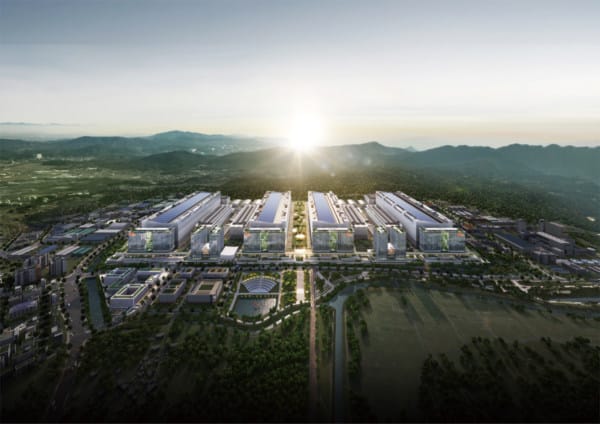
The Yongin semiconductor cluster requires an enormous 15 GW of electricity supply in total, including 9 GW for Samsung Electronics and 6 GW for SK hynix. The article expects the companies' in-house power supply strategies to begin there. Samsung Electronics is already taking a strategic approach to securing electricity for the initial operation of semiconductor production facilities by using nearby liquefied natural gas (LNG) generation facilities.
Companies are also moving ahead with building their own power lines. SK hynix has completed construction of a line directly connecting Sinanseong substation to the Yongin general industrial complex, establishing a stable foundation for supplying 2.83 GW of electricity to its first and second plants.
These companies are also working closely with the government's nationwide grid plan, known as the energy highway, which includes high-voltage direct-current (HVDC) transmission to bring electricity from east-coast nuclear plants and areas with concentrated renewable generation in Honam to the Seoul metropolitan area. As exporters, they are addressing the challenges of meeting RE100 commitments to 100% renewable electricity and securing stable baseload or continuous power 24 hours a day through a mix of nuclear and carbon-free power sources.
Energy-intensive companies, in particular, are expanding their involvement in small modular reactors (SMRs) and carbon-free power purchase agreement (PPA) arrangements. Examples include SK Group and POSCO Group, which, like global technology companies, are increasing investment in SMRs and hydrogen power generation infrastructure.
Policy requests and equipment partnerships
Industry is also asking the government to revise regulations to expand eligibility for Direct PPA arrangements, previously limited to renewable energy, to include nuclear power and SMRs to ensure a stable supply of carbon-free electricity 24 hours a day. Domestic hardware and electrical equipment companies are also forming partnerships to improve the efficiency of data centers and electricity grids themselves.
Another development attracting attention is cooperation between global power semiconductor company Infineon Technologies and companies including LS ELECTRIC, covering energy storage system technology and solid-state transformers; Hyosung Heavy Industries, covering HVDC infrastructure; and SOLUM, covering high-efficiency server power supplies. They are working to build a Korean energy technology ecosystem to reduce electricity losses inside AI data centers.
Experts emphasize the need to secure electricity supply networks, which have rapidly become essential infrastructure in the AI era, through timely government-led grid construction, DC innovation, AI-based intelligent demand optimization and regionally differentiated tariffs. The article concludes that companies have a central role and contribution to make, while the government must also move to expand the grid quickly, efficiently and with greater intelligence.
Original Korean article: womentimes.co.kr
English brief by Korea Wind Intelligence, koreawindintel.com

















