

Part 1. AI data center expansion reshapes power infrastructure: AC/DC integration and AI-based distribution are key challenges
Part 2. Can North American data center orders translate into earnings growth? DC technology commercialization, profitability and local competitiveness are critical
November 2, 2026 | Industry and energy analysis

Competition in the AI industry is extending beyond semiconductors and servers to power infrastructure. Large AI data centers require reliable power supplies and efficient power conversion systems. As electricity demand becomes concentrated in particular regions, the capacity of existing transmission and distribution networks and the pace of investment in equipment are emerging as constraints on industry growth. The criteria for competitiveness among power equipment companies are also expanding beyond equipment production and delivery to include power conversion, equipment diagnostics and energy management.
In response to these changes, LS ELECTRIC identified the integration of direct current (DC) and alternating current (AC), artificial intelligence (AI)-based grid operation and bidirectional energy platforms as core strategies for the next-generation power distribution industry. LS ELECTRIC Chairman Koo Ja-kyun presented a vision for next-generation intelligent DC grids in a keynote address at the 2026 International Conference on Electricity Distribution (CIRED) workshop, held at the JW Marriott Dongdaemun Square Seoul on November 2.
The company's proposed direction is an attempt to expand beyond its existing power equipment supply business into power infrastructure solutions combining data and software. However, translating this technological vision into earnings growth will require commercializing DC distribution, securing repeat orders from North American customers, achieving profitability across products and establishing local production and supply capabilities. This is why the industry opportunity presented by rising AI data center electricity demand needs to be assessed separately from the prospects for an individual company's earnings improvement.
Part 1. How AI data centers are changing the power industry: the rise of DC distribution and intelligent grids
A new industry investment cycle driven by rising electricity demand
The expansion of AI data centers is changing the structure of demand in the power industry. Whereas electricity demand was previously dispersed across industrial production, household consumption, heating and cooling, large data centers concentrate substantial electrical loads in particular regions. This makes continuity of supply, power quality and the pace of equipment expansion important alongside the amount of electricity consumed.
In Electricity 2026, published in February 2026, the International Energy Agency (IEA) projected that global electricity demand would increase by an annual average of 3.6% from 2026 to 2030. Industry, electric vehicles, cooling and data centers were identified as drivers of demand growth. In a separate data center outlook, the agency expected global data center electricity consumption to rise from approximately 485 TWh in 2025 to approximately 950 TWh in 2030.
This means data center electricity consumption could nearly double over 5 years. However, the projections may vary depending on the pace of AI investment, data center construction schedules, semiconductor computing efficiency, advances in cooling technology and electricity supply conditions. If data center investment is delayed more than expected or electricity consumption per AI computation falls rapidly, actual demand growth could differ from the projections.
Power equipment companies face 2 types of demand. The first is for physical equipment such as transformers, switchboards and circuit breakers. The second is for digital control and monitoring technologies that enable efficient operation of existing grids. With demand arising simultaneously for investment in new equipment and improvements in existing equipment efficiency, the power industry could expand its business structure by combining equipment manufacturing with software.
However, electricity demand and grid construction do not advance at the same pace. The IEA estimated that projects totaling more than 2,500 GW worldwide were awaiting grid connections, including projects involving large loads such as data centers, renewable energy and storage facilities. This means that even where plans exist for generation facilities or data centers, transmission and distribution network expansion and grid connection procedures can become bottlenecks before electricity can actually be supplied.
Assessing growth prospects in the data center power infrastructure market therefore requires examining not only data center investment but also orders for substation and distribution equipment, grid connection schedules and local electricity supply conditions. Even if power equipment companies receive more orders, delays in customers' facility construction could push back deliveries and revenue recognition.
Grids for AI and AI for Grids: improving power supply and operation together
Koo's concepts of Grids for AI and AI for Grids describe the relationship between AI and the power industry in both directions.
Grids for AI is an approach to upgrading grids to reliably supply the large amounts of electricity required by AI data centers. Data centers must manage voltage, frequency and power quality while responding to changes in server loads. This increases the importance not only of power supply equipment but also of power conversion, protection and control devices, and systems that monitor equipment condition in real time.
Conversely, AI for Grids refers to applying AI to grid operation itself. Whereas previous grid management relied primarily on historical consumption and operating rules, digitalized equipment can use real-time data to predict demand and equipment condition and detect signs of abnormalities. As distribution networks become more complex, the ability to accurately understand power flows and coordinate multiple resources becomes increasingly important.
The official theme of the CIRED Seoul workshop is also digital transformation and AI for next-generation distribution networks. The event program identified AI-based grid operation, grid planning and forecasting, new business models and consumer participation, and data governance as major discussion areas.
This indicates that AI-based grids are becoming a shared challenge for the international power distribution industry, extending beyond individual companies' technology development. With electricity demand rising, continuing to expand generation facilities alone is unlikely to resolve bottlenecks in every region in the short term. Technologies that improve the utilization of existing grids through demand forecasting and optimized equipment operation are also needed.
However, AI does not eliminate the physical limitations of grids. If transformer capacity is insufficient or transmission lines are saturated, algorithms alone cannot supply additional electricity. AI's effectiveness depends on data quality, the extent of sensor deployment, the interoperability of control systems and the physical conditions of the actual grid. Grid upgrades and equipment expansion should be viewed as complementary rather than as substitutes.
For LS ELECTRIC to establish competitiveness through its intelligent grid strategy, it needs to demonstrate concrete results rather than merely whether it uses AI. Actual operating data should show how early it detects equipment abnormalities, how much it reduces power losses and maintenance costs, and how much it improves outage risk and restoration times.
From AC to DC: power conversion arrangements create business opportunities
DC distribution was presented as a core technology in LS ELECTRIC's strategy. Much of today's grid is built around AC, but data center servers and power electronics equipment use DC internally. This requires converting AC power into DC, with conversion losses and equipment configurations varying according to power system design.
DC distribution is discussed as an alternative because it can reduce the number of power conversion stages or configure them more efficiently in certain sections. In facilities such as data centers, where electricity consumption is high and loads are concentrated, even small differences in efficiency can affect long-term operating costs. Reducing conversion losses and cooling requirements could help lower customers' total cost of ownership (TCO).
However, the economics of DC distribution vary by application environment. Voltage levels, distribution distances, load characteristics, protection device configurations and compatibility with existing AC equipment must all be considered. In particular, unlike AC, whose current naturally passes through zero, DC requires separate technical considerations for interruption and protection design. Equipment standardization and safety validation are also challenges that must be addressed during commercialization.
Koo's emphasis on harmonizing AC and DC can therefore be interpreted as a direction toward efficiently combining them according to customers' electricity use environments, rather than an intention to convert all power infrastructure to DC. A practical approach could be to maintain the reliability of existing AC-based equipment while introducing DC first in sections where it offers advantages.
The competitiveness LS ELECTRIC needs to establish in this process extends beyond the performance of individual devices. It must be able to integrate power conversion systems (PCS), distribution equipment, protection and control systems, and monitoring software to provide systems tailored to customers' design requirements. Taking responsibility for integrated design, installation and operating support could allow it to compete on the efficiency and reliability of entire projects rather than on individual product prices.
Integrated solutions, however, also increase supply responsibilities and project management demands. Equipment compatibility problems or installation delays could generate greater costs than individual product sales. This is why expanding the scope of its technology must be accompanied by capabilities in design validation, quality management and after-sales support.
Part 2. Can North American data center orders change earnings? Commercialization and profitability need to be demonstrated
Targeting North America: growth opportunities come with costs
Assessing LS ELECTRIC's next-generation grid strategy requires examining the business results it actually achieves in North America. The United States is a market where AI data center investment is a major contributor to electricity demand growth. Increased investment in power infrastructure by local customers creates business opportunities for suppliers of distribution equipment and power conversion solutions.
According to Lawrence Berkeley National Laboratory's 2025 report on data center electricity use, released by the US Department of Energy, US data centers could account for 11.8% of total electricity consumption in 2030. The range across scenarios is 9.5% to 15.3%. This is not a single definitive figure but an estimate that may vary with data center construction, equipment deployment and operating efficiency.
Such demand projections give power equipment companies an incentive to expand their North American businesses. However, market growth does not mean every supplier will achieve the same level of profitability. Whether a company can meet customers' certification requirements, deliver within required schedules and support local installation and maintenance affects its actual competitiveness in securing orders.
LS ELECTRIC's business strategy is to broaden customer relationships by combining power equipment with solutions tailored to data centers. Supplying power conversion systems together with distribution systems could create opportunities for customers to consolidate suppliers during design and procurement. For the supplier, expanding its product portfolio could increase the scope of supply per project.
Entering the local market, however, entails costs. Product certification, production facilities, local staffing and service systems, inventory management and supply chain responses are all necessary. Even with rising orders, rapid increases in local investment and initial operating costs could limit profitability improvements.
Assessing sustainable competitiveness in North America requires examining not only contract size but also customer composition, contract terms, delivery schedules, the share supplied locally and product-level margins. Heavy dependence on 1 or 2 large customers could increase the impact of changes in their investment plans on earnings.
From power equipment manufacturing to platforms: securing recurring revenue is a challenge
The intelligent bidirectional energy platform presented by Koo reflects a change in the power equipment industry's business model. Traditional power equipment manufacturing has primarily involved supplying and installing products, then providing additional services through maintenance contracts. Adding sensors, communications and data analytics could enable ongoing services throughout equipment operation.
For example, equipment temperature, current and load changes could be analyzed in real time to detect abnormalities and conduct inspections before the risk of failure increases. If an energy storage system and distributed generation facilities are connected, functions that adjust energy flows according to electricity supply and demand could also be considered.
If such services produce actual cost savings for customers, commercial relationships could continue after equipment sales. Combining equipment diagnostics, remote monitoring, maintenance and energy management services could potentially establish a recurring revenue base distinct from one-time equipment sales.
However, the performance of a platform business should not be judged simply by sales volumes of products incorporating AI functions. What matters is whether customers obtain sufficient economic benefits to replace existing systems, whether the platform can interoperate with equipment from different manufacturers, and whether data security and operating stability can be ensured.
Unlike ordinary business software, grid failures can lead to damage to physical equipment or power outages. Operating risks could increase if AI makes an incorrect judgment or an external attack affects a control system. Grid platforms therefore need not only accurate forecasting but also control authorization management, security systems, recovery procedures for failures and arrangements for operator intervention.
For LS ELECTRIC to make its platform business a new source of growth, it needs to disclose and improve specific metrics such as the share of software revenue, the size of service contracts, customer retention and service segment profitability. Expanding equipment supply and establishing an independent revenue base for a platform business are separate challenges.
Global power distribution market projected at 200 trillion won: order conversion matters more than market size
The supplied materials project that the global power distribution market will grow to approximately 200 trillion won by 2030. However, the research organization, market definition, exchange rate and calculation basis behind this figure need to be checked. Market size can vary depending on whether it includes only distribution equipment or also encompasses data center power infrastructure and digital power management services.
Likewise, estimating revenue growth solely from total market size is not appropriate when assessing LS ELECTRIC's business opportunities. The assessment must account for the product categories and regions the company can actually supply, certification requirements, prices and delivery times relative to competitors, and production capacity.
In particular, there is a time lag between a growing order backlog and increases in revenue and profit. Rising raw material prices or delayed deliveries during project execution could reduce expected profitability. Capital expenditure to expand production capacity and increases in inventory and accounts receivable could also put pressure on cash flow.
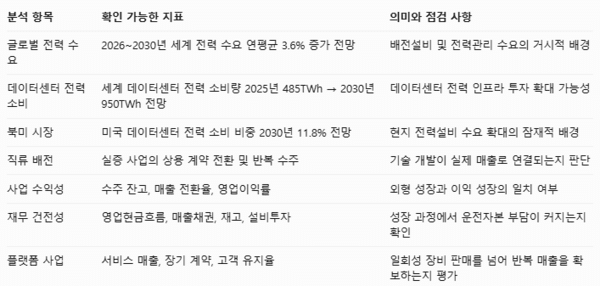
The key indicators that investors and the industry should examine are therefore as follows.
Data analysis | Indicators for assessing LS ELECTRIC's next-generation grid business
Taken together, these indicators allow LS ELECTRIC's growth strategy to be assessed in 3 stages. The first is expanding its order base in North America. The second is reliably fulfilling those orders and converting them into revenue and profit. The third is expanding the scope of supply per customer and recurring revenue through DC distribution and intelligent platforms.
If success in the first stage does not lead to the second and third, improvements in company profitability could remain limited despite market growth. Conversely, if the company establishes a delivery record and technological reliability while increasing repeat orders and service revenue, it could develop beyond a simple equipment manufacturer into an integrated power solutions developer.
Technical standards, local competition and investment costs: 3 barriers to overcome
LS ELECTRIC needs to address 3 challenges to establish competitiveness in the next-generation grid market.
The first is technical standards and commercialization. DC distribution designs and protection methods may vary by application environment. Since customers consider compatibility with existing systems, safety and ease of maintenance when introducing equipment, the superiority of an individual technology alone cannot guarantee market expansion. Standardization, field validation and actual operating experience need to accumulate.
The second is local competition. In North America, established power equipment companies and local suppliers compete on the basis of customer relationships, certifications, production and service systems. For LS ELECTRIC to establish a long-term market position, it must consistently deliver not only on price but also on delivery reliability, quality and local responsiveness. The ability to adjust production and inventory flexibly when data center investment schedules change is also important.
The third is investment costs and profitability. Expanding production capacity and building local supply chains require initial capital expenditure. Even if revenue continues to grow, cash flow could deteriorate if capital expenditure and working capital requirements increase more quickly. Business quality should not be judged by growth rates alone; returns on investment and cash generation should also be examined.
Cybersecurity and data management issues arising from grid digitalization add further challenges. As operating data from power equipment becomes interconnected, responding to the risks of information leaks and control system breaches becomes increasingly important. In a business model combining power equipment and software, security is not an optional feature but a factor directly linked to product reliability.
Reporter's perspective: earnings quality matters more than a technology vision for the power industry's future
The expansion of AI data centers is providing a new source of demand for the power equipment industry. LS ELECTRIC's presentation of DC distribution, AI-based power management and bidirectional energy platforms reflects the industry's expansion from equipment manufacturing into system integration and operating services.
However, market growth projections and corporate profit growth must be distinguished. Even if North American orders increase, profitability could fall short of expectations if delivery delays, rising costs and local investment requirements intensify. For DC distribution, too, the key question is whether technology at the demonstration stage leads to recurring commercial contracts and a reliable operating record.
For LS ELECTRIC to establish sustainable competitiveness in the global grid market, it must transparently demonstrate not only order volumes but also changes in revenue conversion, operating margins, cash flow and service revenue. Competition in power infrastructure in the AI era is moving beyond how much equipment companies supply toward how much they reduce customers' electricity costs and operating risks. The ability to translate a technological vision into tangible economic value will determine companies' medium- to long-term performance.
Original Korean article: newsvalue.kr
English brief by Korea Wind Intelligence, koreawindintel.com

















