

Energy management certification
LG Uplus said on November 2 that its Pyeongchon 2 data center in Anyang, Gyeonggi Province, had received ISO 50001 certification, the International Organization for Standardization's international standard for energy management systems.
Pyeongchon 2 is a data center completed in 2023 with three basement levels and nine above-ground floors. The company incorporated its own cooling technology from the design stage to manage heat from servers efficiently and improve cooling efficiency. It explained that reductions in energy consumption through a high-efficiency cooling system using cold outside air helped underpin the certification.
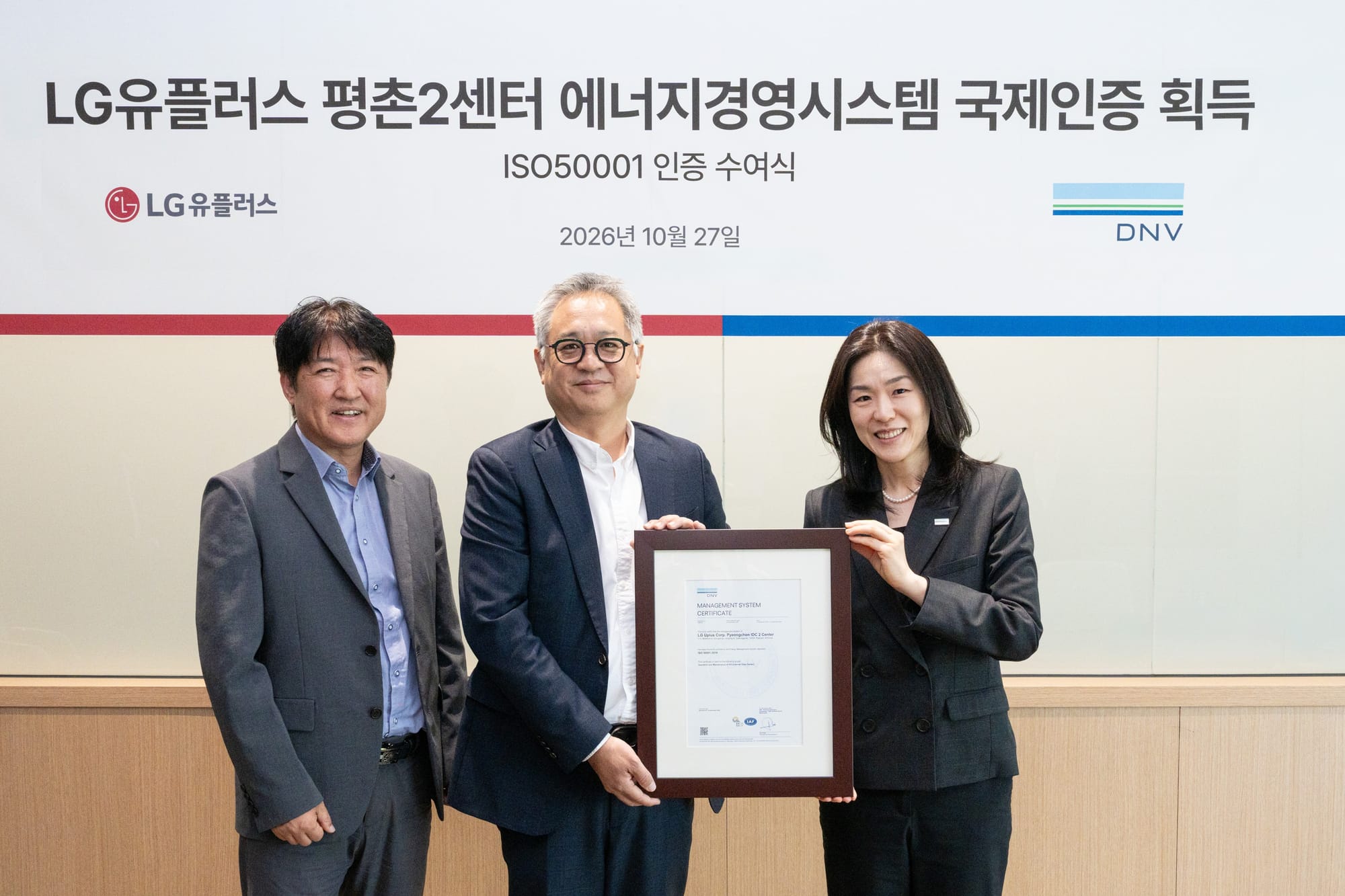
ISO 50001 is an international standard specifying requirements for establishing and operating an energy management system so that organizations can manage energy systematically and continually improve performance. Because it assesses whether an organization has a system to manage its overall energy use, rather than the efficiency of a single piece of equipment, it is widely regarded as an indicator of operational capabilities.
Energy savings and liquid cooling trials
Beyond Pyeongchon 2, LG Uplus is pursuing energy-saving activities across its major business sites, including data centers. These include replacing equipment with high-efficiency models, improving the operation of cooling equipment and switching to renewable energy. At its internet data centers, it is expanding the use of cooling that draws outside air directly into the facilities and optimizing cooling equipment operations, while progressively improving the energy efficiency of servers and power equipment and replacing equipment with high-efficiency models.
The company is also preparing for the greater heat load associated with an increase in AI servers. It is evaluating liquid cooling technology to handle high-heat AI servers. At Pyeongchon 2, it is demonstrating next-generation cooling technologies such as Direct-to-Chip cooling, which uses coolant to cool server GPUs directly. As air cooling reaches its limits with increasing GPU density, delivering coolant close to the chips is being discussed as an alternative. LG Uplus plans to use the demonstration to improve the cooling efficiency and sustainability of AI data centers.
With telecommunications competitors including KT and SK Telecom also increasing investment in AI data centers, power efficiency is emerging as a factor in business competitiveness. Customers are increasingly considering power usage efficiency and renewable energy use alongside location and reliability when choosing data centers, so the certification is expected to provide supporting evidence in sales discussions.
Continued energy management
Following the certification, LG Uplus intends to continue monitoring energy use at major facilities, including data centers. It will also continue efforts to improve energy efficiency through high-efficiency equipment and AI-based operational technologies.
Lee Woo-jung, who oversees AIDC operations at LG Uplus, said, "This certification reflects our efforts to systematically manage energy use and continually improve efficiency at major facilities, including data centers. We will further expand energy savings and the transition to renewable energy to strengthen the foundations for sustainable management."
Original Korean article: ER Economic Review
English brief by Korea Wind Intelligence, koreawindintel.com

















