

Lablup, which is preparing to list on KOSDAQ, is seeking to persuade investors with subscription revenue and overseas growth prospects amid concerns about artificial intelligence investment. As financing concerns originating with CoreWeave spread to big technology companies, Lablup is seeking to differentiate itself through software that increases utilization of existing AI infrastructure.
According to the Financial Supervisory Service’s electronic disclosure system on October 23, Lablup set its IPO price at 19,000 won, the bottom of its indicative range of 19,000 to 22,000 won. The offering comprises 2.18 million shares worth 41.42 billion won. Retail subscriptions were held through NH Investment & Securities from October 22 to October 23.
Institutional bookbuilding was 284.53 times subscribed, but price assessments were conservative. Of 1,129 applications, 553, or 49.0%, proposed prices below the bottom of the range. Applications below the bottom also accounted for 49.9% of the shares requested, rising to about 61% when shares requested at the bottom price were included.
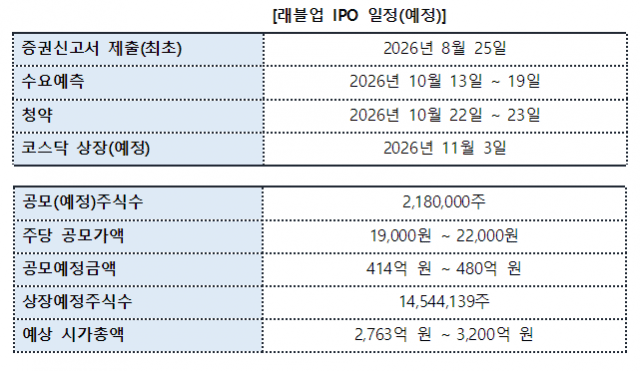
On the first day of retail subscriptions, 9,483 applications were received, with the proportional allocation portion 0.834 times subscribed. The expected equal allocation was 28.74 shares per account. Participation on the final day is expected to determine the final subscription result.
Market conditions, however, are challenging. On October 22, local time, concerns about returns on investment resurfaced following Meta’s plans to expand AI investment and raise financing. The Nasdaq Composite fell 2.6%, while the Philadelphia Semiconductor Index dropped 6.7%. OpenAI also lowered its target valuation from $1.4 trillion to $1.25 trillion during a new pre-IPO fundraising round.
In South Korea, weak returns from newly listed stocks are also weighing on subscriptions for subsequent IPOs. According to the securities industry, six of the nine companies newly listed on KOSDAQ from September through October 20 were trading below their IPO prices at the October 21 close. The nine stocks had an average return of minus 9.31%. Although Elice subsequently rebounded and recovered its IPO price, considerable volatility immediately after listing means investors will also assess Lablup’s growth outlook and whether its offering price is appropriate.
Lablup’s offering price reflects future earnings from overseas expansion. NH Investment & Securities applied an annual discount rate of 15% to estimated 2029 net income of approximately 21.2 billion won, converting it to a present value of about 13 billion won. Applying the average price-to-earnings ratio of 33.6 times for Wisenut, Suresoft Technologies and Nutanix produced an assessed value of 29,551 won per share. The final offering price is about 35.7% below that figure.
This valuation assumes a sharp increase in earnings from domestic and overseas business expansion. The prospectus projects revenue rising from approximately 9.9 billion won this year to approximately 57.9 billion won in 2029, and operating profit increasing from about 1 billion won to about 25.5 billion won. These figures reflect existing customers adding graphics processing units, expansion into finance, healthcare and defense, and the acquisition of overseas neocloud customers.
Lablup plans to expand subscription sales of its AI infrastructure operations platform, Backend.AI, to demonstrate through its results the growth expectations reflected in the IPO price. Because license fees depend on the types and quantities of AI accelerators customers use, equipment expansion by existing customers and the acquisition of new customers translate into increased revenue.
There are positive signs that expanding subscription sales is producing results. Subscription license revenue rose from about 1.6 billion won in 2023 to about 5.5 billion won last year, while its share of total revenue increased from 52.8% to 82.4%. The company expects subscription revenue growth to have a greater positive effect on profitability because the variable costs of additional supply are relatively small.
Lablup recorded consolidated revenue of approximately 6.7 billion won and operating profit of about 700 million won last year, and remained profitable at the operating level in the first half of this year. First-half revenue rose 58.2% year on year to approximately 4.7 billion won, with operating profit of about 600 million won. It recorded a net loss of approximately 2.8 billion won over the same period, mainly because of valuation losses and interest expenses related to redeemable convertible preference shares, or RCPS. However, Lablup believes the subsequent impact of related valuation gains and losses will be limited because all RCPS were converted into common shares during the first half.
Lablup plans to use the IPO proceeds to extend its domestic business base overseas. It allocated approximately 22.1 billion won to working capital, including global marketing, overseas operations and additional research and development personnel. It will combine direct sales to overseas neocloud developers with customer acquisition through regional resellers, while pursuing the establishment of a Japanese subsidiary in 2027 and a Singapore base in 2029.
The company will also strengthen the product support capabilities needed to acquire overseas customers. It plans to invest approximately 18.7 billion won in facilities, including a GPU and NPU test farm and a data center for validation, to verify compatibility and performance with next-generation AI accelerators from various manufacturers.
Related articles
Against this backdrop, customers’ investment schedules could affect the pace of future revenue growth. The prospectus identifies the risk that revenue could materialize later than planned depending on neocloud developers’ investment timing and customers’ adoption decisions. The company’s position is that weaker investor sentiment across the stock and IPO markets had a greater influence on the bookbuilding result than concerns about its individual business.
A Lablup representative said, “We believe increased stock market volatility and caution toward the AI sector had a greater influence on this bookbuilding result than concerns about the individual company. With supply-and-demand pressures from excessive institutional allocations in some recent offerings also attracting attention, risk appetite for IPO investment has declined overall.”
Original Korean article: ZDNet Korea
English brief by Korea Wind Intelligence, koreawindintel.com

















