

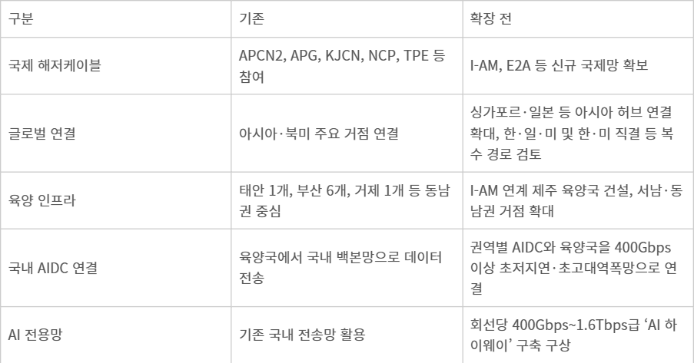
KT is expanding international subsea cable infrastructure to meet global demand for data connectivity in the artificial intelligence (AI) era. Its strategy is to combine more than 40 years of subsea cable operating experience with new international networks, cable landing stations, domestic telecommunications networks, and AI data centers (AIDCs) to build a highly interconnected network linking overseas AI and cloud hubs with domestic AI infrastructure. KT's strength lies in its ability to connect subsea cables directly to domestic infrastructure. It also owns the infrastructure needed to carry data arriving from global hubs through subsea cables, landing stations, and the nationwide backbone network to AIDCs and AI edge infrastructure. It envisages integrating these assets into a single end-to-end system to provide reliable data and computing resources for AI services. Part 2: Subsea networks connect AI infrastructure with the world. KT's connectivity capabilities are becoming more important as AI services expand. Subsea cables are critical telecommunications infrastructure, carrying approximately 99% of data traffic between countries and continents. They are long-term assets used for more than 25 years once installed, and cables newly built last year had a design capacity of approximately 290Tbps per cable. Demand for large-volume cross-border data transmission is expected to expand as AI training and inference and the use of overseas cloud services increase. KT has built its global network foundation by participating in international subsea cable projects including APCN2, APG, KJCN, NCP, and TPE. It is adding new cables, including I-AM, which connects Malaysia, Singapore, Japan, South Korea, the Philippines, and Taiwan, and E2A, which connects Asia and North America. It is expanding connectivity capacity to major Asian data hubs, including Singapore and Japan, and to North America, and is reviewing multiple routes, including South Korea-Japan-US connections and direct South Korea-US connections. The expansion of new international networks is driven by growing data demand associated with AIDC expansion. KT estimates that the government's target of building 18.4GW of AIDCs by 2035 would generate approximately 1,700T of global traffic. The capacity of subsea cables currently operating or scheduled to be built by 2030 is approximately 200T. Expecting at least 1,500T+ of additional connectivity capacity to be required by 2035, the company is accelerating efforts to secure subsea networks. It is also expanding landing infrastructure to connect subsea networks with domestic AIDCs. International subsea cables are currently concentrated largely in the southeastern region, with 1 in Taean, 6 in Busan, and 1 in Geoje. KT is building a Jeju landing station linked to I-AM and plans to expand its locations into the southwestern region and the southeastern region to diversify international network entry routes and improve connectivity with regional AIDCs. Data arriving at landing stations is delivered to AIDCs in each region through the domestic transmission network. KT envisages an ‘AI Highway’ connecting regional AIDCs and landing stations through ultra-high-bandwidth, ultra-low-latency networks of at least 400Gbps. It aims to minimize data transmission bottlenecks between GPUs and AIDCs distributed across multiple regions by using capacity of 400Gbps to 1.6Tbps per circuit and shortest-route optical fiber links. KT's strategy is to connect subsea cables, landing stations, the domestic backbone network, AIDCs, and AI edge infrastructure into a single network, creating a connectivity system extending from overseas global hubs to domestic AI infrastructure. A KT representative said, “AI competitiveness can be secured when computing resources and connectivity infrastructure are closely integrated.”
Original Korean article: ETNews
English brief by Korea Wind Intelligence, koreawindintel.com

















