

As the government pursues gigawatt-scale AI data centers, concerns have been raised that South Korea's current submarine cable infrastructure would make it difficult for the country to become a global AI hub. The argument is that policy support is needed, including expanded submarine cables to carry large volumes of data center traffic overseas, the formation of public-private consortia and more geographically diverse cable landing stations.
Jeon Myeong-jun, head of the Enterprise Service Division within KT's Enterprise Business Group, said at the Gangwon AI Infrastructure Hub Strategy Symposium at the National Assembly on October 26: “Even if South Korea builds gigawatt-scale AI data centers, they would serve only as storage facilities without connections to carry the data they generate. We must expand submarine cables to transmit the large volumes of data generated by AI data centers overseas.”
Submarine cables are critical telecommunications infrastructure that transmits data between countries and continents. More than 99% of international data traffic worldwide travels through submarine cables, which provide the infrastructure connecting global cloud services and AI data centers.
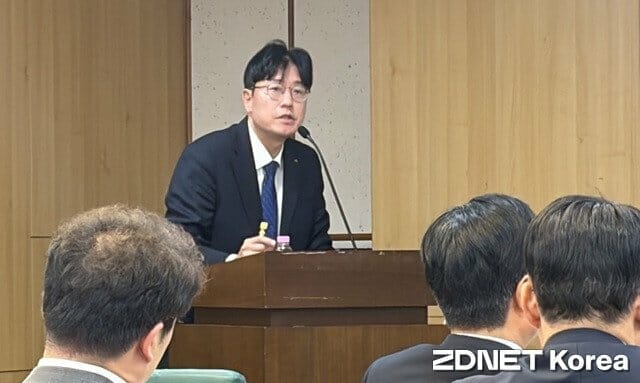
Jeon emphasized that the government's target of building 18.4 GW of AI data centers by 2035 requires a corresponding expansion of international telecommunications networks. Jeon explained that current submarine cable infrastructure is not keeping pace with traffic growth driven by data center construction and the expansion of AI services.
According to KT's estimates, assuming each 1 GW of AI data center capacity generates about 91 terabits per second, or Tbps, of traffic, the expected global traffic from 18.4 GW would reach approximately 1,700 Tbps. By contrast, the capacity of submarine cables that will be operational or are planned for construction by 2030 is around 200 Tbps, leading to the argument that infrastructure accommodating more than an additional 1,500 Tbps is needed.
Jeon assessed that submarine cables are becoming particularly important as AI use expands from training toward inference. This is because demand for cross-border data transmission increases as connections among AI users, cloud services and external application programming interfaces, or APIs, grow, and real-time inference tasks between overseas data centers expand.
Only 8 submarine cables constrain AI hub competitiveness
Jeon emphasized that South Korea must expand its international data connections alongside data center construction to become a global AI hub connecting the United States and Asia.
Global telecommunications hubs are locations where data is exchanged intensively between countries, supported by submarine cables, cable landing stations and data centers. The United States, Japan, Singapore and Hong Kong are currently considered major hubs. According to TeleGeography data cited by Jeon, the share of global traffic passing through hub countries is expected to reach 99% in 2030. Traffic passing through South Korea was put at around 3% of the total.
South Korea is assessed as having favorable conditions for expanding AI data centers, including relatively reasonable electricity costs, competitiveness in memory semiconductors and a skilled IT workforce. The explanation offered was that South Korea could attract attention as an alternative as existing Asian hubs such as Japan, Hong Kong and Singapore face problems involving power, land, regulation and costs.
Nevertheless, there is a large gap in the scale of international telecommunications networks. South Korea operates 8 global submarine cables, far fewer than Japan's 43 and Singapore's 34. The concern is that even if AI data centers expand, insufficient telecommunications infrastructure connecting them overseas would limit their ability to attract global traffic.
Public-private investment and more diverse cable landing locations needed

Jeon proposed forming public-private consortia as a way to expand submarine cables. The assessment was that rapid infrastructure expansion would be difficult through investment by private telecommunications operators alone, given the substantial funding and long construction periods required for submarine cables.
Jeon emphasized the need to move beyond consortia centered on global telecommunications operators toward an investment framework involving telecommunications operators, global technology companies, financial investors and the government. Jeon also called for institutional support, including expedited permitting, tax support and low-interest loans.
Jeon also identified the geographic concentration of cable landing stations, where submarine cables connect to land, as an issue to address. Jeon explained that landing stations, currently concentrated in the southeast, should be diversified into areas including the south and the southwestern region to reduce data transmission bottlenecks between AI data centers to be built nationwide. Jeon considered that this would also enable a dedicated AI data center network supporting ultra-high bandwidth of at least 400 gigabits per second, or Gbps, and ultra-low latency.
“To become one of the top 3 AI powers, it is important not only to establish AI data centers but also to build ultra-low-latency infrastructure capable of efficiently transmitting the traffic they generate,” Jeon emphasized. “We must build a dedicated AI network linking global connectivity, AI data centers and AI edge infrastructure, supported by expanded public-private cooperation and institutional and policy support.”
The National Assembly and the government also agreed on the need to expand submarine cables. The symposium discussed linking a planned 2.4 GW AI data center in Donghae, Gangwon, with submarine cables to develop South Korea into a global AI infrastructure hub.
Song Ki-hun, chair of the National Assembly's Science, ICT, Broadcasting and Communications Committee, said: “We expect South Korea to become a global AI hub if AI data centers are established in Gangwon and a global network connecting to the United States through submarine cables is built.”
Ha Jung-woo, standing vice chair of the National AI Strategy Committee, also said: “The key issue in expanding AI infrastructure is submarine cables directly connected to data centers. It is important to discuss this carefully and develop solutions.”
Original Korean article: ZDNet Korea
English brief by Korea Wind Intelligence, koreawindintel.com

















