

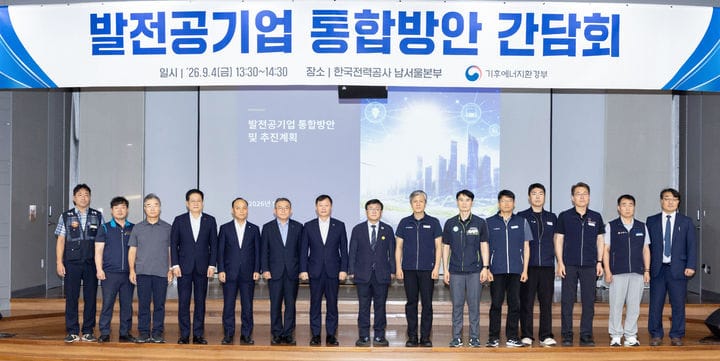
The MCEE (Ministry of Climate, Energy and Environment) held an "Integrated Plan Meeting for Gencos" on November 4 at the South Seoul headquarters of KEPCO (Korea Electric Power Corporation).
As the government moves to eliminate all coal-fired power generation by 2040, the five state-owned Gencos, EWP (Korea East-West Power), KOWEPO (Korea Western Power), KOMIPO (Korea Midland Power), KOEN (Korea South-East Power), and KOSPO (Korea Southern Power), face mounting operational burdens. Coal power plants are closing in stages, weakening existing revenue bases, while the companies must simultaneously shoulder new investments to expand replacement generation capacity.
There is consensus on the direction toward carbon neutrality and renewable energy transition, but concerns have emerged that the financial deterioration from rapid business restructuring has not been adequately examined.
According to the energy industry on November 9, the five Gencos recently jointly commissioned a "Consulting and Support (PMI) Project for Integration of the Five Gencos." The aim is to examine in detail what is needed to integrate the five companies substantively, chemically, and institutionally.
Through the project, practical work spanning law, administration, accounting, taxation, and labor matters will begin, and after the new corporation launches, follow-up work including organizational and workforce restructuring, business integration, and succession of invested projects will proceed. The companies have begun in earnest to establish the integrated corporation, targeting launch in October next year.

















