Analysis shows that even if the government secures six offshore wind turbine installation vessels (WTIV) by 2030, achieving an annual installation capacity of 4 gigawatts will be difficult unless installation ports and projects ready for construction start are prepared on schedule. Experts point out that coordinating the timing of offshore wind projects, ports, and vessels matters more than the scale of ship procurement for reaching the deployment target.
The climate and energy think tank Next released an issue paper on September 9 titled "Appropriateness of Korea's WTIV Procurement Plan: Utilization Analysis Reflecting Construction Start Delays and Installation Port Conditions." A WTIV is a specialized vessel that lifts wind turbine towers, nacelles, and blades at sea and installs them on substructures.
According to Next, even when offshore wind projects begin construction five years after receiving an Electricity Business License, cumulative completion by 2035 falls short of the government's 25 gigawatt target. If construction start is delayed by an additional three years, the period when vessels remain idle increases roughly sevenfold due to lack of projects to install, and the charter income lost by ship owners is estimated to reach up to 1.258 trillion won.
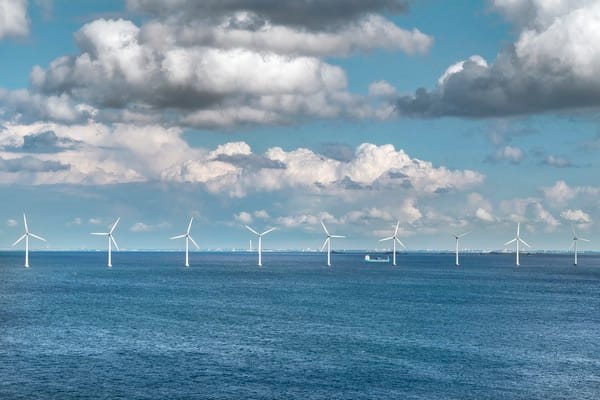
The core finding is that to achieve the offshore wind deployment target, the government must not only increase installation vessels but also align project construction starts, port expansion, and ship procurement into a single schedule.
Six vessels secured but annual installation capped at 3.43 gigawatts as ports become bottleneck
The government currently plans to add four 15-megawatt WTIVs to the two existing 10-megawatt vessels in Korea by 2030, securing a total of six ships and establishing an annual offshore wind installation capacity of 4 gigawatts. The government calculated that each 10-megawatt vessel can install 500 megawatts annually and each 15-megawatt vessel 750 megawatts, summing to 4 gigawatts across six vessels.
Next analyzed the actual availability of vessels and ports across 86 fixed-bottom offshore wind projects of 50 megawatts or larger in Korea, totaling 29.17 gigawatts. The study modeled a "standard scenario" with construction start five years after receiving an Electricity Business License and a "delay scenario" where construction start is postponed by an additional three years.
Under the standard scenario, cumulative completion reached 4.24 gigawatts in 2030, exceeding the government's 3 gigawatt target, but fell to 18.60 gigawatts by 2035, short of the 25 gigawatt goal. Under the delay scenario, completion was 2.21 gigawatts in 2030 and 14.75 gigawatts in 2035, falling below targets in both years. The final completion date for analyzed projects shifted from August 2039 in the standard scenario to June 2041 in the delay scenario, a delay of roughly one year and ten months.
Peak annual turbine installation was analyzed at 3.43 gigawatts in 2037 under the standard scenario and 3.26 gigawatts in 2034 under the delay scenario. In both cases, installation fell short of the government's 4 gigawatt target. The report notes that the government's 4 gigawatt plan simply adds up vessel installation capacities without reflecting real operational constraints such as port capacity, weather conditions, and project schedules.
Construction delays and port shortages could cost up to 5 trillion won in lost charter income; integrated roadmap needed
Construction start delays on offshore wind projects sharply increase periods when installation vessels have no work. Cumulative idle time for WTIVs due to insufficient projects was 1.31 vessel-years annually under the standard scenario but jumped to 9.04 vessel-years under the delay scenario, roughly sevenfold higher.
Idle time due to port shortages was 23.72 vessel-years annually under the standard scenario and 17.59 vessel-years under the delay scenario. The standard scenario shows greater idleness from port constraints because when projects proceed on schedule, turbine installation demand concentrates early, but available ports are insufficient. This means that even if construction start delays are resolved, ports could become a new bottleneck without accompanying port expansion.
Next converted these idle periods into lost charter income for ship owners. The opportunity cost of additional demand shortfall idleness caused by construction delays beyond the standard scenario is estimated at 1.209 trillion to 1.258 trillion won. The opportunity cost from port shortages in the standard scenario alone reaches 4.419 trillion to 4.570 trillion won. The analysis applied daily charter rates as of January 2026 of 385 million to 402 million won for 10-megawatt vessels and 581 million to 598 million won for 15-megawatt vessels.
In actual charter contracts, separate rates for vessel standby could reduce ship owner losses. Conversely, if private shipping companies and investors defer vessel procurement due to insufficient projects and ports available for construction, the result could be installation capacity shortages at critical times rather than idle cost losses.
The report recommends that the government first resolve bottlenecks delaying project construction starts, including permitting, community acceptance coordination, and grid connection, then manage WTIV and installation port introduction timing and scale as a single infrastructure roadmap.
Given that WTIV charter contracts typically run six to eighteen months, shorter than loan maturities, the report states that policy financing repayment terms should be adjusted. It calls for structures linking actual charter income, such as concentrating principal repayment when revenue is generated from confirmed charter contracts or applying excess cash flow to additional repayment.
Original Korean article: ESG Economy
English brief by Korea Wind Intelligence, koreawindintel.com