The final wind power auction volume eligible for REC multiplier benefits has been announced. Developers are expected to engage in intense negotiations over the next month regarding the 2.2 GW scale of announced capacity, which aligns with the offshore wind auction roadmap announced in June.
KEA (Korea Energy Agency) Renewable Energy Center announced on October 30 that it will begin accepting applications for the second-half 2026 offshore wind fixed-price contract competitive auction with a volume of approximately 2,200 MW.
This announced capacity represents a record high, increasing by 400 MW from the first-half offshore wind auction volume of 1,800 MW. The government's allocation of 4 GW in offshore wind auction volume for this year, with 1.8 GW in the first half followed by the remaining 2.2 GW proceeding without delay, is viewed positively.
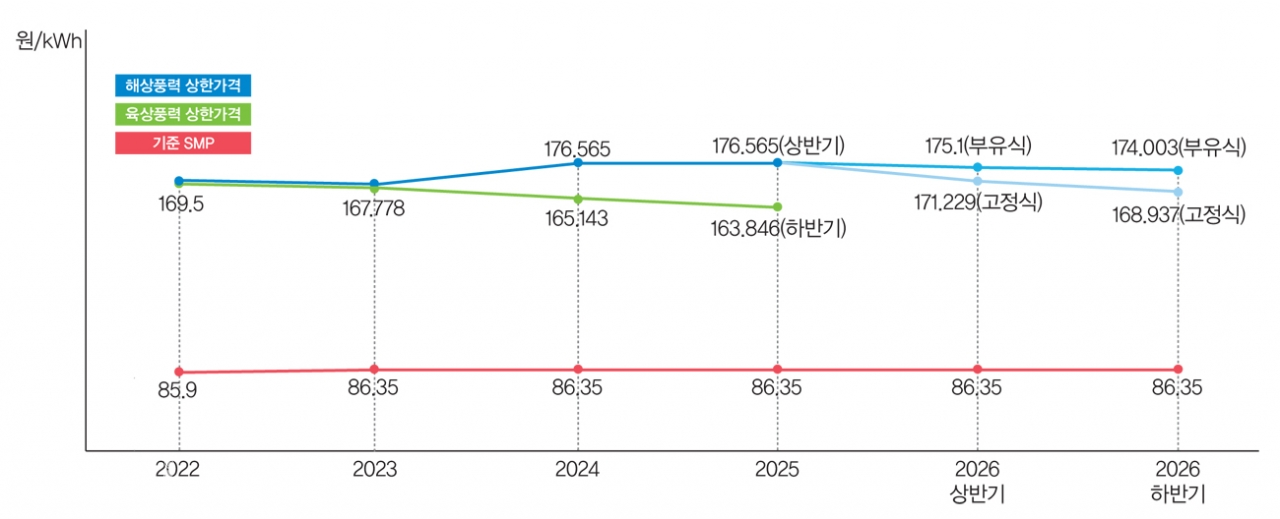
However, the successively lower auction price ceilings have placed developers in a position where they must re-analyze project economics. While developers are expected to participate in the auction as a final opportunity to receive REC multiplier benefits before the RPS system sunset, if project viability appears uncertain, some may refrain from bidding and instead monitor market conditions.
Developers wishing to participate in this second-half auction, which runs through December 10, may submit their auction participation documents, supporting materials, and project evaluation reports through the KEA Renewable Energy Center competitive auction system. Final selection results are scheduled to be announced individually in December.
Government and Industry Remain at Odds Over Development Costs
The second-half 2026 offshore wind auction price ceiling (SMP plus 1 REC price) is divided into fixed-bottom and floating categories, the same as the first half, with both reaching record lows. The government has lowered the price ceiling in the second-half auction following the first half, in line with its policy goal of reducing the offshore wind generation cost to 250 won per kWh by 2030 and 150 won per kWh or less by 2035.
Fixed-bottom offshore wind projects have been assigned price ceilings of 168.937 won per kWh for mainland sites and 168.913 won per kWh for Jeju. While the decline from the previous auction has narrowed, the mainland rate has fallen by 2.292 won (1.34 percent), suggesting that developers will face greater deliberation over bidding prices.
The floating offshore wind price ceiling, separated from fixed-bottom since the first-half 2026 auction, has been set at 174.003 won per kWh for mainland sites and 173.979 won per kWh for Jeju. This represents a modest decline of 1.097 won (0.63 percent) compared to the first half, but given the various risks inherent in such projects, even a one-won reduction is considered a significant burden for developers. Compared to 2024, when floating offshore wind auctions first opened, this represents a decrease of 2.562 won (1.45 percent).
Regarding the price ceiling reduction, MCEE (Ministry of Climate, Energy and Environment) states that the adjustment was made in consideration of domestic and international offshore wind LCOE forecast changes and shifts in market conditions such as exchange rates. The reference electricity trading price (SMP) has remained at 86.35 won per kWh, unchanged since 2023.
Although the price ceiling reduction has narrowed compared to the first half, given the current state of domestic supply chains where market activation has not yet occurred, there are limits to reducing development costs. Consequently, it is forecast that achieving project viability for both fixed-bottom and floating offshore wind will not be straightforward.
However, many observers note that the price ceiling reduction has not reached the three percent level that the industry had feared in the first half, making various responses to secure project viability possible. Having prepared in advance for the government's price ceiling reduction policy, the argument goes that a 1.34 percent reduction is manageable.
An industry official stated: "The fixed-bottom price ceiling set in this second-half auction is lower than the bidding prices submitted by three of the four fixed-bottom projects selected in the first-half auction. Although the auction has reopened after six months, there have been no notable supply chain market changes in the interim that would allow developers to reduce development costs, making it difficult for developers to formulate bidding strategies." The official added: "Developers preparing for the second-half auction will have already designed bidding prices, wind turbine models, and supply chain configurations based on various scenarios. During the roughly one-month application period, they plan to reconsider their participation, turbine selection, and supporting documentation based on the reduced price ceiling, so there is a possibility that the industry's expected participation volume and turbine models may differ significantly."
Seven General Fixed-Bottom Projects in Competition: Two to Four Expected to Be Selected
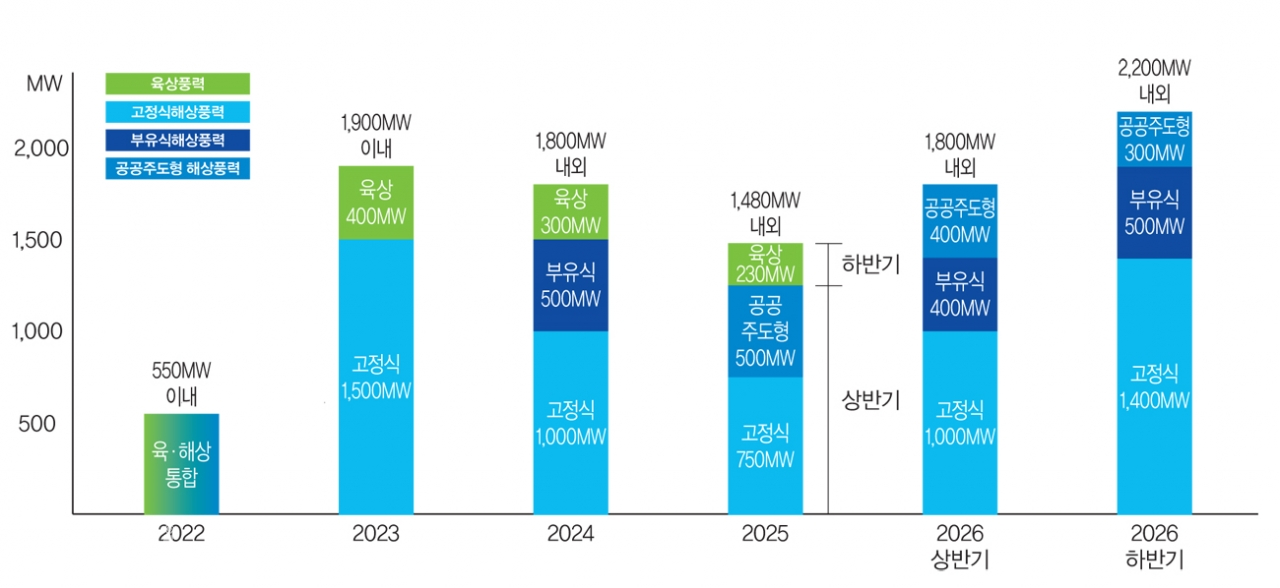
The second-half 2026 offshore wind competitive auction announced capacity is divided into general fixed-bottom (approximately 1,400 MW), general floating (approximately 500 MW), and publicly led fixed-bottom (approximately 300 MW), for a total of approximately 2,200 MW. The use of the phrase "approximately" again leaves open the possibility of determining the final selected volume to exceed the announced capacity.
In the first-half auction, general fixed-bottom capacity of approximately 1,000 MW and floating capacity of approximately 400 MW were announced, with final selections exceeding these by 94 MW and 132 MW respectively. However, for excess capacity, REC trading contracts are concluded at a weighted average rate calculated using the second-place bidder's price among participating projects, which may reduce the final winning bid price.
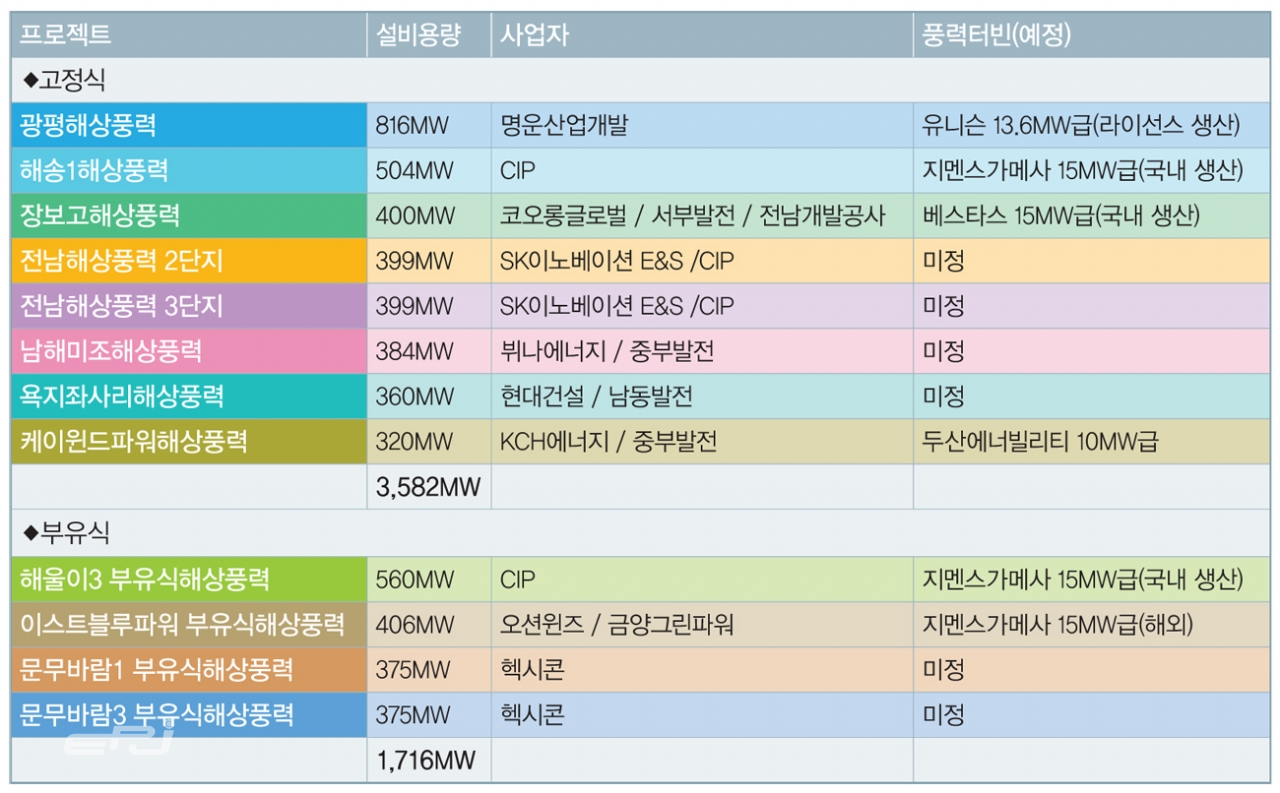
According to the wind industry, seven fixed-bottom offshore wind projects are expected to participate in the second-half general auction: Gwangpyeong (816 MW), Haesong 1 (504 MW), Jangbogo (400 MW), Jeonnam P2 (399 MW), Jeonnam P3 (399 MW), Namhae Mijo (384 MW), and Yokji Jwasari (360 MW). The combined capacity totals 3,262 MW.
The Yokji Jwasari project, which had been expected to see publicly co-led market participation with KOEN (Korea South-East Power) as a co-developer, is now likely to participate in the general sector. Additionally, the Jangbogo project, which participated in the publicly led market in the first-half auction, is expected to shift to the general sector in the second half, intensifying competition among developers.
If all these projects participate in the second-half auction as expected, the general fixed-bottom auction competition ratio is forecast to reach 2.33 to 1. With projects totaling 3,262 MW competing for approximately 1,400 MW of announced capacity, two to four projects are expected to be selected based on bidding prices and evaluation results.
Doosan Enerbility Leads Public Sector Supply
In the general floating offshore wind market, Haewoori 3 (560 MW), East Blue Power (406 MW), Munmu Wind 1 (375 MW), and Munmu Wind 3 (375 MW) are known to be considering participation in the auction.
Given the high development cost burden of floating offshore wind, qualitative evaluation scores based on wind turbine model and production method differences are expected to influence winning bids more than price competition. However, if projects using Chinese wind turbines with price competitiveness emerge, the competitive landscape could become more complex.
With an announced capacity of 500 MW, up to two projects could be selected, but given the development difficulty of floating offshore wind, the likelihood of overambitious selections appears low.
For the publicly led fixed-bottom offshore wind auction, only one project, K-Wind Power (320 MW), is expected to participate. Given current conditions requiring state-owned enterprise equity participation and effectively limiting participation to domestic wind turbines, it is unlikely that additional projects will participate by the application deadline. Barring any disqualifying factors, K-Wind Power's selection probability appears high as the sole participant in the public sector.
As before, the second-half publicly led offshore wind auction will provide a base preferential price of 3.66 won per kWh and an additional preferential price of 27.84 won per kWh for using government R&D demonstration wind turbines. However, the K-Wind Power project will use the 10 MW-class Doosan Enerbility model already selected in a previous public auction, so it will not receive the additional preferential price.
If K-Wind Power is finally selected in this auction, Doosan Enerbility will achieve the distinction of being the sole turbine supplier for all projects selected in publicly led auctions to date.
Chinese Wind Turbines Expand Domestic Entry: Supply Chain Policy on Trial
The second-half 2026 auction evaluation will proceed in two stages as before. The first stage evaluates project details and the second stage examines bidding prices, each with 50 points, and the final developer is selected based on the combined score.
Notable is the close examination of the "contribution to equipment and materials supply chain establishment" category, which carries the highest evaluation score of 14 points among evaluation items. A new item titled "nacelle and hub assembly technology transfer type" has been added to the project details reviewed during qualitative evaluation.
In other words, depending on the domestic supply method for overseas wind turbines, scoring will be differentiated among technology transfer production, licensed production, and OEM production. The intent is to award higher scores to production methods that allow domestic companies to receive and utilize related technology transfer rather than simple nacelle and hub assembly approaches.
This change in evaluation criteria specific to wind turbines is not unrelated to the government's goal of reducing generation costs, analysts suggest. By adjusting evaluation criteria to allow developers to consider diverse wind turbines and thereby inducing competition among manufacturers, development costs can be lowered.
Differentiated evaluation based on domestic wind turbine supply methods can yield effects including technology transfer, investment attraction, job creation, and workforce development. The problem is that meeting these evaluation criteria would allow Chinese wind turbines to enter the domestic market freely.
The Yeonggwang Hanbit offshore wind project, already selected in the first-half auction, is scheduled to receive a 13.6 MW wind turbine from Unison, which has concluded a licensing agreement with Vensys, the European subsidiary of China's Goldwind. In this second-half auction, Hyosung Heavy Industries is also considering supplying a localized 14 MW-class model from China's Shanghai Electric. Additionally, Mingyang and Envision are known to be exploring various avenues for domestic market entry.
An industry official emphasized: "Energy security should be approached as a comprehensive concept that considers not only the possibility of sensitive information leakage overseas during offshore wind development but also the possibility of external interference that could affect stable power supply systems. Retaliatory tariffs or import-export restrictions arising from political and diplomatic conflicts between nations can be addressed through policy responses, but if problems threatening power supply stability occur, the ripple effects on the national economy could be substantial, requiring thorough preparedness."
The official continued: "The government plans to continuously lower auction price ceilings to induce generation cost reductions, and it is showing a trend of increasingly permitting domestic entry of Chinese wind turbines with price competitiveness under the pretext of reducing development costs. Market expansion uncertainty remains, yet there are questions about how positive the policy decision to lower costs by inducing competition through Chinese wind turbines will be for fostering the domestic industry."
Original Korean article: Electric Power
English brief by Korea Wind Intelligence, koreawindintel.com