

Fixed-bottom price ceiling down 4.32% from the first half of 2025; rising equipment and financing costs signal project viability concerns
Offshore wind auction price ceilings have fallen twice this year, triggering frustration from developers over project viability. Industry responses also suggest that lower price ceilings will inevitably shrink investment capacity needed to secure domestic turbine production and technology development, delivering industrial contribution.
The situation has reached a point where developers face a bind: investing in domestic supply chains increases cost burdens, while switching to cheaper overseas sourcing undermines competitive evaluation scores and makes financing harder. Some say they could reconsider participation in auctions altogether.
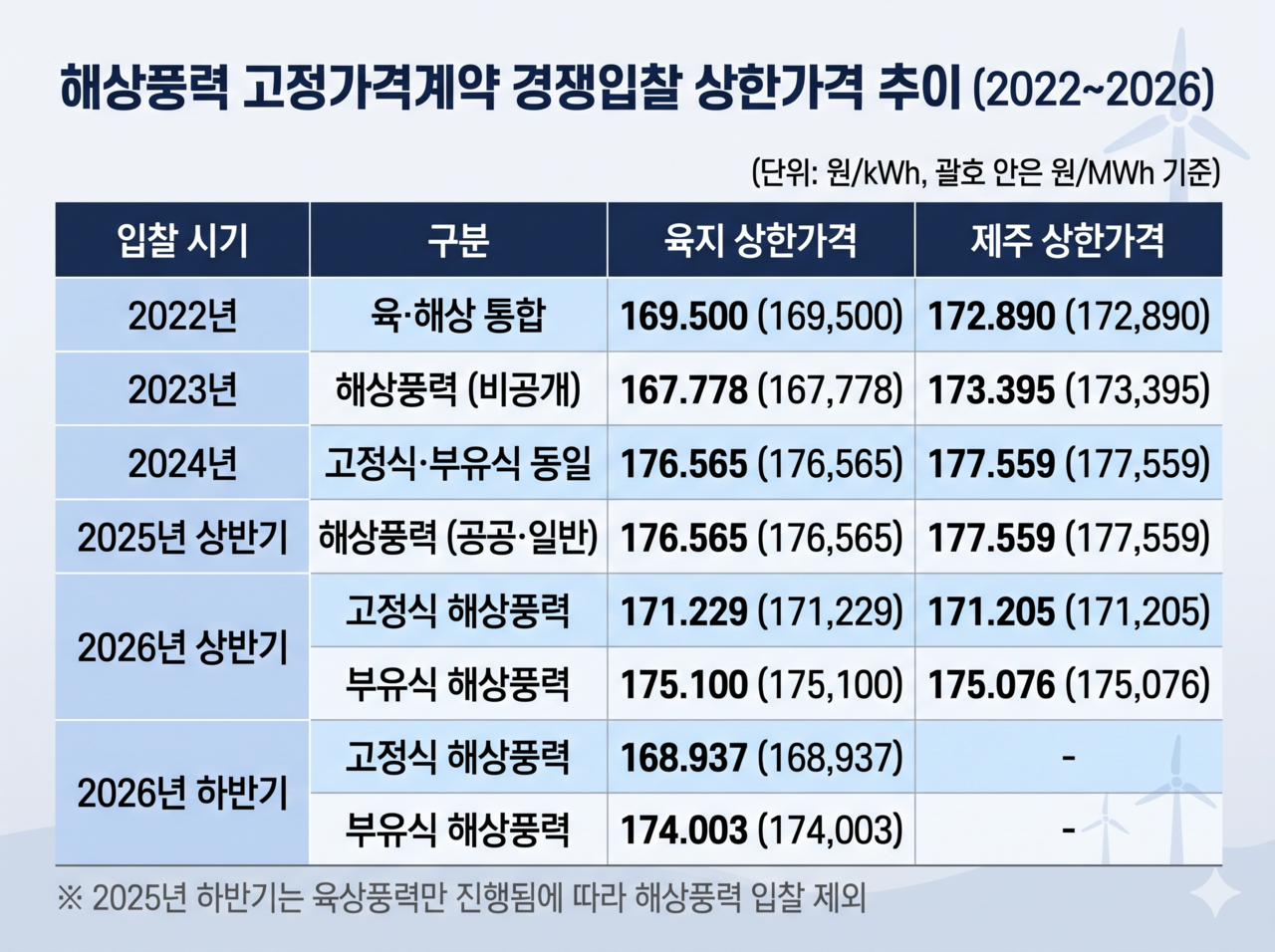
According to a competitive auction notice issued by KEA (Korea Energy Agency) on October 30, 2026 for the second half of 2026 fixed-price contracts for offshore wind, the mainland reference price ceiling stands at 168,937 won per MWh for fixed-bottom and 174,003 won per MWh for floating. These represent declines of 1.34 percent and 0.63 percent respectively from the first half. The announced volume totals approximately 2,200 MW, comprising 1,700 MW of fixed-bottom capacity including 300 MW led by public entities, and 500 MW of floating capacity.
The fixed-bottom price ceiling has fallen from 176,565 won per MWh in the first half of 2024 and 2025 to 171,229 won per MWh in the first half of this year, with this latest reduction pushing it further down. The decline from the first half of last year amounts to 4.32 percent. The government states it adjusts prices by reflecting global levelized cost of electricity (LCOE), capital expenditure (CAPEX) trends, and technological progress.

















