

Expectations for tighter data center regulation
Regulation of artificial intelligence (AI) data center construction is expected to tighten following the Democrats' landslide victory in the US midterm elections. Korea Investment & Securities expects South Korean companies including VINATech and TNE Korea to benefit from growing demand for Bloom Energy's fuel cells as regulation of electricity and water use expands.
In a report on November 5, Korea Investment & Securities analyst Kim Geon-woo said: “Discussion of ways to address data center regulation will come into greater focus after the US midterm elections.” Kim forecast that “Bloom Energy's solid oxide fuel cells (SOFC), a power source capable of addressing these regulations, will expand their market.”
In the Texas gubernatorial election held on November 3, local time, Democratic candidate Gina Hinojosa defeated incumbent Republican Governor Greg Abbott. Governor-elect Hinojosa has advocated an immediate moratorium, or temporary halt, on approvals for new data center construction, citing local water use, rising electricity prices and an inadequate regulatory framework as problems.
Democrat James Talarico also won the US Senate election in Texas. Senator-elect Talarico likewise maintains that AI data center developers should pay grid connection costs and introduce closed-loop water systems to prevent water pollution.
“Texas is a location for large-scale data center investment, including Google's Armstrong campus, Meta's El Paso data center campus and OpenAI's Stargate project,” Kim said. “After the election, addressing regulation related to new data center construction is expected to become a more prominent issue.”
Fuel cells and water and power constraints
“The central issues in restructuring the regulatory framework will be restrictions on local water use and responsibility for rising electricity prices,” Kim continued. “Bloom Energy's fuel cells are expected to expand their market because they can address these regulations.”
This is because fuel cells generate electricity through electrochemical reactions rather than by burning fuel. “Unlike conventional power plants, they do not require cooling towers and consume only a small amount of water during reforming,” Kim said. “Fuel cells can be installed on data center sites to generate power independently without electricity supplied through the wider grid, reducing pressure on local grids and electricity prices.”
Domestic supplier recommendations
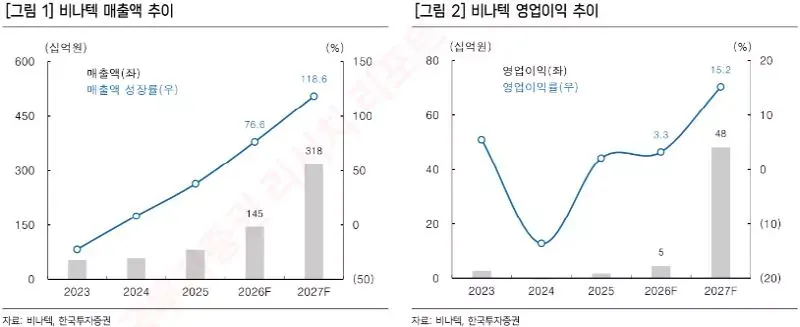
Korea Investment & Securities named VINATech its top domestic stock pick to benefit from Bloom Energy's growth, setting a target price of 112,000 won. It selected TNE Korea as its second choice.
“As AI technology advances, power density per data center rack is rising and the scale of power supply is increasing, making the buffering function that maximizes power stability more important,” Kim said. “Bloom Energy's revenue growth will lead to increased supercapacitor supply volumes from VINATech.”
VINATech announced successive large-scale supercapacitor supply contracts for Bloom Energy in October. The combined value of the 2 contracts was approximately 240 billion won, about 3 times VINATech's annual revenue last year.
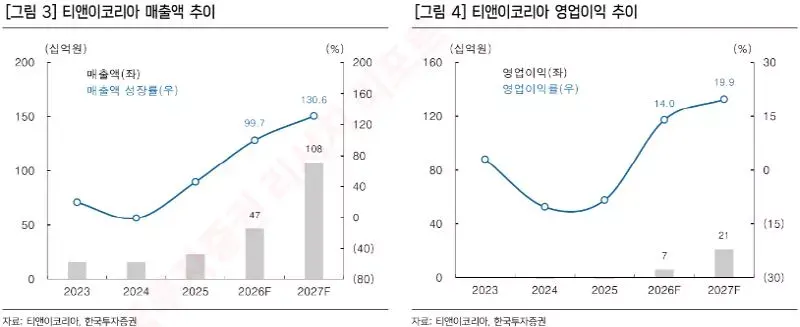
TNE Korea was presented as the second choice. TNE Korea is a turbomachinery manufacturer whose main products are air blowers used in SOFC systems. “As the fuel cell market expands, TNE Korea's revenue next year is expected to rise 130.6% year on year to 108 billion won, with operating profit of 21.4 billion won,” Kim said. “Its operating margin is forecast at around 19.9%.”
Original Korean article: Viewers
English brief by Korea Wind Intelligence, koreawindintel.com

















