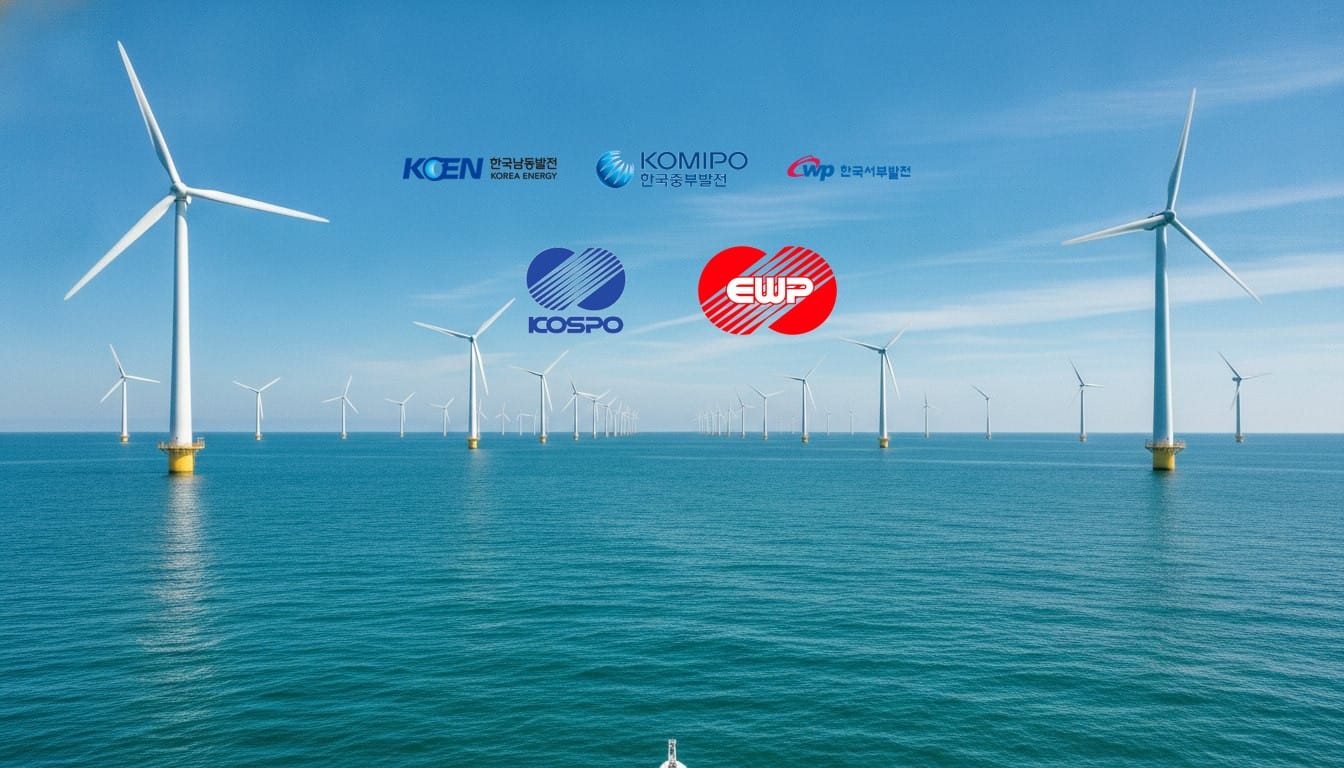
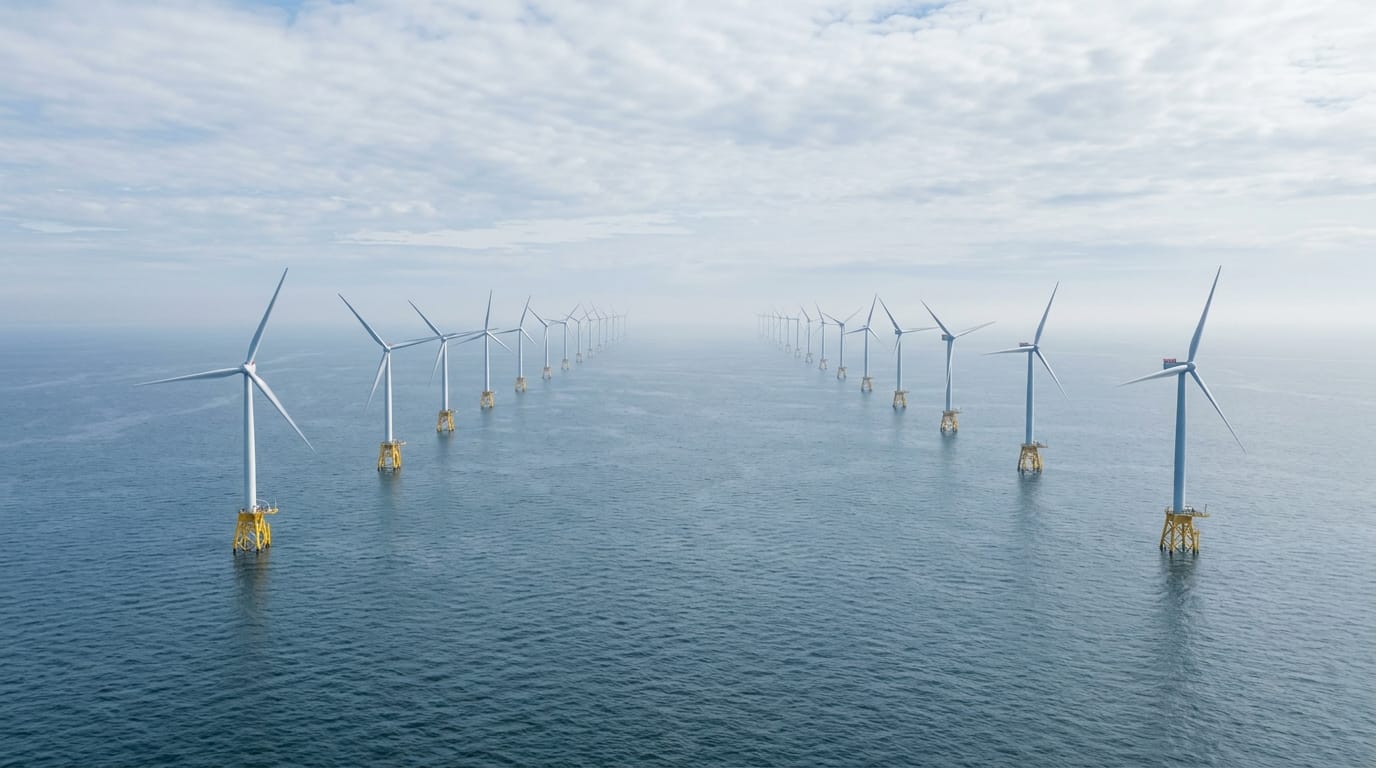
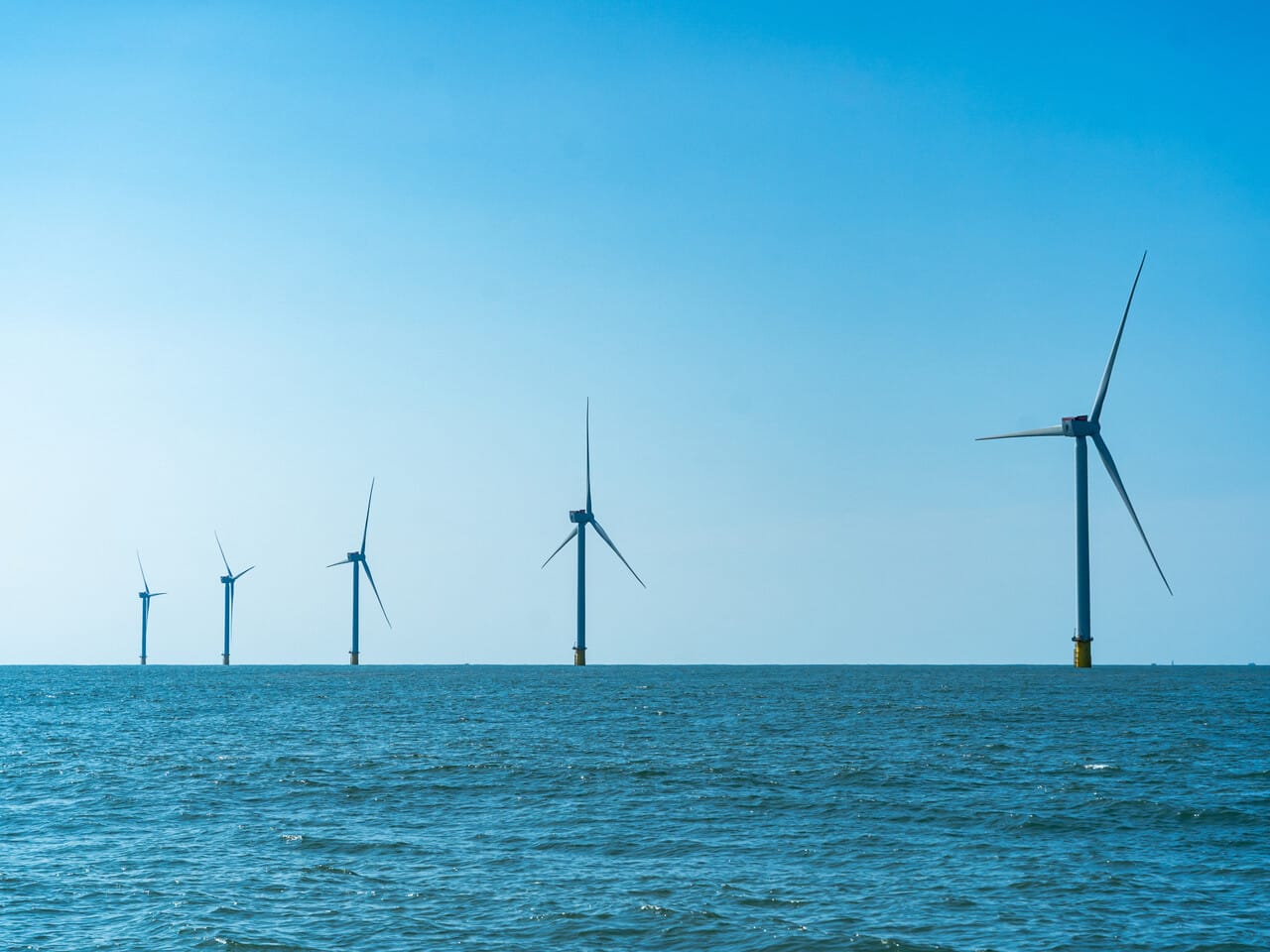
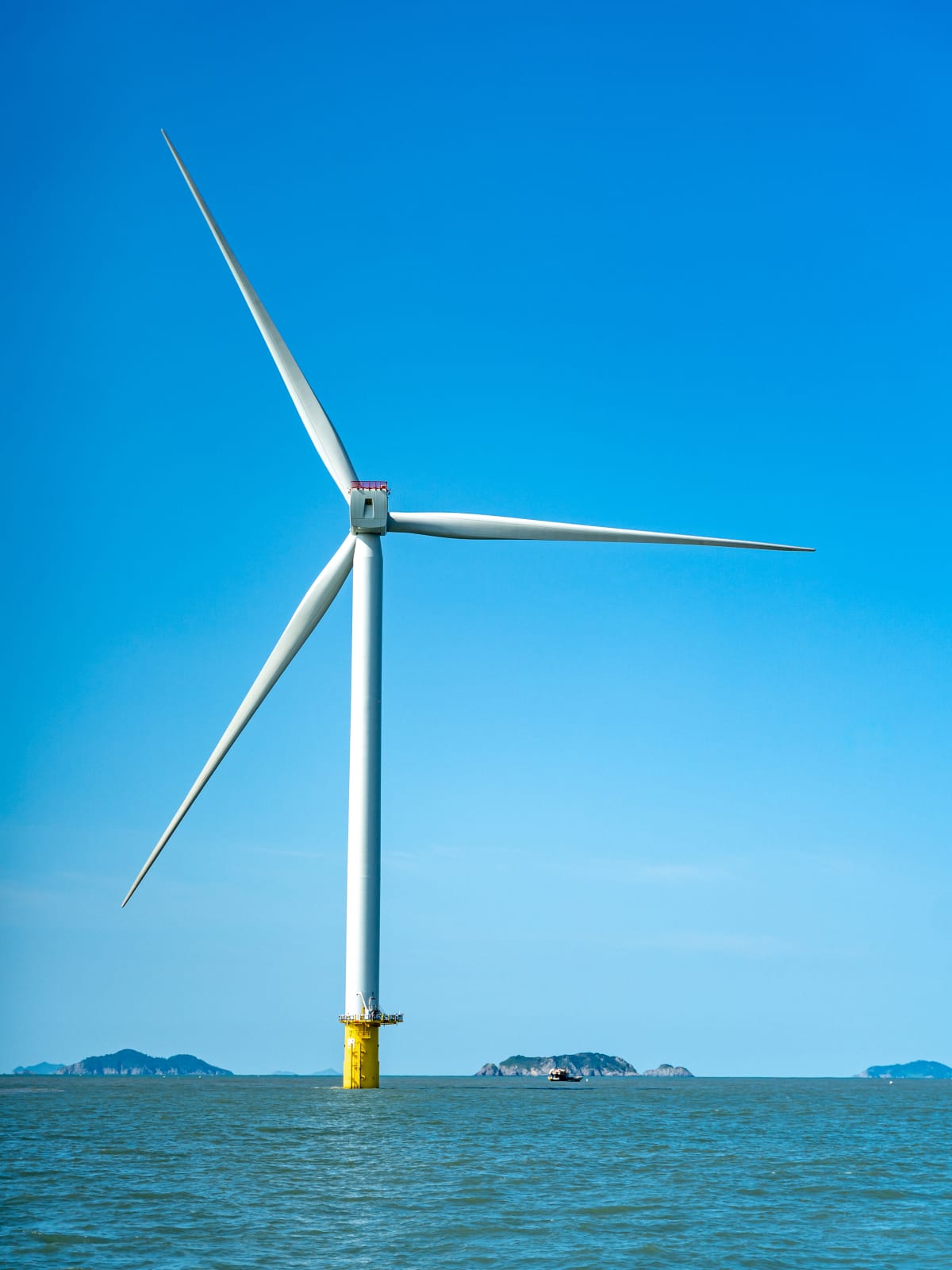
One hour and thirty minutes after setting out by boat from about 9 kilometers off the coast of Jaeun Island in Sinan County, Jeollanam-do, the wind turbines scattered like dots beyond the horizon came into full view. As we drew closer, the size of the turbines exceeded what the eye could judge from a distance. The height from the sea surface to the blade tip reaches 227 meters, and each blade alone measures 97 meters in length. The turbines are positioned to minimize the "wake effect," in which rough winds reduce the efficiency of downstream generators, taking into account the prevailing north-northwest winds in this region.
Jeonnam P1 - SK E&S, which began commercial operation in May last year and has now been operating for over a year, continues to generate power. The site comprises ten 9.6 megawatt turbines, six to the north and four to the south, forming a total 96 megawatt generation facility. It is the first large-scale offshore wind farm completed under private leadership in South Korea and also symbolizes the first winning bid in the government's fixed-price competitive bidding for offshore wind power.
On September 9, 2026, Electric Times visited the site with the Korea Wind Energy Association to observe operations that have entered a stabilization phase following commercial operation. At around 1 p.m. on the day of the visit, a gentle tailwind was blowing, but according to officials, the facility achieved a capacity factor exceeding 66 percent at one point in the early morning, indicating favorable wind conditions.
Kim Jin-chul, CEO of Jeonnam P1 - SK E&S, said, "Most of the shutdowns that occurred during the initial turbine stabilization phase have been resolved, and recently there has been almost no output control due to grid constraints. Through Phase 1, many developers have shared experience and the relevant content has been reflected in government policy, so it can be said that we have played a priming role for domestic offshore wind power."
Ten Turbines Off Jaeun Island: Private Offshore Wind's First Real Test
The Jeonnam P1 - SK E&S project entered the review stage starting in 2013, when there was almost no large-scale offshore wind experience in South Korea. After receiving an Electricity Business License in 2017, SK E&S accelerated commercialization in 2020 by partnering with Copenhagen Infrastructure Partners (CIP), a global offshore wind developer. SK contributed domestic licensing, government and local government coordination, and community acceptance, while CIP applied basic design, engineering, procurement and construction expertise and offshore wind development experience accumulated overseas.
CEO Kim said, "At the time, there were no large-scale private offshore wind projects in South Korea to reference, so it was difficult to be confident that actual commercialization could be achieved, but by combining the capabilities of both companies, we found clues one by one."
The biggest test in this process was financing. By applying non-recourse project finance that evaluates the profitability and cash flow of the project itself rather than relying on shareholder guarantees, the project set a precedent for the South Korean financial market to evaluate the viability of large-scale private offshore wind. Despite the Russia-Ukraine war and the Legoland incident freezing the financial market, approximately 600 billion won was raised from two domestic financial institutions and seven overseas financial institutions.
The project also gained new experience in technology and supply chains. Phase 1 was the first in South Korea to apply monopile substructures for offshore wind, following seabed survey and design. Unlike jacket methods, monopiles involve installing a single large steel pipe into the seabed, reducing steel consumption and manufacturing and installation processes.
CEO Kim said, "If we over-design, project costs rise, and if we under-design, structural safety issues arise, so we put considerable effort into optimal design. We have confirmed through actual project implementation that monopiles can be sufficiently applied in South Korea if water depth and ground conditions are suitable."
Domestic companies participated extensively in substructures, towers, cables, and marine construction excluding turbines. Through this process, seabed geological surveys, substructure design, and large equipment transportation and installation, which were unfamiliar to domestic developers at the time, were accumulated as practical project experience.
Turbine installation required separate port infrastructure. Since there were not many ports nearby capable of withstanding the weight of nacel units around 600 tons and large installation vessels while allowing pre-assembly of towers and blades, Mokpo New Port was selected. Jeonnam P1 - SK E&S reinforced some seabed at its own expense, and the established infrastructure can subsequently be utilized for other offshore wind projects in the southwestern region.
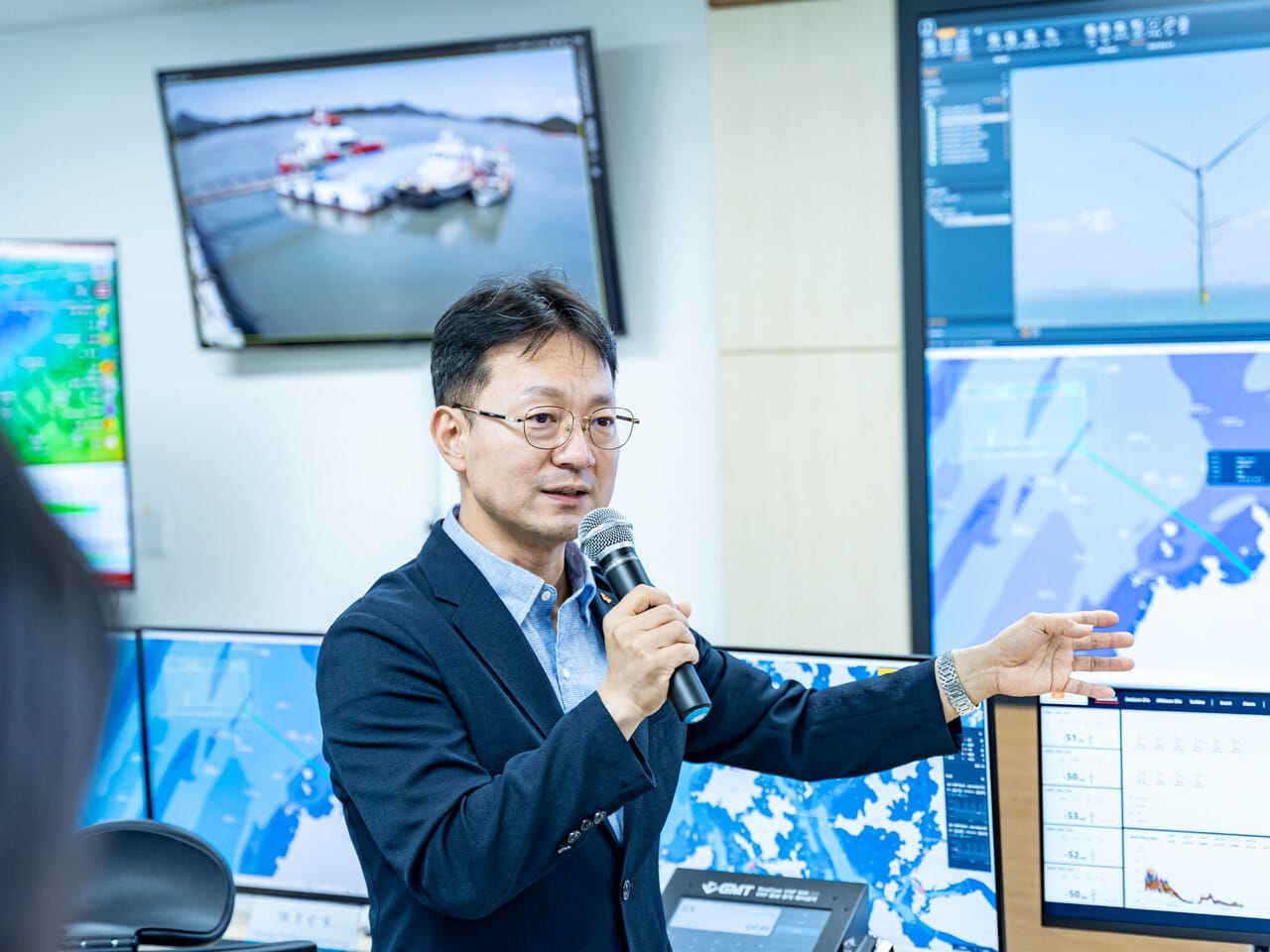
Experience gained during construction has carried over to operations and maintenance following commercial operation. At the onshore operations and maintenance center at nearby Saenggkim Port, about thirty personnel monitor generation output, wind speed and direction, voltage, turbine status, and weather conditions in real time through a SCADA system. Accumulated data and maintenance experience are used to identify anomalies and maintenance timing and improve operational efficiency.
Experience accumulated at Phase 1 is expanding to subsequent projects. Jeonnam P1 - SK E&S is developing Phase 2 and Phase 3, each with 400 megawatt capacity, nearby. After completing environmental impact assessment coordination in August, the company is preparing to participate in fixed-price contract competitive bidding in the second half of this year, with a target of construction start in 2028 and commercial operation in 2031.
Phase 2 and Phase 3 will incorporate experience from all stages of Phase 1, from seasonal wind patterns and available offshore working days through seabed survey and design to equipment procurement, installation, and operations and maintenance. When Phase 2 and Phase 3 become operational, a generation facility of nearly 900 megawatts in total will be formed including Phase 1, and the operations and maintenance center's maintenance and monitoring workforce is expected to grow from the current thirty or so to around one hundred.
Sinan County Developing Wind Farming Across Its Islands
Taking Jeonnam P1 - SK E&S Phase 1 as a starting point, gigawatt-scale offshore wind farm plans are already sprouting in the waters off Sinan. Currently, offshore wind projects totaling 11.7 gigawatts, comprising 8.5 gigawatts of fixed-bottom and approximately 3.2 gigawatts of floating capacity, are in development and planning stages. Of these, approximately 3.7 gigawatts are being pursued as an offshore wind integrated zone, and Sinan Ui, a 390 megawatt project, is targeting construction start this year and commercial operation in 2029.
Sinan County views offshore wind as an industrial and income base to counter regional depopulation. Like Jeonnam P1 - SK E&S, which relocated its corporate headquarters to Sinan following commercial operation, Sinan Ui has also committed to relocating its corporate headquarters. Large-scale equipment assembly and loading will use Mokpo New Port, but the operations and maintenance hub and workforce recruitment needed for decades after commercial operation will be based in Sinan. The county plans to establish maintenance hubs in the northern, central, and southwestern regions and build professional training infrastructure in line with 2029 to 2031, when large-scale facilities begin full operation.
Lee Jung-soo, director of Sinan County's New and Renewable Energy Division, said, "When construction begins, personnel and equipment move, and after commercial operation, maintenance personnel remain continuously. It is not enough to simply build centers; offshore wind can take root as a regional industry only if we also build the foundation to cultivate professional personnel."
The benefits flowing to residents are also growing. Since 2018, Sinan County has operated a structure allowing residents to participate in power generation projects and share profits through cooperatives and bonds under an ordinance on sharing development benefits from renewable energy. From the first quarter of 2021 through the second quarter of this year, approximately 45.9 billion won in profit-sharing payments have been distributed, benefiting about 48 percent of the county population, or roughly 20,000 people. In particular, with the operation of Jeonnam P1 - SK E&S, the expanded revenue source known as "wind pension" generated approximately 5.5 billion won over one year through the second quarter of this year.
Preconditions for Regional Industry to Take Root: Shared Grid Connection Facility Must Be Designated as National Power Grid
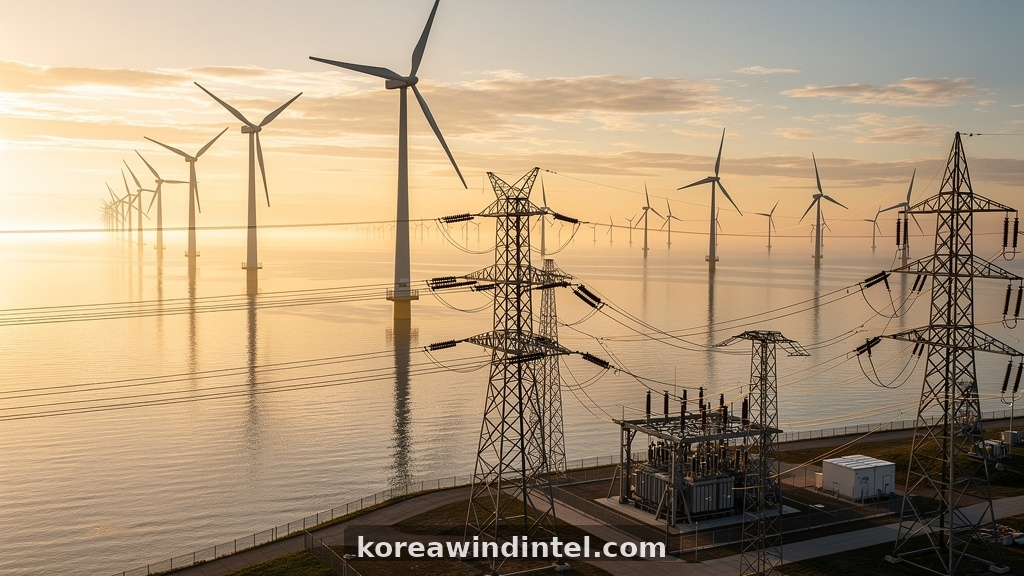
While facility development is accelerating, the power grid and support systems to transmit electricity are not keeping pace. Of the eleven generation facilities included in the Sinan offshore wind integrated zone, nine facilities, approximately 3.0 gigawatts, must transmit power produced through shared grid connection facilities to the mainland.
Power travels from Imja Island along a 345 kilovolt transmission line approximately 87 kilometers to Sinjang Substation. The line passes through five cities and counties: Sinan, Muan, Hampyeong, Yeonggwang, and Jangseong. The total project cost for constructing the shared grid connection facility is approximately 1.2 trillion won, comprising 780 billion won for transmission lines and 420 billion won for shared grid connection buses.
Rather than having multiple generation facilities individually construct transmission lines, a single shared facility was chosen, but as the large-scale line passes through multiple regions, another community acceptance issue has emerged. Residents in affected areas are raising objections, asking why they should bear the burden of transmitting electricity produced in Sinan.
If grid construction is delayed, there is a possibility that completed facilities will be unable to transmit generated power in a timely manner. How quickly a transmission network to accommodate generation facilities is secured will determine the overall project schedule.
To resolve this, Sinan County is requesting that the Imja shared grid connection facility and onshore transmission network be included in the national power grid under the Special Act on the Expansion of the National Power Grid. Under the current situation where this has not been reflected, support of 2 billion won per kilometer for residents in affected areas cannot be applied, and the county argues that securing community acceptance is expected to face difficulties.
Director Lee said, "If reflected as a national power grid, support funds can be used to pursue resident wishes, income and welfare projects in the five cities and counties spanning the 87-kilometer affected area. A structure must be created where sufficient compensation and benefits reach residents in affected areas so that community acceptance for the entire project can be secured."
There are also criticisms that community participation and surrounding area support standards do not match offshore wind reality. Under current guidelines, offshore wind facilities of 100 megawatts or more target residents of cities, counties, or districts that include mainland coastlines or islands within a 10-kilometer radius of each turbine. However, in Sinan, where islands are widely scattered and generation facilities are located in distant waters, residents of Sinan may be excluded from participation if the facility is in Sinan waters but exceeds the distance threshold.
In the case of Haesong 3 offshore wind, the facility is more than 10 kilometers from Tae Island in Heuksanmyeon, Sinan County, and the transmission line landing point is in Haenam, so under current standards, Sinan residents could be excluded from project participation. The county is requesting that the community participation distance threshold be expanded to at least 15 kilometers and that the administrative jurisdiction where the generation facility is actually located also be considered.
Surrounding area support funds face similar issues. Under current regulations, support is differentiated according to the area-weighted average distance between the power plant and the nearest coast, with 100 percent applied within 16 kilometers, 64 percent for 20 to 25 kilometers, and 44 percent for 25 to 30 kilometers. Sinan Ui, with an average distance calculated at 23 kilometers, is estimated to receive approximately 7.89 billion won less in support compared to 100 percent payment. Sinan County is requesting that the standard be relaxed to provide full support funds within 30 kilometers, considering the locational characteristics of offshore wind.
Director Lee said, "What is the use of building generation facilities without even having connection equipment? Power is generated in Sinan, but due to distance standards, the benefits go to other regions. This unreasonable aspect also needs to be improved to match offshore wind reality."
KWI developer profile — SK E&S
2 projects in Korea totalling 798 MW. Compiled from the KWI database. Not part of the source article.
Jeonnam P3 - SK E&S Offshore Wind
| SK E&S |
Jeonnam P2 - SK E&S Offshore Wind
| SK E&S |
Project data: KWI database — Electricity Business Licence records, EIA filings (ME2024C017, ME2024C018), Electricity Regulatory Commission minutes, and pre-EBL permit filings.
Original Korean article: Electric Times
English brief by Korea Wind Intelligence, koreawindintel.com