

A policy forum was held to explore ways to promote regional RE100 using Jeju's offshore wind power and to advance toward building RE100 ports.
The Jeju Provincial Council's Future Economy and Industry Committee, along with the Climate and Resource Justice Center Arc, Pacific Environment, the Energy Transition Forum, and the Energy Citizens Alliance, held a policy discussion on October 8 at the Jeju Provincial Council's main conference hall. They proposed building Jeju's wind power operations and maintenance (O&M) support cluster, a commitment of the Jeju provincial government, as an RE100 facility. The announcement was made on October 14.
The keynote presentations began with So Yun-mi, policy director of the Energy Transition Forum, discussing "domestic and international trends and cases related to RE100 promotion in ports and port facilities." This was followed by a presentation from Dr. Gwak Sung-jo of the Korea Institute of Energy Research on "overseas O&M ports and domestic offshore wind support port cases."
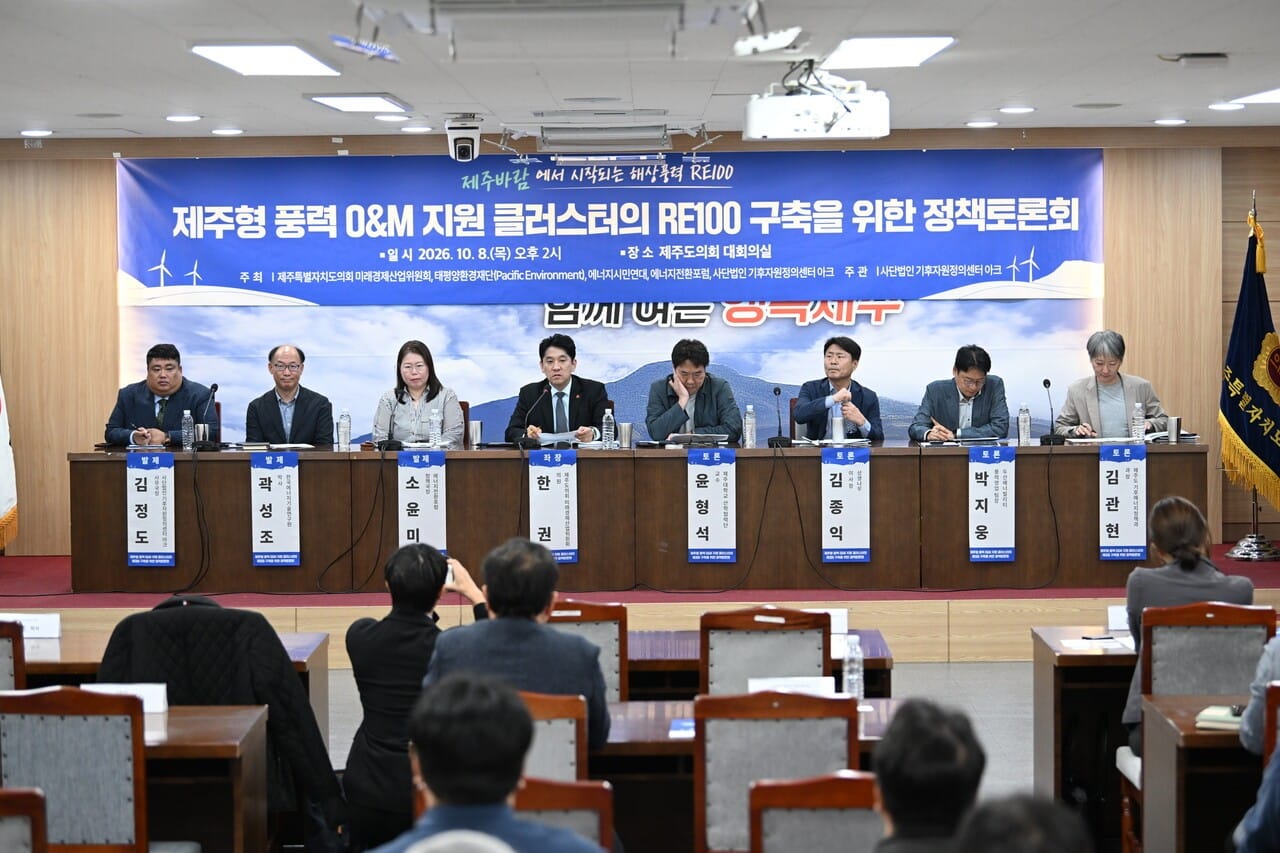
Finally, Kim Jeong-do, secretary general of the Climate and Resource Justice Center Arc, presented on "linking the Jeju-type RE100 offshore wind O&M support cluster construction to the commitments of the ninth-term Jeju provincial government."
Jeju ports as strategic renewable energy hubs
So Yun-mi, policy director of the Energy Transition Forum, argued that Jeju ports should be designed as strategic demand centers for renewable energy and as hubs for grid flexibility. She diagnosed that Jeju needs storage and demand resources to absorb surplus power from frequent output curtailment, and that it is emerging as a new power demand center due to the increase in large international vessels calling at the port.

















