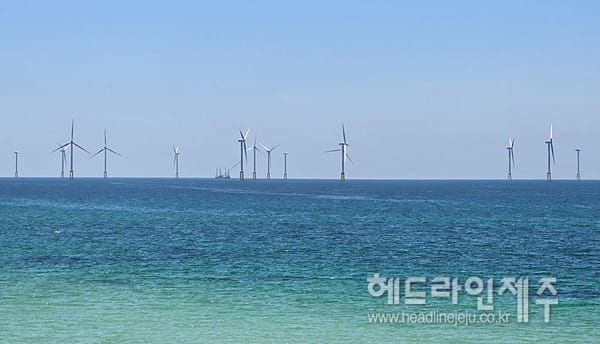
The revenue-sharing method of Jeju's Hanlim offshore wind project, which had been presented as a model case of community participation, has become embroiled in controversy over alleged legal violations.
According to Jeju Special Self-Governing Province and other sources, KEA (Korea Energy Agency) recently received legal opinions from three law firms regarding Hanlim's profit-sharing method, and all three concluded that it is unlawful.
Hanlim is a special purpose vehicle in which KEPCO (Korea Electric Power Corporation) and KOMIPO (Korea Midland Power) are investing.
Local residents borrowed 30 billion won at low interest rates through policy funds and then invested in the company's corporate bonds under the Renewable Energy Development, Use and Supply Promotion Act, receiving profits in the form of 7 percent annual interest.
The REC multiplier dispute
Hanlim receives REC multiplier incentives based on electricity sales from wind power generation, and it receives additional weighting on these incentives due to community participation.
However, Article 27-2, Section 3 of the same law stipulates that when residents participate in renewable energy development projects, the developer can receive an additional REC multiplier, and the revenue generated from this must be provided to local residents. REC stands for renewable energy certificate, which certifies that electricity was produced from renewable sources. Developers can sell these certificates or gain additional revenue under related schemes.
The law firms interpreted this provision to mean that the REC multiplier incentive should provide to residents the additional revenue generated by community participation, not that the money should be used as a source for paying corporate bond interest. They concluded that paying corporate bond interest carries legal risk.
Jeju's response and next steps
With these legal opinions now public, Jeju is in a state of confusion. The province had presented this project as a model case for offshore wind development, but the community profit-sharing method is now caught up in legal controversy.
A Jeju official said: "Hanlim and residents signed an agreement for community participation, and the agreement was concluded after review by financial institutions and law firms at the time. We are discussing response measures with Hanlim."
Hanlim is conducting internal legal review of the matter and is also in discussion with power authorities.
This controversy is expected to make a revision of the community participation and profit-sharing method for offshore wind power generation inevitable.
Original Korean article: Headline Jeju
English brief by Korea Wind Intelligence, koreawindintel.com
KWI project profile — Hanlim Offshore WindCompiled from the KWI database. Not part of the source article.
|  |
Project data: KWI database — EBL records, and Electricity Regulatory Commission minutes.