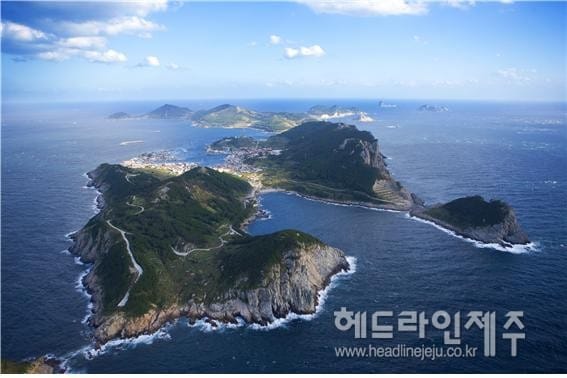
Last Friday, an unexpected remark emerged during a regular session of the Jeju Provincial Council. It came while questioning follow-up measures for the failed Chuja-do offshore wind power project procurement. The question asked how the cause of the procurement failure was being analyzed and how the system would be improved going forward. Governor Wi Seong-gon, who answered, cited the sharing of benefits with residents and the power grid connection issue as the biggest causes of the failure. He pointed out that the condition requiring annual benefit-sharing of more than 130 billion won and the design for grid connection to Jeju's main island had become obstacles, and stated he would address these two conditions.
However, this analysis diverges completely from the diagnosis that civil society has been directly raising about the project's problems. For the governor's diagnosis to gain credibility, it must at minimum be confirmed what Korea Midland Power (KOMIPO), the only bidding participant at the time, actually decided. KOMIPO participated in the first stage of procurement while agreeing to the procurement conditions of benefit-sharing of more than 130 billion won and grid connection to Jeju's main island. Yet when it came to the second stage document submission phase, it suddenly withdrew its participation.
Not a single procurement condition changed between stage one and stage two. Moreover, it was confirmed that in November 2025, a meeting was held within KOMIPO to review the economic feasibility of the Chuja-do offshore wind project, and results were produced. Despite media and civil society requesting information disclosure through every available channel, those results were kept strictly confidential. This raised questions about whether external factors other than economic viability were at play, but the matter sank below the surface as time passed.
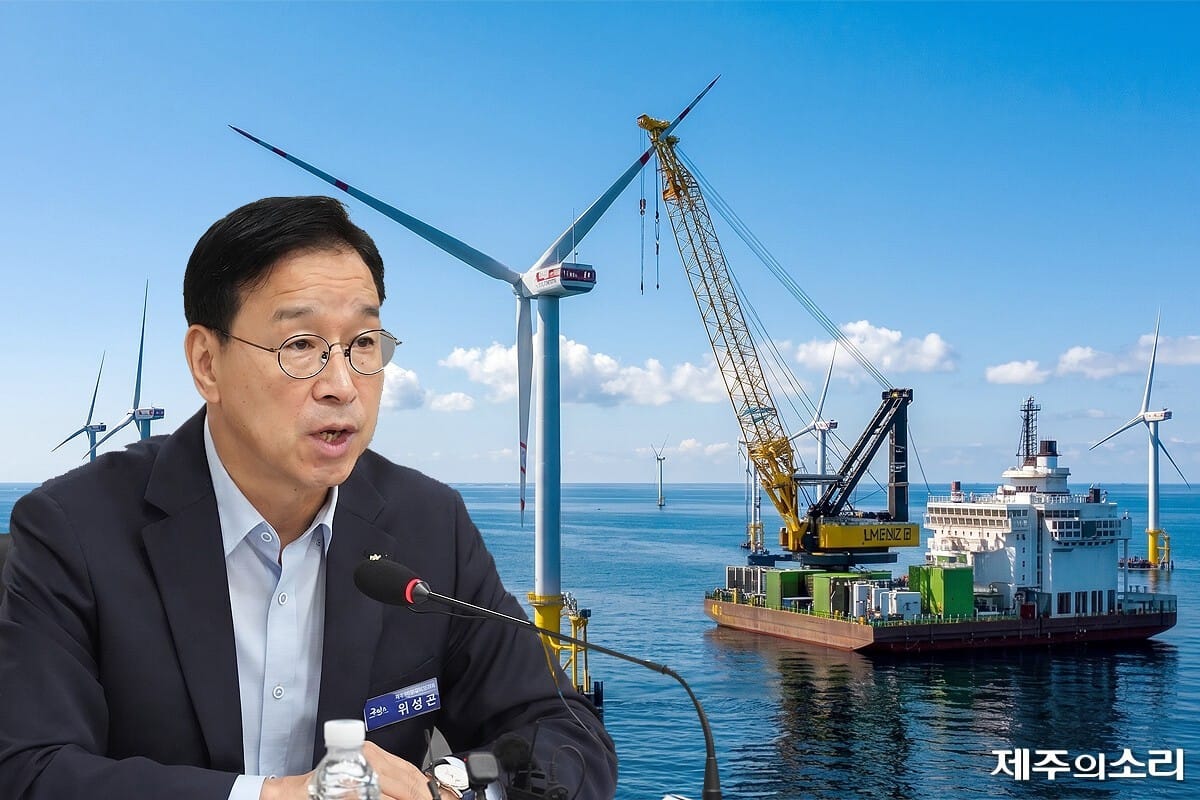
Yet Governor Wi Seong-gon is pinpointing the cause of the procurement failure as the unreasonableness of the procurement terms themselves. Interestingly, there was one entity raising problems using exactly this same logic: Equinor, which stood at the center of the Chuja-do offshore wind development controversy. Regarding Equinor's decision to object to the procurement conditions and not participate at all, civil society at the time evaluated it as a fortunate outcome that prevented the outflow of Jeju offshore wind benefits and blocked the retreat of public wind policy. This reflected the fact that the project itself, driven by Equinor, had already accumulated enormous conflict and problems.
In a situation where KOMIPO's clear internal reasons for abandoning the project have not been disclosed, it is truly bewildering that the governor has stepped forward to offer the same diagnosis as the private developer that had sparked conflict. For civil society that has long tracked and protested this issue, this statement is simply unacceptable. Particularly concerning is what this statement implies in terms of the fundamental principle of public-led wind power development.
Wind as a Public Resource
Jeju's wind is a public resource of the residents, and the obligation to manage it publicly is stipulated in the Jeju Special Law. The wind resource sharing fund was established precisely to fulfill the intent of this special law, so that profits generated from the use of natural resources are enjoyed by Jeju society as a whole. The core purpose of the fund as specified in the ordinance is to use wind development profits for promoting renewable energy distribution, achieving regional energy independence, and advancing energy welfare for residents.
Of course, there are areas for improvement in fund management. The passive payment of contributions by private power companies and public enterprises, low execution rates in the energy welfare sector, and the practice of redirecting projects that the general budget should handle toward the fund have all been consistently pointed out. Reasonable alternatives have also been proposed, such as actively investing the fund in energy efficiency projects like home improvement and conducting surveys on the actual conditions of energy-poor households.
While such institutional improvements may be necessary, it is problematic for the governor to advance logic aimed at neutralizing the fund itself. Governor Wi Seong-gon is proposing direct investment in projects through resident procurement instead of the fund. But how can dividend returns from direct investment be viewed as the social return of benefits from utilizing shared resources?
Profit distribution through investment is a benefit that accrues only to specific individuals or regions that provided capital. Jeju's wind is not the exclusive property of a particular village but a resource of all residents. The framework of this system is to grant business rights with the character of a patent to natural resources and return a portion of those profits evenly to Jeju society as a whole. Remarks that shake this framework and neutralize the fundamental premise of public management of wind resources can only be explained as a farce born from insufficient understanding of the historical context of Jeju's wind resource sharing.
The Path Forward
What the provincial government now needs is not to shake the foundation of the sharing fund but to make it work properly. It must reflect from the ground up on why the Chuja-do offshore wind power project was engulfed in severe controversy from the start, and why civil society strongly criticized and demanded the abolition of the revised public-led wind development plan. Why did the previous public-led wind development 2.0 plan discussion meeting result in disruption, and why did civil society strongly resist? If the plan is forcibly changed based on superficial diagnosis, it will repeat the mistake of facing rough waves again.
The necessary conditions for offshore wind to achieve genuine success are publicness and public interest. If these are lost and the logic of capital and development alone hold sway, that path can only be thorny. Even the United Nations Environment Programme warns that achieving the 1.5 degree target is in jeopardy and that only extreme effort can maintain the 1.8 degree line. We absolutely do not wish for renewable energy distribution to be delayed in overcoming the climate crisis.
However, we are concerned precisely because we have had the painful experience that projects not grounded in publicness inevitably generate social conflict and ultimately delay the pace of energy transition. What is needed now is responsible leadership from the provincial government that deeply internalizes this experience and boldly leads a just renewable energy transition. We hope that Jeju will advance on the correct path of public wind policy through deep deliberation rather than hasty judgment.
Original Korean article: JejuSori
English brief by Korea Wind Intelligence, koreawindintel.com