

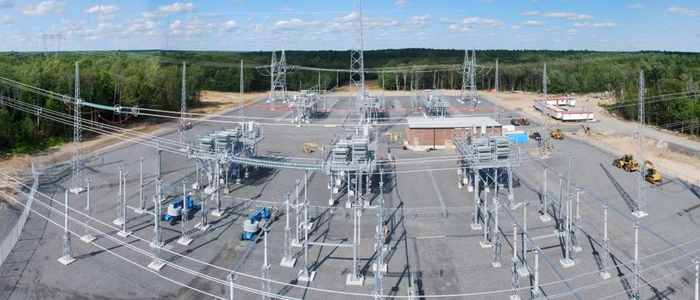
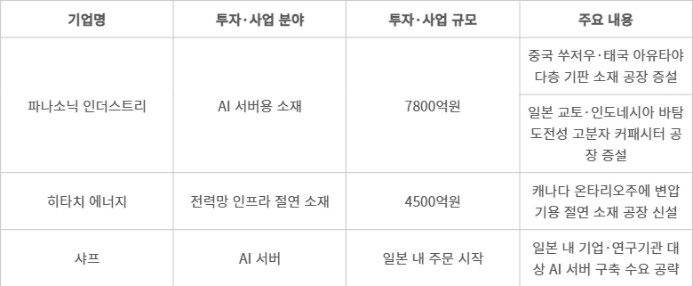
Japanese electronics companies that once led the global home appliance market are shifting their businesses toward artificial intelligence (AI). They are accelerating efforts to enter the hardware supply chain market for materials, components and servers essential to building AI infrastructure. As their prominence as home appliance manufacturers fades, they are restructuring their businesses to prepare for renewed growth. Panasonic Industry is investing a total of 92 billion yen (approximately 780 billion won) in expanding production capacity for AI data center materials and electronic components. It is concentrating 67 billion yen, equivalent to 73% of the new investment, on expanding production of multilayer circuit board materials. These materials are essential to high-speed communications in AI servers. Panasonic is expanding its supply chain for multilayer circuit board materials by enlarging plants in Suzhou, China, and Ayutthaya, Thailand. It is also investing 17 billion yen in expanding plants in Kyoto, Japan, and Batam, Indonesia, to meet demand for conductive polymer capacitors, which provide a stable current in AI server power circuits. Hitachi Energy is investing 479 million Canadian dollars (450 billion won) to build a transformer insulation materials plant in Ontario, Canada, to address power supply bottlenecks resulting from the rapid increase in AI data centers. The investment will establish Hitachi Energy's first transformer insulation materials production infrastructure in North America to meet local demand. Hitachi plans to complete the Canadian plant in 2028 to improve the stability of North America's power infrastructure supply chain.
Sharp, which was acquired by Taiwan's Foxconn, has entered the AI server market. Sharp has begun taking orders in Japan for enterprise AI servers equipped with Nvidia's Blackwell graphics processing units (GPUs). It plans to expand its lineup with servers based on next-generation Rubin GPUs, targeting demand from security-conscious Japanese companies and research institutions seeking to build their own AI servers. Japanese companies' global production networks and advanced materials expertise are expected to provide a strong competitive advantage in the contest for AI supply chain leadership. They are strengthening their influence in the business-to-business (B2B) AI hardware market rather than business-to-consumer (B2C) home appliances, where demand is declining.
An electronics industry representative said, “With the home appliance market clearly facing limits to growth, Korean companies also need to expand their portfolios rapidly beyond home appliances and across the AI infrastructure supply chain to strengthen their market position.”
Original Korean article: ETNews
English brief by Korea Wind Intelligence, koreawindintel.com

















