

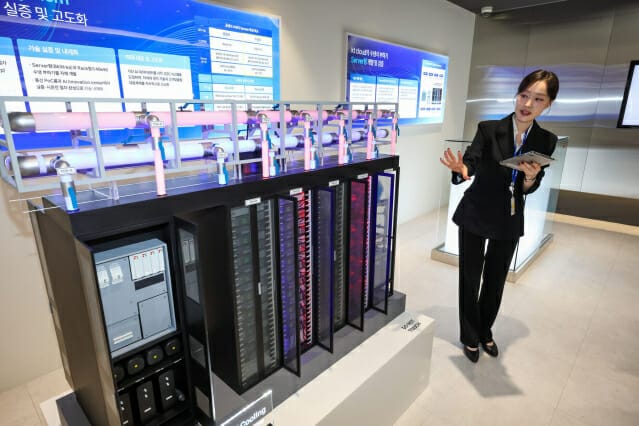
On October 30, at kt cloud's Mokdong 2 Data Center in Yangcheon District, Seoul, entry to the AI Innovation Center's demonstration laboratory required an access card and biometric authentication. Inside were high-performance GPU servers for artificial intelligence computing and liquid-cooling equipment.
Coolant supplied through pipes flowed into cold plates attached directly to server chips to remove heat. An autonomous robot moved between server racks, collecting environmental data such as temperature and humidity. In the same building, an integrated control room monitored power and cooling equipment and network conditions at major data centers in the Seoul metropolitan area in real time.
The AI Innovation Center is a facility for testing core infrastructure technologies, including cooling, power and networking, needed for next-generation AI data centers. One notable feature on site was the range of technologies developed directly by kt cloud. These included equipment for testing GPU server cooling performance, AI-based power control and operations monitoring solutions.
Through the AI Innovation Center, kt cloud is using the experience and data accumulated over 25 years of data center operations to develop technologies. Its strategy is to apply these technologies to new AI data centers and group innovation projects while commercializing them as solutions for external companies.
Liquid cooling for high-density GPUs, tested with in-house equipment
kt cloud has already incorporated direct-to-chip, or D2C, liquid-cooling technology for high-density AI servers into commercial services. It provides D2C liquid-cooling services to a global hyperscaler customer at its Gasan AI data center.
D2C removes heat by attaching cold plates directly to GPU chips and passing coolant through them. Coolant supplied by a coolant distribution unit, or CDU, circulates through manifolds to cold plates inside the servers. The company said the method offers greater cooling efficiency than conventional air cooling and can reduce cooling power consumption by 20 to 30%.
kt cloud handles cooling system design, flow analysis and performance verification itself. It checks coolant flow rates, pressure and temperature and identifies potential risks, including leaks, corrosion and foreign matter, in advance, incorporating the findings into new AI data center designs. It has also separately tested immersion cooling, which removes heat by submerging servers in an electrically insulating coolant.
In particular, it developed its own water-cooled load banks to verify cooling system performance. The equipment reproduces heat generation and cooling conditions similar to those of actual servers without requiring expensive GPU servers for testing.
The server-type load bank takes the heat generation characteristics of Nvidia B200 servers into account, producing a thermal load of 8 kW per unit and up to 64 kW in a 42U server rack. The rack-type load bank reproduces thermal loads of up to around 140 kW for ultra-high-density server racks in the GB200 NVL72 class.
The internally developed load banks do more than generate heat: they also account for the cooling characteristics of actual GPU servers. By reproducing similar operating conditions, including coolant flow rates, pressure and temperature, they allow cooling system stability to be verified before actual servers are installed.
Lee Won-min, a kt cloud manager involved in the development, said, "It is easy to make a device that simply generates heat and cools it down." Lee explained that the internally developed load banks were designed with the characteristics and cooling conditions of actual GPU servers in mind.
kt cloud has also completed load tests using its own equipment against the actual operating requirements of global customers. It plans to use the verification capabilities gained through this process to design and build new AI data centers for next-generation GPUs.
Monitoring solutions developed by operations staff use accumulated data to predict failures
Internal staff also developed the operations software themselves. Key examples include Path Finder, which analyzes power equipment in real time to identify recovery paths when failures occur, and DIMS Insight, which uses AI to analyze equipment data and predict anomalies and faults.
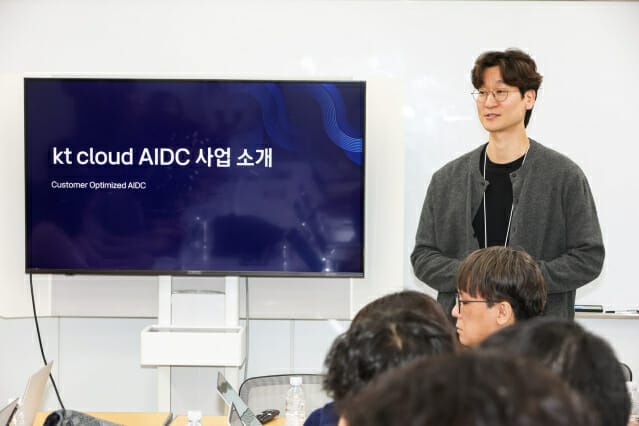
Bang Jae-won, head of kt cloud's AI Data Center Business Development Team, said, "We developed solutions such as DIMS ourselves. They were developed directly by the people who operate the facilities, rather than purchased from outside suppliers."
This in-house development is based on operating data accumulated over many years. The company stores data from normal operations, equipment anomalies, failures and recovery processes in its DIMS operations platform and analyzes it with AI to identify potential faults and points requiring preventive maintenance.
It is also expanding the scope of data collection during on-site inspections. After testing server room inspections and robot monitoring technology using autonomous mobile robots, or AMRs, in 2025, it is pursuing a second phase of testing in 2026 using Boston Dynamics' Spot quadruped robot.
The company plans to further develop the technology by linking environmental information collected by robots, including temperature, humidity and thermal images, with the operations platform for analysis.
kt cloud aims to develop these operating technologies into solutions offered not only at its own data centers but also to external customers. The approach is to use AI to analyze the experience and data accumulated by operations staff and provide them as standardized services.
Seoul's first data center with seismic isolation, according to kt cloud, informs plans for 1 GW of new capacity
kt cloud's operating experience is also reflected in building design and major equipment.
The company said Mokdong 2 was the first data center in Seoul to adopt seismic isolation. It installed 84 seismic isolation devices at the building's intermediate level between the second and third floors to reduce shaking transmitted to the upper structure during an earthquake. Major power and cooling equipment is located above them on the third floor.
The power supply system also has redundancy. The facility receives electricity from different substations, and its power receiving and distribution rooms are physically separated. If the external power supply is interrupted, 12 emergency generators operate and can supply power for around 48 hours at the current load.
The company also draws on this operating experience when designing new AI data centers. Data center operations staff directly conduct computational fluid dynamics, or CFD, analysis to verify airflow and temperature distribution in server rooms. The company said it had also shortened the analysis period by around 30% compared with its previous process.
Growing demand for AI infrastructure is behind kt cloud's efforts to accelerate in-house technology development and new construction. Most of the capacity at its approximately 152 MW of operating data centers has been sold, making it difficult to accommodate additional large GPU customers.
It therefore plans to secure more than 1 gigawatt, or GW, of additional data center capacity by 2031, separate from its existing facilities. Starting with Bucheon in 2027, it is pursuing new AI data center projects in locations including Gunsan, Cheongna and Ansan.
New data centers will have reinforced floor-load specifications and power and cooling designs to accommodate high-density GPU servers. The company is jointly researching power infrastructure for modular data centers with LS ELECTRIC and working with Vertiv to optimize the design of power, liquid-cooling and modular infrastructure.
Park Jae-woo, who oversees kt cloud's data center business, said the company would expand data centers based on actual demand in line with KT Group's gigawatt supply target and respond as fully as possible to the pace and volume of supply required by the market.
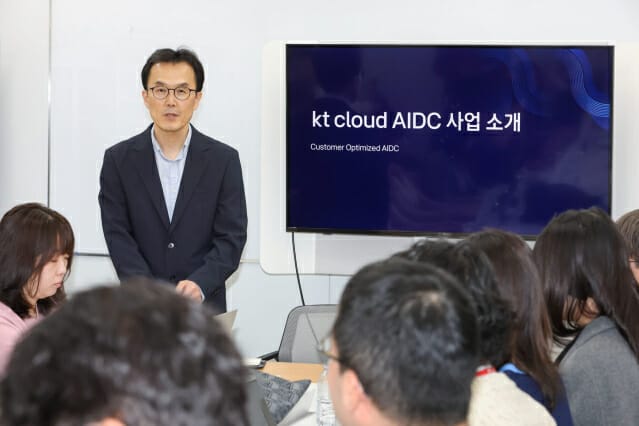
Bang said, "We believe we can turn diverse operating experience into data, analyze it and organize it with AI into a product, then offer it as a service to other customers seeking to build and operate data centers."
Original Korean article: ZDNet Korea
English brief by Korea Wind Intelligence, koreawindintel.com

















