Original Korean article: Incheon Today
English brief by Korea Wind Intelligence, koreawindintel.com
The waters off Incheon, identified as a key hub for carbon neutrality and the transition to renewable energy, have become a major testing ground. Large-scale offshore wind power projects with a total installed capacity exceeding 7 gigawatts are being pursued. However, conflicts and limitations emerging in the implementation process have exceeded dangerous levels, contrary to the momentum on the ground. Incheon Today will examine the key issues in Incheon's offshore wind power initiative and seek alternatives for coexistence between renewable energy transition and local communities.
Two representative Incheon offshore wind projects, Ørsted and Gulup Wind Development, have both lost their resident and fishery worker councils. Both projects share a common point: they have repeatedly faced criticism for "insufficient community acceptance" since receiving government approval. Now that the councils have collapsed, concerns are emerging that the projects' very rationale is being shaken.
Approval granted despite lack of community acceptance: warnings repeated for five years
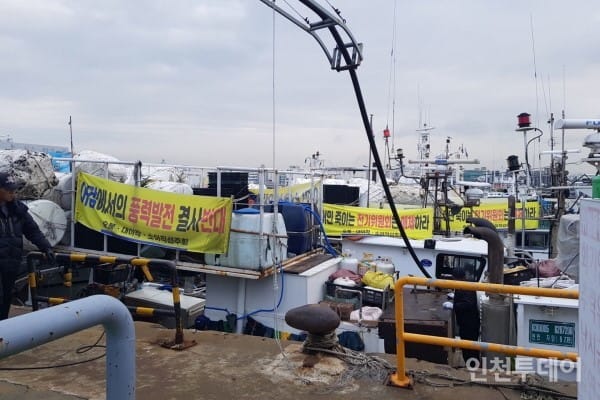
Both projects faced noise from the outset of government review. In October 2018, C&I Leisure Industries, the parent company of Gulup Wind Development, installed a wind measurement device on Gulup-do (onshore), but the Energy Technology Research Institute pointed out that the onshore standard (2 kilometers) should be applied rather than the offshore standard (5 kilometers radius). Despite these controversies and opposition from fishery workers and residents, the Ministry of Trade, Industry and Energy issued an Electricity Business License in September 2020, which was transferred to the subsidiary Gulup Wind Development through a physical split in December 2021.
At the time, Incheon Today reported that numerous procedural violations were found among the developers and that approvals were issued successively despite the failure to secure community acceptance. The government's subsequent establishment of Public-Private Councils for public-led projects under the "Guidelines for Creating and Supporting Renewable Energy Integrated Zones" (November 2020) and regional councils for private-led projects under the "Offshore Wind Power Development Guide with Residents and Fishery Workers" (April 2023) came later. Approvals had already been issued during a period when there was no formal system to assess acceptance.
Ørsted followed a similar path. It received its initial wind measurement device approval from Ongjin County in November 2019 and applied for an Electricity Business License to the Ministry in November 2021. However, the 274th Electricity Regulatory Commission meeting held in December 2022 deferred the review, stating that efforts to increase regional acceptance were necessary.