

Samsung Heavy Industries is not the only leading Korean shipbuilder interested in commercializing floating data centers. Hanwha Ocean and HD Korea Shipbuilding & Offshore Engineering have also launched projects, each with a different strategy, to establish an early position in the floating data center market.
Only one floating data center (FDC) has entered commercial operation worldwide. The 6.5 MW FDC operated by Nautilus at the Port of Stockton in California, United States, has been operating since 2021.
However, some consider Nautilus's FDC too small to be regarded as the original model for the sector. Samsung Heavy Industries, Hanwha Ocean and HD Korea Shipbuilding & Offshore Engineering are developing much larger FDCs in the 50 to 60 MW range and are expected to gain an early advantage in the global market if commercialization succeeds.
Hanwha Ocean combines group energy and data technologies to strengthen competitiveness
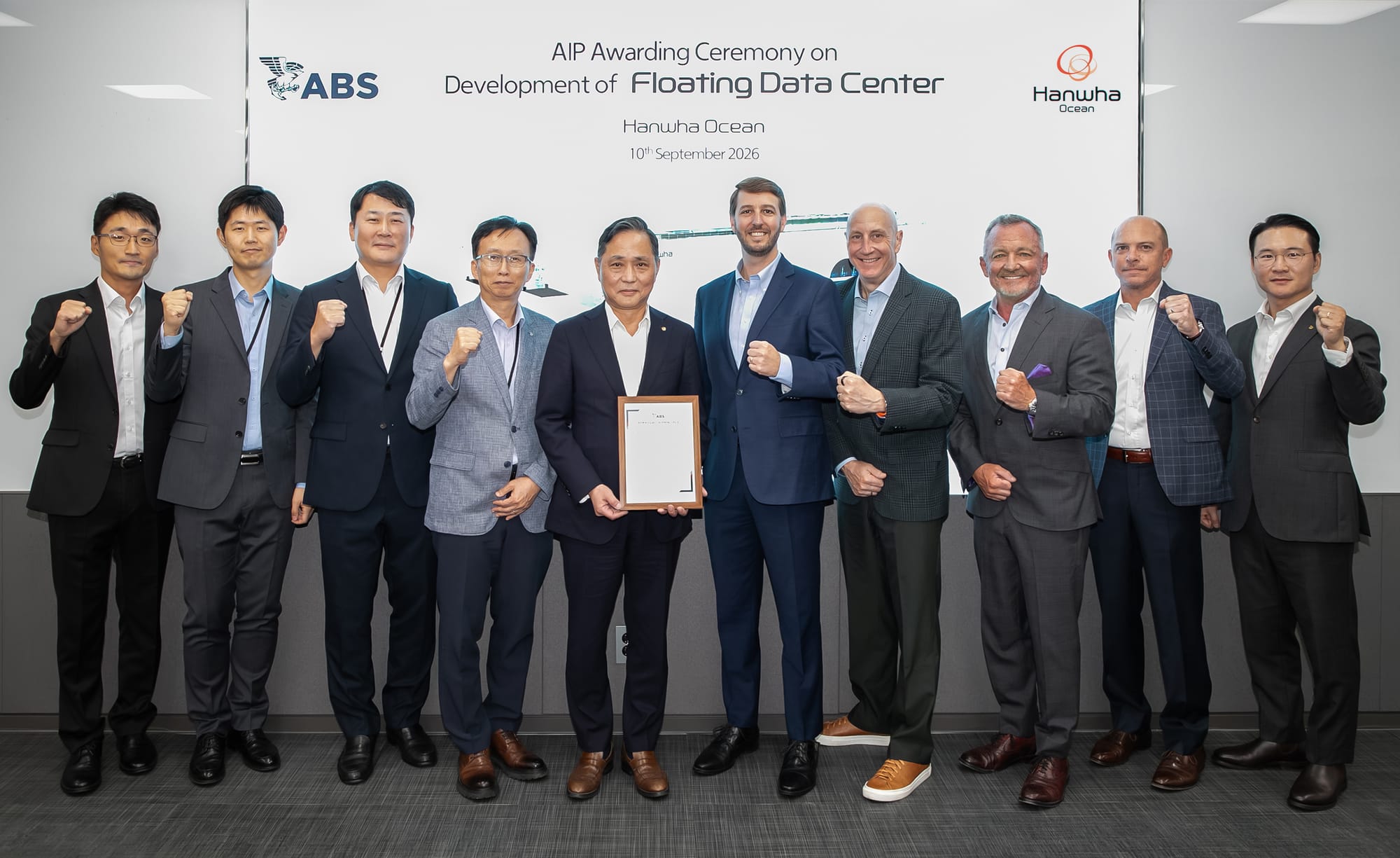
In September 2026, Hanwha Ocean first unveiled its 60 MW FDC at Gastech 2026, one of the world's largest energy exhibitions. It developed the facility to address rapidly increasing demand for data centers in the artificial intelligence (AI) era.
The company cited constraints on new land-based data center construction as the reason for the development. Although global data center demand is increasing rapidly with the recent explosive growth of the AI industry, existing land-based facilities face problems including enormous electricity requirements, difficulty securing sites, cooling efficiency and complaints from local residents.
A Hanwha Ocean representative said: “That was the first time we presented a physical model of the FDC we are pursuing as a future business to global customers. We are currently proposing FDCs as a new alternative that addresses the limitations of land-based data centers.”
The representative added: “FDCs can generate their own electricity offshore and improve energy efficiency through cooling systems that use seawater. We actively presented the business model and its technological competitiveness to global energy companies, data center developers, major shipowners and other industry representatives.”
According to Hanwha Ocean, its modular design allows flexible configurations of power generation and supply methods, server types and data center capacity according to local conditions and customer requirements. Through this approach, it plans to provide customized FDC solutions optimized for customers' electricity demand, IT infrastructure and installation environments.
A particular strength identified in Hanwha Ocean's FDC is its combination, within a single business model, of Hanwha Group's capabilities in data centers, shipbuilding and offshore engineering, power generation and energy, operations and maintenance (O&M), and security.
By combining its ability to design and build large floating structures with the group's energy and data technologies, Hanwha Ocean is expected to establish a distinctive competitive position in the global FDC market.
Hanwha Ocean also recently obtained Approval in Principle (AiP) from the American Bureau of Shipping (ABS), a global classification society, for its 60 MW FDC concept design, receiving recognition of its technical feasibility.
Son Young-chang, a vice president who heads Hanwha Ocean's product strategy and technology institute, said: “By combining the technological expertise we have accumulated in shipbuilding and offshore engineering with Hanwha Group's energy and data capabilities, we will offer a new solution that addresses the limitations of land-based data centers and lead the global FDC market.”
HD Korea Shipbuilding & Offshore Engineering jointly develops FDCs with Schneider Electric
HD Hyundai Group has chosen a strategy of collaboration with a leading global provider of data center infrastructure solutions.
In July 2026, HD Korea Shipbuilding & Offshore Engineering, the intermediate holding company for HD Hyundai's shipbuilding business, signed a memorandum of understanding with Schneider Electric for the joint development of FDC infrastructure technology.
An HD Korea Shipbuilding & Offshore Engineering representative said: “An FDC, also described as a data center at sea, is a next-generation data center that operates servers on a floating structure offshore. It is regarded as the most suitable alternative for addressing the difficulty of securing land and the enormous server cooling costs associated with conventional land-based data centers.”
Schneider Electric is a global leader in data center power, cooling and energy management. It provides next-generation digital infrastructure solutions based on its experience building hyperscale data centers and AI infrastructure.
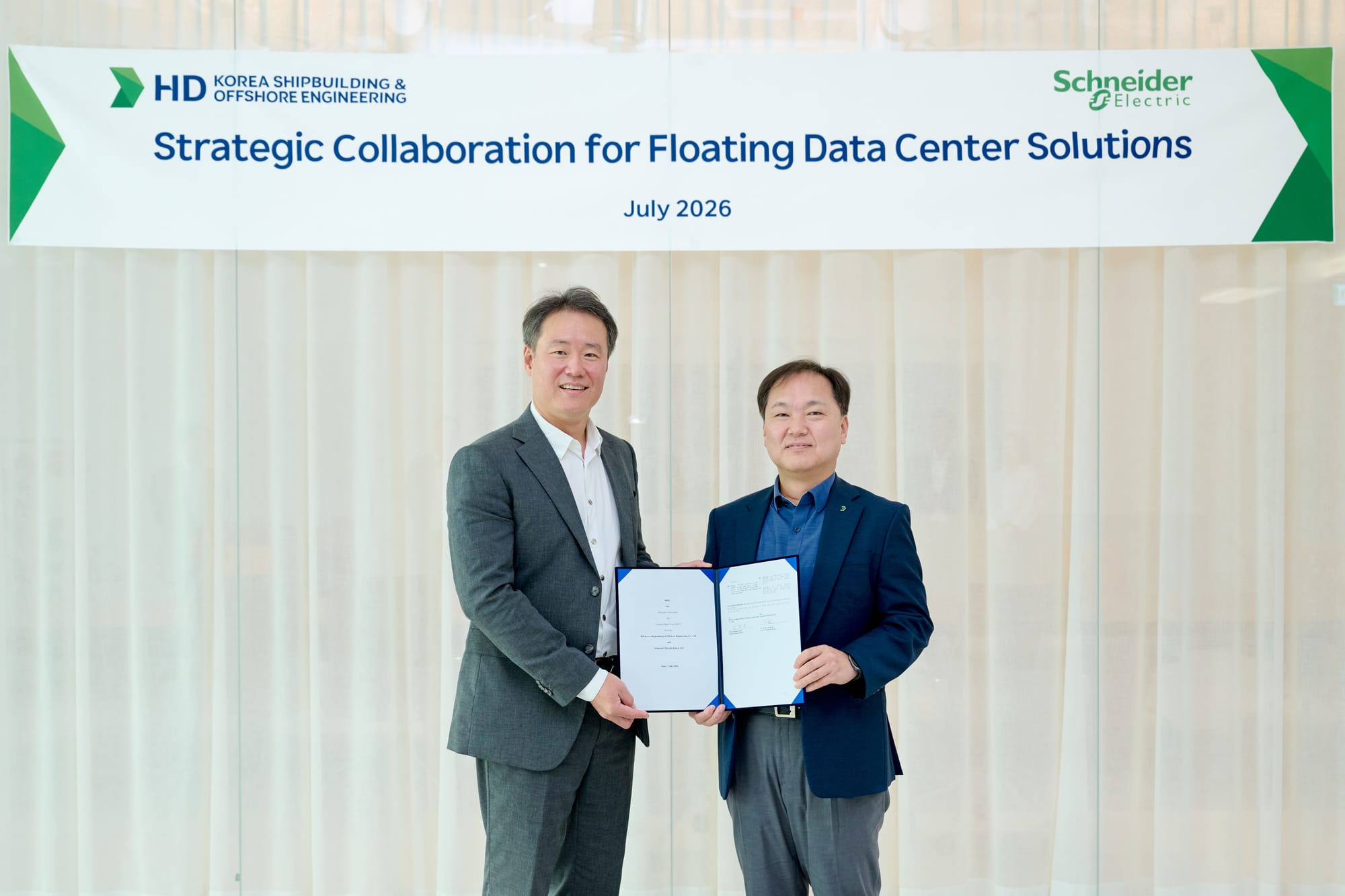
The two companies plan to expand cooperation on core data center infrastructure technologies and the engineering needed to optimize them for offshore environments, with the goal of integrated development of data center infrastructure on offshore platforms.
They plan to review the infrastructure and technical requirements for FDCs and jointly identify optimal infrastructure solutions suited to offshore platform environments. HD Korea Shipbuilding & Offshore Engineering said it aims to establish integrated design capabilities combining data center power and cooling infrastructure with offshore platform technology.
The companies also agreed to regularly share information on the latest FDC technology trends and engineering issues and to expand their partnership by identifying further opportunities for joint research and development.
Kwon Ji-woong, head of Schneider Electric Korea, said: “As AI infrastructure expands, data center power efficiency and sustainability are becoming important challenges.”
Kwon added: “By combining Schneider Electric's global data center technology capabilities with HD Korea Shipbuilding & Offshore Engineering's shipbuilding and offshore engineering expertise, we will establish new standards for next-generation floating data centers.”
Kim Hyung-kwan, head of HD Korea Shipbuilding & Offshore Engineering, said: “We are accelerating the development of offshore data center technology based on the floating structure design and construction capabilities we have accumulated in shipbuilding and offshore engineering. Through collaboration between the two companies, we will advance the core technologies needed to reliably deploy large-scale, high-density computing infrastructure offshore.”
Other FDC projects targeting commercial operation in 2027 to 2028
Global companies are also competing to commercialize FDCs. Large FDCs of at least 20 MW are expected to begin operating on the water as early as 2027.
According to SK Securities, major projects include a 25 MW FDC being built by Singapore's Keppel in Loyang, Singapore; FDCs converted from used vessels, jointly developed by Japan's Mitsui O.S.K. Lines and Hitachi, with undisclosed capacities and locations in Japan, Malaysia and the United States; an integrated FDC platform jointly developed by Mitsui O.S.K. Lines and Türkiye's Karpowership, with a capacity of 20 to 73 MW and a location yet to be determined; and an FDC planned by an NTT Facilities consortium in Yokohama, Japan, with an undisclosed capacity.
Since some of these projects have already begun construction, some analysts suggest Samsung Heavy Industries, Hanwha Ocean and HD Korea Shipbuilding & Offshore Engineering could commercialize their FDCs somewhat later.
Han Seung-han, an analyst at SK Securities, said: “As demand for FDCs from large data center companies has recently expanded, FDC-related stocks are also attracting attention.”
Han added: “Major shipbuilders are expected to gain support for share price increases through a reassessment of their corporate value, based on businesses involving the production, maintenance and repair of engines for AI data centers, newbuild and conversion work for FDCs, and newbuild and conversion work for powerships.”
Original Korean article: ER Economic Review
English brief by Korea Wind Intelligence, koreawindintel.com

















