

Google is pursuing plans to invest $17 billion in its first data center in the US state of Wyoming and develop a large-scale power supply project combining a 702 MW natural gas fuel cell facility with carbon capture and storage (CCS) technology. It plans to capture a substantial share of the carbon dioxide (CO₂) generated during electricity production and store it permanently underground, pursuing both reliable electricity supplies for an AI data center and lower carbon emissions.
In an official announcement on November 5, local time, Google said it would build its first Wyoming data center in Laramie County and work with Tallgrass Energy, Black Hills Energy, American Electric Power (AEP) and Related Digital. AEP previously announced on October 14 that it would invest about $4 billion in a 702 MW power generation project using US-made Bloom Energy fuel cells and had signed a 20-year power purchase agreement with Google.
Google to invest $17 billion in its first Wyoming data center
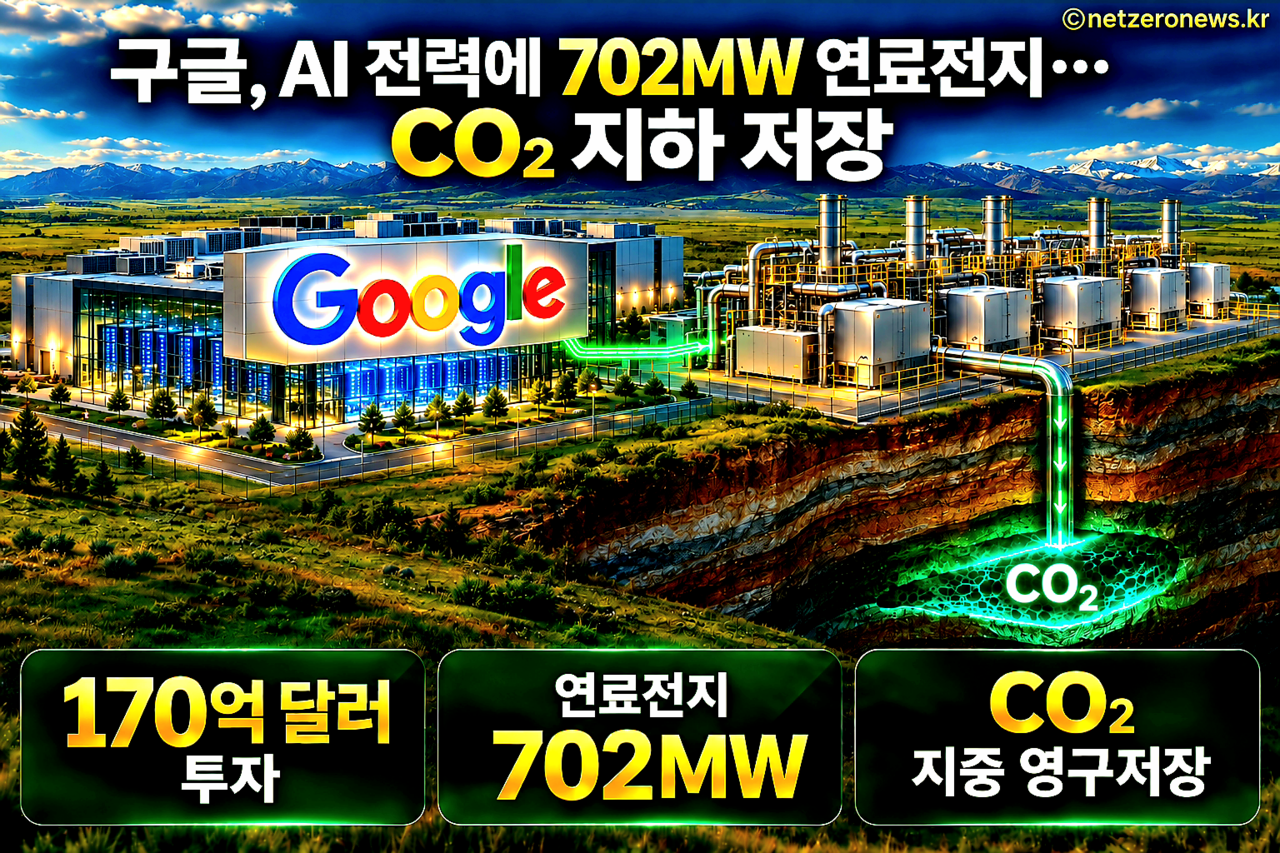
Google has decided to make a long-term investment of $17 billion to build its first Wyoming data center in Laramie County. Tallgrass Energy, Black Hills Energy, AEP and Related Digital are participating in the project.
Alongside data center construction, Google plans to expand electricity infrastructure, support the local economy, and promote education and workforce development. It intends to provide long-term economic benefits to Laramie County residents and businesses and operate the data center in cooperation with the local community.
A 702 MW fuel cell power generation facility will form the core of the electricity supply system. Google has entered into an agreement with AEP to pursue a project combining commercial, large-scale fuel cells with CCS. Google described it as the largest project of its kind planned to date and the first commercial, large-scale project combining fuel cells and CCS.
Fuel cells are power generation equipment that converts the chemical energy of fuel into electrical energy through electrochemical reactions. This project will use US-made Bloom Energy fuel cells fueled by natural gas.
Google said it expected the fuel cells to produce the electricity needed by the data center efficiently while helping reduce carbon emissions and water use during power generation. It plans to combine fuel cells with CCS to supply electricity to the data center while reducing carbon emissions.
AEP plans about $4 billion for fuel cell generation and a 20-year power purchase agreement
AEP has decided to invest about $4 billion to build a 702 MW fuel cell power generation facility near Cheyenne, Wyoming. The facility will use Bloom Energy's fuel cell technology, and Google is expected to receive its electricity over the long term.
Google signed a 20-year power purchase agreement (PPA) with Cheyenne Fuel Cell, the developer on AEP's side. AEP owns and controls about 92% of Cheyenne Fuel Cell, while the remaining approximately 8% is held by funds advised by Basalt Infrastructure Partners.
AEP and its partners plan to begin construction of the power generation facility in 2026 and bring the entire facility into operation by the end of 2028. AEP intends to use Bloom Energy's fuel cell technology to provide reliable electricity to large electricity users and combine it with CCS to reduce carbon emissions during generation.
AEP Chairman and Chief Executive Officer Bill Fehrman said the project would combine new technologies and partnerships to respond to growing electricity demand and quickly provide reliable power to large customers.
Google's $17 billion represents its long-term investment centered on the Wyoming data center, while AEP's approximately $4 billion is its planned investment in constructing the fuel cell power generation facility. The companies have established a business structure under which Google purchases the electricity needed to operate the data center over the long term and AEP develops and operates the generating facility.
Capturing substantial CO₂ for underground storage, with about 1 GW of CCS-linked capacity under contract
The project will use CCS technology to capture CO₂ produced by natural gas fuel cells and store it permanently underground.
Google said it plans to capture a substantial share of the carbon emissions generated by the fuel cells and store them permanently at the nearby Eastern Wyoming Sequestration Hub being developed by Tallgrass Energy.
Geological storage is a technology that injects captured CO₂ into suitable underground geological formations for long-term storage. Google plans to combine fuel cells and CCS to reduce carbon emissions from natural gas power generation and accelerate the commercialization of low-emission generation technologies needed to supply data centers.
Google described the project as a follow-up to its first CCS project in the United States, announced in the fall of 2025. Including this agreement, Google's contracted capacity for CCS-linked power generation facilities reaches about 1 GW.
Google said it expected CCS technology to capture and permanently store a 'large majority' of the carbon emissions generated by the fuel cells. The captured CO₂ would be sent to Tallgrass Energy's geological storage facility for permanent sequestration.
The project focuses on combining large-scale fuel cell generation with CCS to supply the electricity needed by data centers and expand the commercialization of carbon capture technology.
Google reviews CCS for combined-cycle gas generation to broaden electricity sources
In addition to the 702 MW fuel cell facility, Google has decided to procure electricity from gas-fired generating facilities operated by Tallgrass Energy and Black Hills Energy.
In particular, technical studies are underway to apply CCS technology to Tallgrass Energy's combined-cycle gas turbines. Google said it is reviewing whether carbon capture equipment can be installed at the combined-cycle generating facility through front-end engineering and design (FEED), a technical study at the preliminary engineering stage.
Combined-cycle power generation recovers heat from the hot exhaust gases produced by a gas turbine to drive an additional steam turbine. Google plans to review the application of CCS technology to these generating facilities as well, broadening the available pathways for reducing carbon emissions associated with natural gas generation.
The electricity supply system combining fuel cells, gas-fired generation and CCS is intended to secure electricity efficiently for the data center and accelerate the commercialization of carbon capture technology. Google said it plans to use this approach to develop new ways of supplying electricity that reduce carbon emissions associated with natural gas generation.
Google to cover 100% of electricity costs and use air cooling at the data center
Google has decided to pay directly for electricity use and infrastructure costs to reduce the burden of data center expansion on the local community.
Google said it would cover 100% of the cost of electricity used by the data center, as well as the costs of infrastructure needs arising directly from its construction and expansion.
This policy places the costs associated with the data center's electricity use on the developer and seeks responsible growth in cooperation with the local community. Google plans to pursue both electricity infrastructure expansion and community cooperation.
The Wyoming data center will use air cooling to reduce water consumption. Air cooling releases heat using air, and Google plans to minimize pressure on local water resources through this approach.

Under its water stewardship commitments to the community, Google has decided to reduce water use in data center operations and invest in local water replenishment projects. It plans to use technologies that reduce water consumption in fuel cell generation and data center cooling while also undertaking local water resource management projects.
Input from more than 200 residents and expected property tax revenue of hundreds of millions of dollars
Google held several consultations with local governments and community stakeholders while pursuing construction of the data center. At a recent community meeting in downtown Cheyenne, it met more than 200 Laramie County residents and gathered views on the economic effects of data center construction and its impact on the community.
Residents expressed interest in the contribution of data center construction to the local economy, employment and vocational training opportunities, and the effects of data center expansion on the Cheyenne community.
Google said it expected the project to generate hundreds of millions of dollars in property tax revenue for Laramie County and School District 1. Separately, it has decided to support K-12 education, workforce development and Wyoming's economy through community investment projects.
Google plans to work with local educational institutions to support science, technology, engineering and mathematics (STEM) education and provide grants to support local entrepreneurs and skilled workforce development. It has already held its first community event at the Cheyenne Children's Museum and plans to announce additional partnerships.
Six companies to form a Community Council to address data center growth
Google, Tallgrass Energy, Black Hills Energy, Related Digital, AEP and Bloom Energy have decided to form a Community Council to address community issues arising as Cheyenne grows.
The council is expected to discuss the effects of data center expansion on the Cheyenne community and develop practical responses to support community development.
Google plans to continue working with the community during data center construction and operation and pursue support programs for education, vocational training and expanded economic opportunities.
Google emphasized that data centers support a range of technologies used across American society, including online banking, digital maps, hospitals and emergency services. It intends to build long-term partnerships with Wyoming residents based on its experience developing data centers over the past 20 years.
Implications for South Korea
Google's Wyoming project is an example of combining fuel cell generation and CCS to meet large-scale electricity demand from AI data centers and establishing an electricity supply system through a long-term power purchase agreement. As South Korea expands AI data centers and its electricity grid, it could also consider technologies and business models linking reliable electricity supplies with greenhouse gas reductions. Google's approach, which jointly addresses responsibility for data center electricity costs, water resource management and community cooperation, could also inform South Korean policy on data center locations and infrastructure.
The article's commentary highlights Google's 702 MW fuel cell and CCS project as a large-scale commercialization example that pursues both electricity supplies for AI data centers and lower carbon emissions from natural gas generation. It argues that South Korea, too, should consider low-carbon generation technologies, responsibility for electricity costs and community cooperation together as it builds electricity supply systems for AI data centers.
Original Korean article: netzeronews.kr
English brief by Korea Wind Intelligence, koreawindintel.com

















