

Election results and voter concerns
US voters backed Democrats in the midterm elections held on November 3, local time. Voters also approved a succession of local ballot measures restricting data center construction, prompting analysis that the results reflected opposition to the expansion of artificial intelligence, or AI, infrastructure associated with rising electricity bills and water shortages. With Democratic gubernatorial candidates who pledged to halt new construction winning in major data center locations including Texas and Georgia, US AI data center construction schedules are expected to face unavoidable disruption.
According to foreign media tallies, Democrats had gained seven Senate seats and 25 House seats as of November 4, with some counting still outstanding, securing control of both chambers. It is the first time in 20 years that Democrats have regained the Senate and House simultaneously. The new Congress convenes on January 3, 2027. President Donald Trump will spend the remaining two years of the presidential term with the opposition controlling Congress.
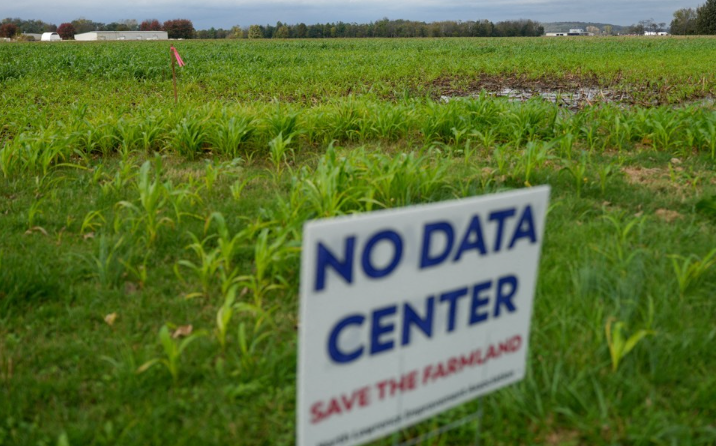
Data centers were among the major election issues. According to a CNBC voter survey, 69% of Democratic supporters identified AI and data centers as a decisive factor in their vote, compared with 29% of Republican supporters.
The explanation is that, despite differences between the parties' supporters, voters viewed data centers as a cost-of-living issue. With gasoline prices rising because of the Iran war and electricity bills also increasing, data centers were identified as a cause of higher utility charges, and voters expressed their dissatisfaction at the polls.
State restrictions and data center construction
Governorships change hands in Texas and Georgia: "No new approvals until legislation is in place." The biggest change came in Texas. Democrat Gina Hinojosa defeated Republican incumbent Greg Abbott to become the state's first Democratic governor in more than 30 years, raising the possibility that data center projects themselves could stop. Throughout the campaign, Governor-elect Hinojosa argued that "new data center approvals should be suspended until the state legislature enacts safeguards for local communities." Hinojosa also pledged to abolish tax incentives for data centers.
Because Texas is a central location for the US data center industry, the consequences are expected to be substantial.
Market research firm SemiAnalysis estimates that Texas accounts for about 30% of the US data center capacity scheduled to begin operating in 2028. Its analysis suggests that even a few months' suspension of Texas permitting could disrupt expansion plans across the United States. Investment advisory firm GLJ Research projected that Hinojosa's election could delay 13 GW of additional data center power capacity in Texas alone.
The possibility of a halt to new construction had already been anticipated. Facing intensifying public opposition ahead of the election, Governor Abbott froze new data center approvals in August 2026.
Abbott instructed the Electric Reliability Council of Texas, or ERCOT, and the Public Utility Commission to audit all projects awaiting grid connections. In September 2026, Abbott expanded the suspension to include related permits issued by the Texas Commission on Environmental Quality, or TCEQ.
The article describes this as a dramatic reversal by a governor who had strongly promoted data center investment but shifted to strong opposition in response to voters. Governor-elect Hinojosa is therefore expected to be able to fulfill the campaign pledge simply by continuing the predecessor's policy. That is why GLJ Research CEO Gordon Johnson said, "With the moratorium created by Governor Abbott already in place, the new governor only needs to maintain it, without having to create a new law."
With new data center construction facing restrictions in Texas, further changes are expected in Georgia, the third-largest US data center market, following the election of Democrat Keisha Lance Bottoms.
It is the first time in 25 years that Democrats have won Georgia's governorship. Appearing on CBS on November 4, Governor-elect Bottoms said, "As soon as I take office, I will sign an executive order halting data center construction." Bottoms also said tax incentive agreements signed to attract data centers would be reviewed. The Georgia Public Service Commission, or PSC, which sets electricity rates, also shifted to a Democratic majority for the first time in 30 years.
Other major locations produced similar results. In Ohio, Amy Acton defeated Vivek Ramaswamy. Governor-elect Acton pledged a "conditional moratorium" requiring data centers to bear 100% of their electricity costs and use only union labor for construction.
In the same state's Senate race, former Senator Sherrod Brown regained a seat with a strategy that portrayed Senator Jon Husted as "the face of data centers." In Wisconsin, David Crowley, who advocated suspending development until a state-level environmental assessment is completed, was elected.
Wisconsin is the location of Project Lighthouse, a 1 GW facility within the Stargate project being pursued by Oracle and OpenAI. By contrast, Republican Byron Donalds, who opposed a data center moratorium, won in Florida.
Voters favor restrictions in 40 of 41 ballot measures; related stocks fall sharply. Local ballot measures showed opposition even more clearly. According to election information website Ballotpedia, 41 data center-related ballot measures were held in 10 states during this election.
Voters backed restrictions everywhere except Harwood, North Dakota. Ohio accounted for 21 measures, more than half the total, and at least 14 municipalities there passed data center bans or restrictions. In Ashville, voters even approved a measure to block a data center complex already under construction.
Markets responded immediately. On November 4, the Dow rose nearly 3% in New York, regaining the 53,000 level on hopes that political uncertainty had eased, but data center-related stocks moved in the opposite direction.
According to Reuters, data center operator Hut 8 plunged 23%, while Core Scientific fell 10%. Power companies Vistra and Constellation Energy, which have substantial exposure to Texas, fell 15.4% and 9.2%, respectively, during trading. Power equipment company GE Vernova also declined 11.5%.
Wall Street appeared to be placing significant weight on the prospect of slower construction. Goldman Sachs said Democratic victories in Texas, Michigan and Georgia could expose about 45% of planned US data center capacity to the risk of construction moratoriums, tighter regulation and reduced tax incentives.
UBS also estimated that about a third of data center capacity scheduled to be added in 2028 could be affected. Analyst Dan Ives said, "The answer to the question of whether this election will slow construction of the 800 to 1,000 data centers planned across the United States is yes."
Elon Musk, who spent heavily on the election, was also directly affected. According to CNBC, Musk donated at least $474 million to the Republican side, including $224 million in Texas, where SpaceX and Tesla are headquartered. SpaceX plans to increase its data center capacity from 1.7 GW at the end of September 2026 to as much as 3 GW by the end of 2026 and 13 GW in 2027. This has prompted concerns that blocked Texas permits could disrupt the company's broader growth plans. Immediately after the election, Musk wrote on X, "Space data centers are looking pretty attractive."
Many observers expect changes at the federal level to be relatively limited. Even if Congress passes legislation directly regulating data centers, President Trump could veto it. Policies implemented through executive authority, such as the 2025 executive order accelerating federal data center permitting, will also remain in place. Instead, Democrats are expected to increase pressure through congressional investigative powers. According to Yonhap News, Democrats on the Senate Finance Committee identified data center taxation as an investigative priority.
However, some analysts say AI infrastructure investment itself will not decline. Stephen Dover, chief market strategist at Franklin Templeton, said, "Given concerns that AI investment and data center construction had become overheated, this result will cool some excessive investment with uncertain profitability," adding, "Indiscriminate expansion will moderate, but there will not be a major contraction." Shares in major cloud companies, known as hyperscalers, actually rose that day. This reflected the assessment that slower new construction could increase the value of data centers already secured and reduce the burden of excessive capital spending.
Implications for South Korea
South Korean semiconductor companies watch closely: "US state regulation is a variable." South Korean companies are also concerned because the pace of US data center expansion is linked to orders for Samsung Electronics and SK hynix, which supply server memory and high-bandwidth memory, or HBM. At a webinar organized by the Korea Financial Investment Association on November 4, Bloomberg Economics analyst Tom Orlik noted, "Most of the data centers planned in the United States from this year through 2028 are in states that held elections this time."
Orlik said, "Construction could slow if the number of Democratic governors increases or Republican governors respond to public opposition," adding, "That could pose a risk to future orders and profitability for the South Korean semiconductor industry."
South Korea cannot avoid the effects either.
In July 2026, the government announced plans to invest 550 trillion won in AI data centers and begin construction of facilities totaling 8.4 GW from the first half of 2028. In the United States, concerns over electricity bills, water and noise accumulated into opposition strong enough to influence election results. This is why calls are growing in South Korea to establish, from the design stage, both the principle that developers bear infrastructure costs and arrangements for compensating local communities.
Original Korean article: ER Economic Review
English brief by Korea Wind Intelligence, koreawindintel.com

















