

Regional data center regulation
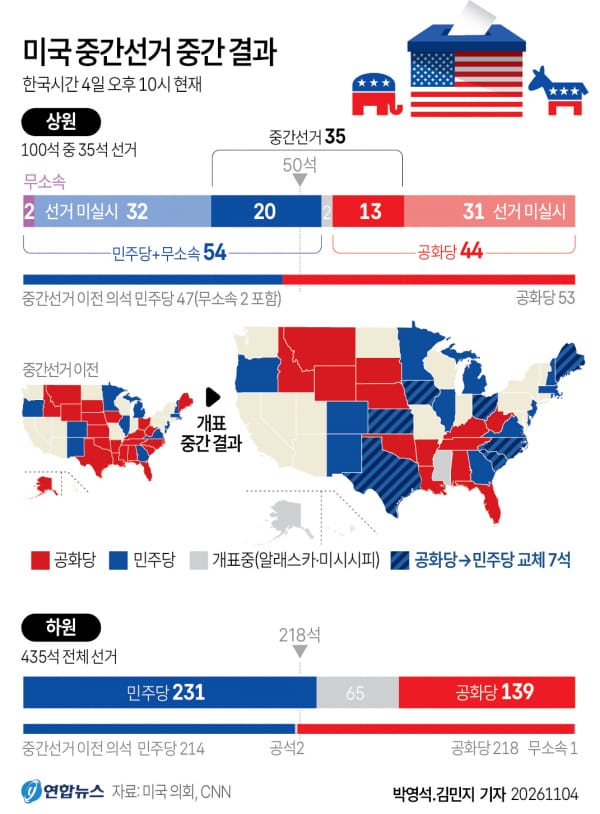
Concerns about tighter regulation of the artificial intelligence industry are growing after Democrats won majorities in both chambers of the US Congress and a majority of governorships in the US midterm elections.
Securities analysts say the US commitment to expanding AI investment itself is unlikely to weaken.
However, they expect tighter regional regulation of data center construction could lead to differing cost burdens and share-price performance among companies in the AI industry.
According to financial investment industry sources and Yonhap News on November 5, Lee Young-gon, head of research at Toss Securities, said, “Democrats and Republicans differ in their policy tools and approaches, but their interests align on the goals of building a US-centered advanced semiconductor supply chain and securing technological superiority over China.”
However, Lee said, “Data center electricity consumption, rising electricity bills and environmental issues could become political issues,” adding that “Democratic control of Congress could provide an occasion for greater oversight and regulatory pressure on these issues.”
Lee added, “Because responding to regulation and securing their own electricity supplies requires enormous amounts of capital, new companies could find it harder to enter the market, while big tech companies that already have capital and infrastructure could strengthen their competitive advantage.”
With Democratic candidates elected governor in Texas, Ohio and Georgia, among other states, the possibility has also been raised that community opposition to data center construction could lead to regulatory measures and permitting delays.
However, securities analysts believe introducing nationwide data center regulation would be difficult.
Han Ji-young, an analyst at Kiwoom Securities, said, “Nationwide regulation faces constraints when the presidential veto, competing interests within the Democratic Party and US competitiveness in AI are taken into account.” Han added, “Alternatives being discussed include requiring companies to bear more of the cost of expanding power grids and restricting permits in some regions.”
Another constraint is that, although Democrats secured majorities in both chambers, they fell short of the two-thirds of seats needed to override President Donald Trump’s veto.
Huh Jae-hwan, an analyst at Eugene Investment & Securities, said, “Data center capacity scheduled for 2027 is already under construction and is unaffected. The issue arising from this election concerns data center construction from 2028 onward.”
Huh added, “For the time being, existing data centers are likely to become more valuable, and new construction is more likely to take longer. This is not positive for companies in South Korea, Japan and elsewhere that have benefited significantly from AI infrastructure, but pressure from severe capital bottlenecks and loss-making competition could ease.”
Diverging AI share prices
In overnight US trading, share-price performance also diverged between big tech companies with existing infrastructure and AI infrastructure suppliers, including semiconductor companies.
Han said, “Hyperscalers are expected to see improvements in free cash flow as their capital expenditure burdens ease, whereas this weighed on AI infrastructure suppliers, such as memory and power equipment companies, that depend heavily on capital spending.”
Byun Jun-ho, an analyst at IBK Securities, also said, “Data center regulatory issues are unlikely to take concrete form in the short term.” However, Byun added, “Uncertainty over investment flows could persist because domestic and global investors could adopt a long-short strategy of selling South Korean memory stocks and buying US big tech stocks.”
Oil prices and policy expectations
By contrast, the sharp fall in international oil prices following the Democrats’ sweeping victory is seen as a positive factor for the South Korean stock market.
This reflected growing expectations of an early end to the war, as the midterm elections appeared to represent a voter judgment on the Iran war and high prices.
Overnight on the New York Mercantile Exchange, West Texas Intermediate crude futures for December delivery closed at $88.12 a barrel, down 8.29% from the previous session.
Brent crude futures for January delivery also ended the session down 8.67% at $94.62 a barrel.
Seo Sang-young, a managing director at Mirae Asset Securities, said, “The sharp fall in oil prices, lower interest rates and a weaker dollar provide a positive environment for domestic consumption, the domestic economy and financial markets overall.” Seo added, “For South Korea’s economy, which depends heavily on energy imports, these factors reduce companies’ cost burdens and inflationary pressure.”
Some analysts also say Democratic control of Congress could increase policy expectations for the clean energy and rechargeable battery sectors, but whether this translates into actual benefits remains to be seen.
Lee said, “President Trump still controls the executive branch, making it difficult for Democrats to actively pursue support policies for clean industries.” Lee added, “The structure makes new subsidy expansions or major policy shifts difficult.”
Securities analysts see the possibility of a short-term rebound in South Korean stocks after the midterm elections, but believe further improvements in conditions are needed for a sustained rise.
Byun said, “Markets have commonly responded more sensitively to positive news than negative news after midterm elections.” Byun added, “The KOSPI is also currently showing extremely low valuations, making it likely to respond sensitively to positive developments.”
Original Korean article: seouleconews.com
English brief by Korea Wind Intelligence, koreawindintel.com

















