

Growing use of AI computing and cloud services is increasing the burden on data center power supplies and cooling. Operators must remove the heat generated as server performance increases while managing electricity consumption and environmental impacts. Alongside computing capacity, the efficiency and supply reliability of power and cooling infrastructure are becoming increasingly important to data center operations.
The International Energy Agency's 2026 report, Key Questions on Energy and AI, projected that global data center electricity consumption would increase from 485 terawatt-hours (TWh) in 2025 to 950 TWh in 2030. Over the same period, electricity consumption by AI-focused data centers is expected to roughly triple.
The need to remove heat generated in confined spaces and maintain a reliable electricity supply has made improving cooling and power infrastructure efficiency important alongside server expansion.
Data centers need designs and operations that reduce cooling, electricity and resource consumption
A sustainable data center is a facility designed and operated to reduce environmental impacts, including resource consumption and carbon emissions, while providing computing, storage and networking functions. The report identifies improved energy efficiency and optimized resource use as central elements.
Energy management extends beyond servers. In addition to servers, storage devices and networking equipment, data centers contain auxiliary equipment for cooling and power supply. According to the International Energy Agency's 2025 analysis, cooling accounts for about 7% of electricity consumption in efficient hyperscale data centers, compared with more than 30% in less efficient enterprise data centers.
Liquid cooling is a technology for removing heat from high-density AI servers. It uses the ability of liquids to carry more heat than air. The International Energy Agency found that the need for liquid cooling is increasing in high-density AI racks. This does not mean applying the same cooling equipment to every data center, but securing cooling capacity suited to server power density and heat generation.
Data center infrastructure management (DCIM) software monitors electricity consumption, cooling equipment and equipment performance, and supports facility planning, asset management and change management. It manages central data centers alongside distributed facilities such as edge sites and is used to track energy use and operating conditions.
Applications include banking, financial services and insurance, IT and telecommunications, media and entertainment, healthcare, government and defense, retail, and manufacturing. Facility types include hyperscale, colocation, enterprise and edge data centers, while deployment types are classified as on-premises, cloud-based and hybrid.
In these industries, cooling and power management are also linked to service continuity. Singapore's Ministry of Digital Development and Information said a data center cooling failure in 2023 disrupted major banks' online banking and payment services for more than 12 hours. The incident involved more than 810,000 failed access attempts and 2.5 million failed payment and automated teller machine transactions. Facility operating problems can interrupt the work of businesses using data centers and their customers.
Electricity prices and denser AI servers encourage efficiency investment
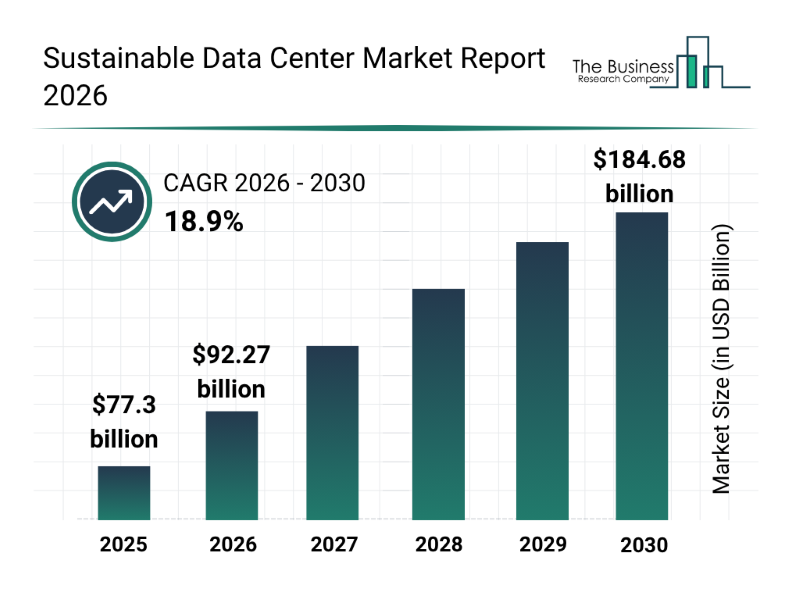
Market research firm The Business Research Company estimated in its Sustainable Data Center Market Report 2026 that the market was worth $77.3 billion in 2025 and $92.27 billion in 2026. It projected annual compound growth of 18.9% from 2026 to 2030, reaching $184.68 billion in 2030.
The report identified rising electricity prices as a major growth driver. Future growth drivers included liquid cooling adoption, on-site renewable generation, the use of energy storage systems to improve power supply reliability, demand for carbon-free operations, and circular use of hardware and resources.
According to data from the European Union's statistical office cited as an example of rising electricity prices, average household tariffs in the first half of 2023 were €28.9 per 100 kilowatt-hours (kWh), up from €25.3 in the same period a year earlier. These were household tariffs at that time and should be distinguished from industrial tariffs for data centers or current global electricity price trends.
Increasing AI server density is also encouraging investment. According to the International Energy Agency, AI server power density increased elevenfold from 2020 to 2025. As electricity consumption and heat generation become concentrated in confined spaces, expanding power supply equipment such as transformers and power electronics has become important alongside cooling capacity.
Efforts are also under way to improve operating conditions to increase cooling efficiency. Singapore conducted trials with local operators to raise data center operating temperatures to at least 26 degrees Celsius. A tropical-climate demonstration facility is also testing cooling technologies suited to high temperatures and humidity.
Power purchase agreements and investment in on-site generation are used to procure renewable energy. Power purchase agreements signed with technology companies contribute to financing new renewable generation facilities. However, a developer's contractual renewable electricity procurement record differs from the generation mix of the electricity actually supplied to a facility.
The International Energy Agency's power supply analysis is based on electricity actually supplied through on-site generation and local grids. Assessing renewable energy use therefore requires examining not only procurement contracts but also the generation mix and grid conditions in the region where a facility is located.
Storage equipment responds to power fluctuations. The International Energy Agency explained that AI training and model execution cause larger and faster power fluctuations than conventional data center workloads. Storage equipment, including batteries, is consequently becoming important to a stable electricity supply.
Systems for measuring and disclosing environmental performance also require operational improvements. The European Union operates a database collecting information on data center energy performance and water use. In September 2026, the European Commission proposed a common assessment framework to improve transparency in energy and water use and enable comparisons among facilities within the same region.
Constraints on electricity availability, cooling water and investment returns
Market expansion faces constraints in securing electricity and equipment. The International Energy Agency identified bottlenecks in energy supply chains and advanced semiconductor manufacturing, as well as pressure on planning and regulatory systems from increasing applications for data center projects. The pace of facility construction is also affected by financing conditions and expectations for investment returns.
Water use is another management challenge. The European Commission identified cooling water demand and carbon emissions associated with electricity supply as major environmental impacts of data centers. Alongside improving energy efficiency, water consumption and impacts on local resources need to be assessed. Electricity consumption alone is insufficient to judge a facility's overall environmental performance.
Renewable energy expansion and increased fossil fuel use are occurring simultaneously. In the International Energy Agency's 2025 outlook, natural gas and coal meet more than 40% of additional data center electricity demand through 2030. The pace of demand growth and the generation mix of local grids could constrain carbon emissions reductions.
Combined air and liquid cooling expands as renewable electricity and operational management investment increases
In cooling, the share using both air and liquid cooling is increasing. In a 2025 survey by 451 Research, the market research unit of S&P Global Market Intelligence, 42% of respondents said they used both technologies at their primary data center, up from 38% in 2024. The share using air cooling alone fell from 48% to 45%.
The share planning to adopt liquid cooling within the next five years increased from 56% to 59% over the same period. In particular, the share planning adoption within the next 12 months rose from 13% to 21%. However, data center research and certification organization Uptime Institute found that adoption is gradual and most operators still rely on air cooling.
Use of external resources also increased in operational services. In the 451 Research survey, the share of respondents that owned their facilities but entrusted operations to a facility management provider rose from 16% in 2024 to 20% in 2025. The share using cloud services also increased from 73% to 79%. These figures represent usage rates among participating companies, not revenue growth rates for sustainable data center services.
Broader adoption of facility and operational management technologies was also observed. In Uptime Institute's 2025 supplier survey, 52% of respondents said customer spending on data center products and services was increasing. The share reporting increased customer adoption of DCIM was 59%, while 56% reported increased adoption of lithium-ion batteries for centralized uninterruptible power supplies. These are percentages of supplier responses.
In power supply, renewable electricity is expected to increase rapidly. In the International Energy Agency's 2025 outlook, renewable electricity generation supplied to data centers increases by an annual average of 22% from 2024 to 2030. It was projected to meet about half of additional data center electricity demand over the same period.
Among applications, expansion in AI and high-performance computing is particularly notable. Uptime Institute found that major liquid cooling deployments are concentrated in high-performance computing workloads such as academic research, engineering and AI model development. According to the International Energy Agency, electricity consumption by AI-focused data centers increased 50% year on year in 2025, exceeding the 17% growth rate for all data centers.
By region, North America had the largest sustainable data center market in 2025, while Asia-Pacific was expected to grow fastest over the forecast period. In a separate 2025 analysis, the International Energy Agency projected that Southeast Asian data center electricity demand would more than double by 2030, led by Singapore and southern Malaysia.
Growth in AI-related and regional electricity consumption indicates expanding data center demand. However, these figures cannot be converted into sustainable data center market revenue growth rates for individual industries such as finance, healthcare and manufacturing, or for specific regions.
Major companies combining facility operations and energy management
Major companies in the sustainable data center market include Equinix, Digital Realty, NTT DATA Group, Vantage Data Centers, Iron Mountain Data Centers, GDS Holdings, STACK Infrastructure, Aligned Data Centers, NEXTDC and DataBank.
They also include Flexential, Princeton Digital Group, Colt Data Centre Services, AdaniConneX, VIRTUS Holdco, Echelon Data Centres, Kao Data, Yotta Data Services and MEEZA.
These companies' activities include renewable electricity procurement, improvements in cooling and power efficiency, distributed infrastructure management, and the provision of environmental data to customers. Facility operators disclose energy use performance, while management software companies expand monitoring and planning capabilities for power and cooling equipment. Technologies are being applied to manage resource consumption and operational reliability alongside data center computing performance.
Original Korean article: gttkorea.com
English brief by Korea Wind Intelligence, koreawindintel.com

















