

As the expansion of artificial intelligence (AI) data centers drives a sharp rise in electricity consumption, direct-current (DC) distribution has emerged as a next-generation method of supplying power. It can reduce power losses and heat by requiring fewer power conversion stages than conventional alternating-current (AC) distribution. Three Korean power equipment manufacturers are accelerating technology development and demonstrations to establish an early market position.
LS ELECTRIC Chairman Koo Ja-kyun outlined the future development of power grids in a keynote address at a workshop of the International Conference on Electricity Distribution (CIRED) on November 2. Koo emphasized: "Reliable power grids must underpin the stable operation of AI data centers, which consume enormous amounts of electricity. A DC-based intelligent power grid is the definitive solution to meeting AI electricity demand."
Data centers receive electricity through AC distribution, but core equipment such as servers and graphics processing units (GPUs) runs on DC electricity. To provide equipment with a stable power supply, AC electricity must be converted to DC through several types of equipment, including uninterruptible power supplies (UPS) and server power supplies. This process causes power losses, while heat from the equipment increases the burden on cooling systems.
DC distribution can reduce these conversion stages, lowering losses and heat while also saving equipment space. Electricity demand is surging, but the expansion of supply infrastructure, including power plants and transmission grids, is not keeping pace. The growing need to use available electricity as efficiently as possible is increasing the importance of DC distribution.
Many challenges must be resolved before DC distribution can become widespread. Existing power equipment is predominantly built around AC, so switching to DC entails substantial equipment replacement costs. There are also technical limitations. Unlike AC, DC has no point at which the current naturally reaches zero, making it difficult to interrupt power when a fault occurs. Korean power equipment manufacturers are working to overcome these limitations by developing and demonstrating dedicated equipment.
HD Hyundai Electric began jointly developing DC distribution systems with Korea Electric Power Corporation at an early stage. In 2023, it installed a 1 MW-class DC distribution system at the HD Hyundai Global R&D Center (GRC) in Pangyo and began commercial operation. The company described it as the world's first application of a large-capacity DC distribution installation in an urban office building. It is now pursuing the development of DC distribution solutions and power conversion equipment for factories, data centers and other facilities.
Hyosung Heavy Industries is focusing on developing solid-state transformers (SSTs), which use power semiconductors to handle both voltage transformation and AC/DC conversion. In 2022, it developed a 22.9 kV-class SST that can connect directly to urban power grids, and it is now developing products for use at higher voltages. In October, it agreed to work with German electrical and electronics technology company Siemens to develop a data center power solution combining SSTs with an energy management system (EMS). An EMS monitors electricity consumption and supply conditions in real time and efficiently regulates electricity use.
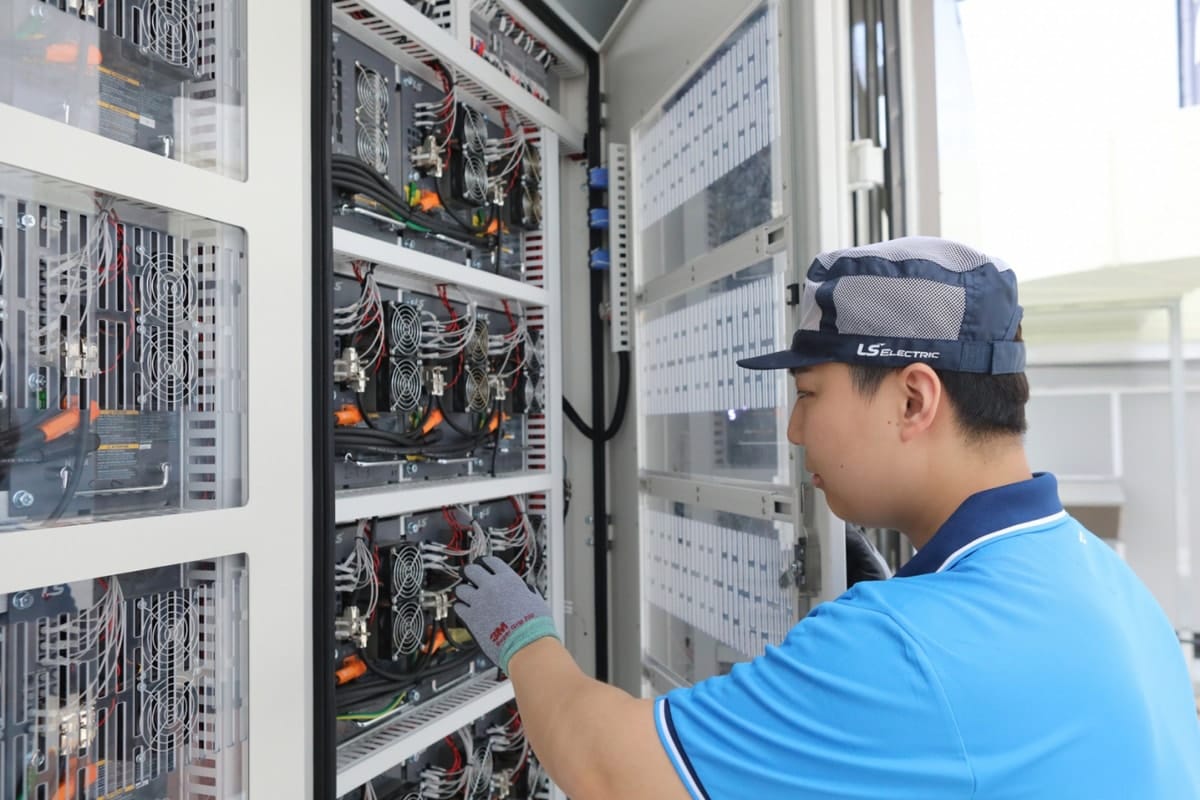
LS ELECTRIC has applied DC distribution technology at an actual production facility. In July, it established a "DC Factory" operating on DC distribution at its Cheonan site in South Chungcheong Province. The company said that applying SSTs, solid-state circuit breakers (SSCBs) and an energy storage system (ESS), among other equipment, improved energy efficiency by more than 10% compared with conventional AC systems. In the same month, it also signed a memorandum of understanding with LG Uplus to jointly develop power infrastructure for AI data centers. The two companies plan to jointly demonstrate 800 V DC power technology and pursue standardization of related technologies.
Original Korean article: Sidae
English brief by Korea Wind Intelligence, koreawindintel.com

















