

Power and cooling technologies
Data Center Korea 2026, an exhibition bringing together power and cooling technologies and facility operation solutions needed for AI data centers, opened on November 4 at the aT Center in Yangjae-dong, Seoul.
This year's exhibition focused on technologies that improve power supply reliability, heat management and energy efficiency in response to increasing server density driven by growing demand for AI computing.
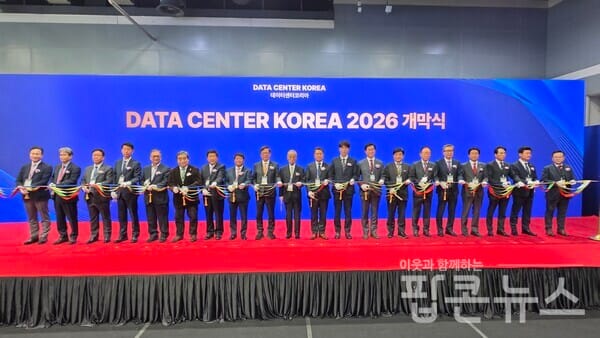
Jointly hosted and organized by the Korea Association of Building Systems Integration and Messe Esang, the event runs for three days through November 6. Main exhibition areas include cooling systems and power equipment needed for data center design, construction and operation, network and IT infrastructure, energy management, data center infrastructure management (DCIM), disaster prevention, fire protection and security technologies.
As the computing capabilities of high-performance servers used for AI training and inference have increased, so have data centers' electricity consumption and heat output. Infrastructure technologies that integrate management of reliable power supply, cooling efficiency and facility operation are therefore becoming increasingly important, alongside the performance of individual servers.
Key technologies presented included liquid cooling for high-density GPU server environments, uninterruptible power supplies (UPS) and power management systems. Technologies that coordinate power and cooling equipment to optimize energy use and improve data center operating efficiency were also introduced.
Exhibitor solutions
Schneider Electric presented integrated solutions spanning power supply, cooling and digital operations. Through its MCSeT high-voltage switchgear, Galaxy VXL modular UPS and MCDU-25 coolant distribution unit (CDU), it presented approaches to improving power reliability and cooling efficiency in AI data centers.
In particular, as increasing AI server density requires both sufficient power supply capacity and cooling performance, the company emphasized building an operating framework that links the entire power and cooling infrastructure, rather than focusing only on the efficiency of individual equipment. Digital operation technologies for monitoring equipment conditions in real time and responding to faults were also introduced as a major business area.
Shinsung E&G unveiled AIO, a server-integrated module for high-heat-output AI servers, and FWU, a space cooling system. Alongside technologies to reduce cooling equipment's energy consumption, it also presented its ECO platform, which supports renewable energy procurement and RE100 implementation.
The company is also expanding its business scope by introducing DAM, a data center development and operation platform from its affiliate Shinsung Inex. This represents a move to strengthen a business model that extends beyond supplying cooling equipment to connect data center development, operation and energy management.
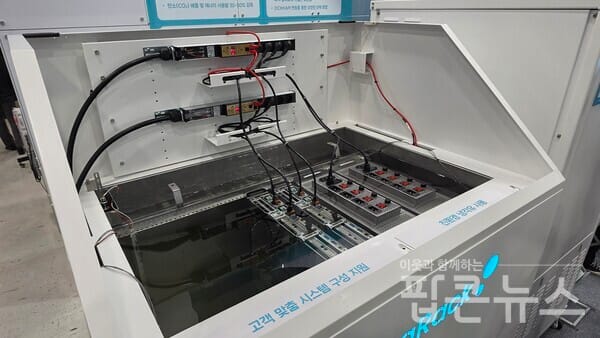
SDT presented Aqua Rack 42U, an immersion cooling system supporting 100 kW-class cooling per rack. The technology manages heat by immersing servers in cooling fluid, addressing heat generated by high-density AI computing equipment.
Unlike conventional air cooling, which removes heat by circulating air through servers, immersion cooling uses cooling fluid. It can improve heat management efficiency in high-density computing environments, but compatibility with server equipment, initial installation costs and maintenance arrangements are among the factors that need consideration during deployment.
Himec exhibited a water-cooled load bank and its HI-BEMS integrated energy management system. These solutions verify cooling equipment performance during data center development and manage energy use during operation. The company introduced data center engineering technologies covering design, commissioning, operation and maintenance.
Conference discussions and operating costs
The Data Center Korea 2026 Global Conference was held alongside the exhibition. Industry experts delivered presentations on AI data center design, power and cooling technologies, government policies and the investment environment, operation and security.
Key sessions covered the business environment outlook in light of changes in data center policy, the status of domestic RE100 efforts to supply renewable energy, and electrical infrastructure equipment in the era of carbon neutrality.
Practical discussions also addressed cooling optimization using AI and digital twins, data center fire suppression equipment and physical security systems, and future trends in design technology.
The growing importance of cooling and power equipment in the data center industry reflects operating cost pressures accompanying the expansion of AI infrastructure.
Stable operation of high-performance servers requires sufficient power supply capacity and cooling performance. Improving data center power usage effectiveness (PUE) and reducing facility operating costs are also emerging as key challenges.
Competition among data center infrastructure companies consequently appears to be expanding from supplying individual equipment to providing integrated solutions covering design, construction and operation. This exhibition also focused on identifying actual development projects and business opportunities through cooperation between technology suppliers and data center developers and operators.
Growing demand for AI data center development is also increasing the growth potential of the related equipment market. However, securing power infrastructure, selecting cooling methods, initial investment costs and operating efficiency remain key variables determining the economics of data center projects.
The actual deployment results and cost savings delivered by the technologies presented by exhibitors are expected to become criteria determining their future market competitiveness.
Original Korean article: popcornnews.net
English brief by Korea Wind Intelligence, koreawindintel.com

















