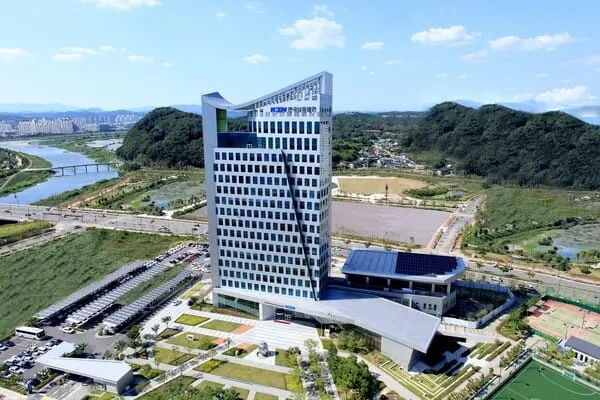
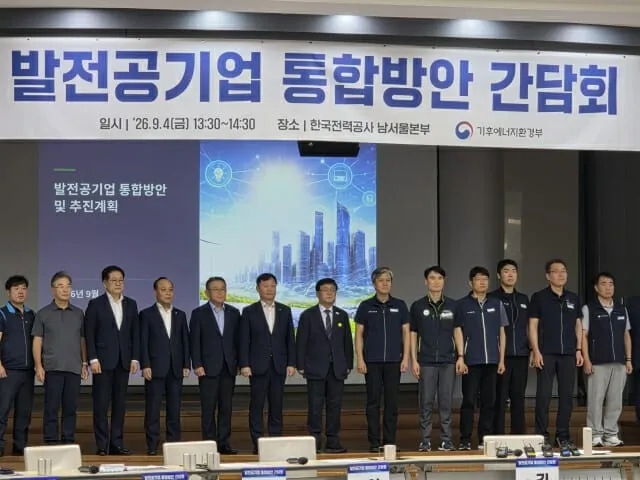
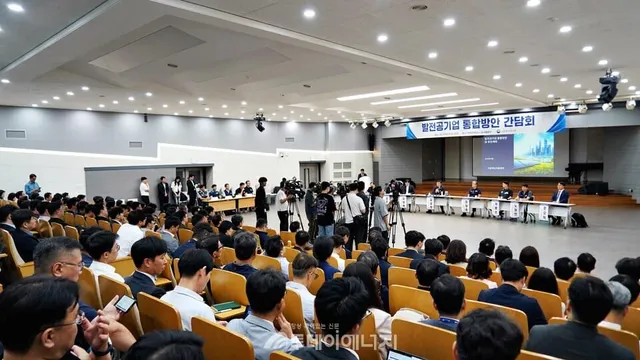
The location of the integrated headquarters should not remain merely at the level of compensating for past damage. It should be a matter of national strategy that asks where the site of energy transition is, where coal-fired power is removed and replaced with renewable energy and clean fuels. If the first article examined the sacrifices that Dangjin has endured, this second article looks at why Dangjin is also a choice that benefits the nation.
From coal smokestacks to renewable energy transition
In Seokmun-myeon, Dangjin, there are 10 coal-fired power generation units at EWP (Korea East-West Power) Dangjin Power Station. The total installed generation capacity is 6,040 megawatts (MW), the largest single thermal power plant complex in the country. As these power plants close sequentially, there will be room to carry renewable energy electricity on the transmission lines that have so far carried coal-generated electricity. The ability to reuse already-laid power grids is also a way to reduce conflicts and costs surrounding the construction of new transmission lines.
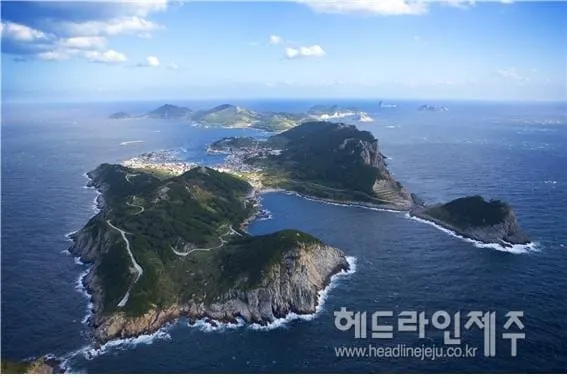
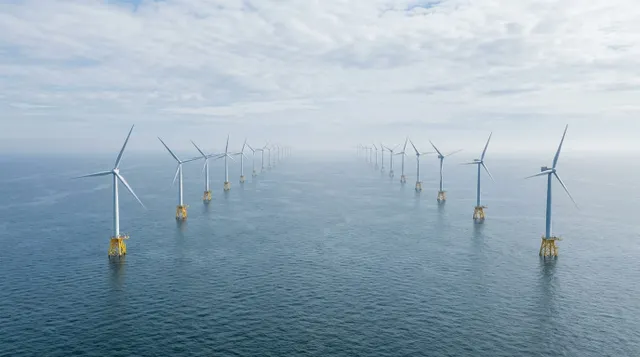
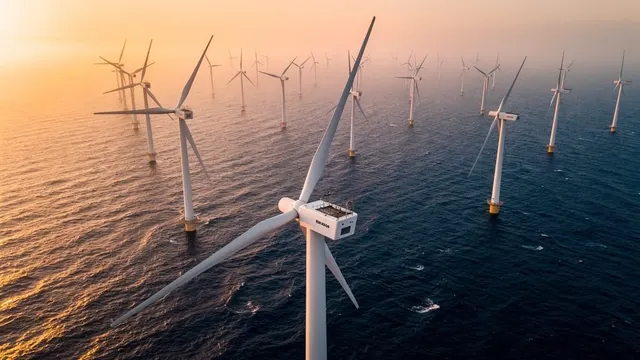
Renewable energy projects are also moving forward one by one. Chungcheongnam-do Province announced a plan in 2021 to build a 400 MW offshore wind farm with 1.9 trillion won investment in the Daenan Island and Dangjin Thermal Power Plant ash disposal area. Private developer Windway received an Electricity Business Licence in 2020 to build a 210 MW wind farm in the sea northwest of Daenan Island. A 50 MW solar power plant received permits in salt-damaged farmland in Saseong-ri, Daehoji-myeon, and the Korea Rural Community Corporation is pursuing a 90 megawatt-peak (MWp) floating solar facility at Seokmun Lake. Floating solar has also been installed on idle water surfaces at the Dangjin Thermal Power Plant ash disposal area. However, offshore wind projects still show slow visible progress.
Clean fuels arriving by sea: Dangjin Port
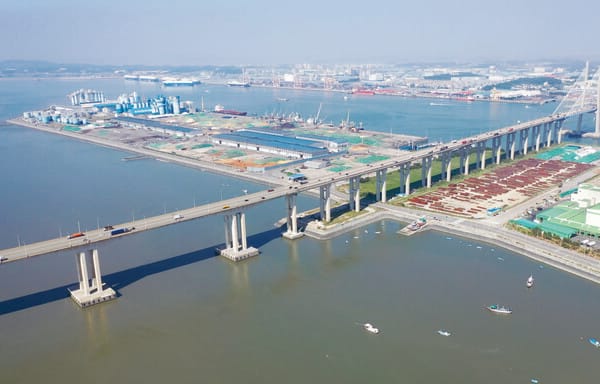
Dangjin's other asset is its port. Chungcheongnam-do Province and Dangjin City signed an agreement in December 2022 with nine companies including EWP and KOWEPO (Korea Western Power) to build a hydrogen and ammonia terminal in the sea off Gagok-ri, Songsan-myeon. The plan calls for investment of 450 billion won by 2030 to install four 40,000-ton ammonia storage tanks and two berths, bringing in 2 million tons of ammonia annually.
Chungcheongnam-do Province expected direct and indirect employment of 4,700 jobs at that time. The revised Fourth National Port Master Plan (2026-2030) announced by MOF (Ministry of Oceans and Fisheries) on July 20 included changing the existing general cargo terminal plan at this location to a hydrogen and ammonia dedicated terminal.
Port boundary expansion, shore power supply facilities (AMP) at Godae and Songak terminals, and disaster-vulnerable area improvement projects were also reflected. However, the LNG terminal and grain terminal that Dangjin City had jointly requested were excluded. Inclusion in national plans does not immediately mean project implementation. Ki Ho-yeon, head of Dangjin City's Port and Fisheries Division, said that follow-up procedures such as basic and detailed design, national financial project inclusion, and securing national budget are important.
In Songsan-myeon, a distribution center for Hyundai Steel's by-product hydrogen to hydrogen vehicle charging stations opened in 2021, and a Ministry of Land, Infrastructure and Transport hydrogen city project to lay hydrogen pipelines around Hyundai Steel is underway. In Seokmun-myeon, a 20 MW fuel cell power generation project is also being pursued.
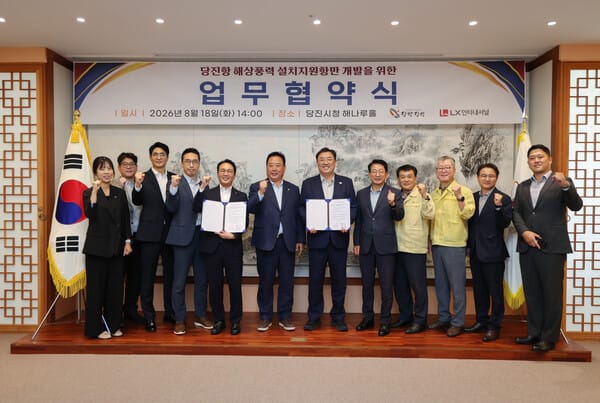
A hub for collecting and assembling offshore wind equipment is also being promoted. Dangjin City and LX International signed a memorandum of understanding (MOU) on August 18 at Dangjin City Hall's Haenaru Hall for "development of Dangjin Port offshore wind installation support port." The project site is 193,779 square meters (approximately 60,000 pyeong) in the Godae district, 10th berth area of the Asan National Industrial Complex in Songak-eup, an area that has not been properly utilized.
LX International plans to invest approximately 300 billion won by 2029 to create a new berth for installation vessels in addition to the existing 280-meter berth, and to reinforce the rear area to enable storage and assembly of large equipment. Construction is targeted to start in the second half of 2027, with operations targeted to begin in 2029. Danish logistics company Bluewater Shipping is participating in design and operations planning, and it is collaborating with Singapore investment firm Scion Renewables and Korea Maritime Promotion Corporation. LX International projects that within a 200-kilometer radius of Dangjin, there is current demand for 7-8 GW of offshore wind installation, with long-term demand exceeding 10 GW.
The production-inducing effect for the Chungcheongnam-do region is estimated at approximately 380 billion won, and the employment-inducing effect at approximately 2,000 jobs. However, the MOU explicitly states that it has no legal binding force, and the project is still in the basic design, feasibility review, and permit consultation stages. The 2,000 jobs also represent direct and indirect effects for all of Chungcheongnam-do, so follow-up procedures remain before actual investment and local employment in Dangjin materialize.
A city that generates, transmits and uses electricity
Dangjin is a crossroads for electricity transmission. From the Bukdangjin Converter Station in Songak-eup to Godeok in Pyeongtaek, a 34.2-kilometer section carries South Korea's first onshore high-voltage direct current (HVDC) transmission line, enabling 3 gigawatts (GW) of electricity generated on the west coast to be sent to southern Gyeonggi including the Pyeongtaek semiconductor complex. Taihan Cable & Solution is building its second HVDC cable factory in Dangjin with a target completion date of 2027. Dangjin City and KEPCO (Korea Electric Power Corporation) ended an eight-year dispute in December 2025 and agreed to actively cooperate in the government's "energy superhighway" construction. In April 2025, the Bukdangjin-Sintangjeong transmission line, which took 21 years to complete, was finished, resolving transmission constraints at Dangjin's thermal power plant complex.
Dangjin is also a city with high electricity consumption. Hyundai Steel is a representative large-scale power consumer, paying over 1 trillion won annually in electricity bills, and its core production base is Dangjin Steel Mill. In contrast, the capital region's 2024 power self-sufficiency rate was 66 percent, far below the national average of 108 percent, and Seoul's was only 11.6 percent. In the same year, Chungcheongnam-do's power self-sufficiency rate was 207.1 percent. Dangjin, where electricity is generated, transmitted, and consumed by factories, has served as a safety valve for the capital region's power grid.
Where coal departs: just transition
The criteria for just transition are more pressing for Dangjin. According to EWP's 2024 plan, the low-carbon and zero-carbon power sources to replace Dangjin units 1-8 are mostly located in other regions: the Sinhonam Combined Cycle Power Plant, a power plant in the Yongin National Industrial Complex, and the Gokseong Pumped-Storage Power Station. MCEE (Ministry of Climate, Energy and Environment) also presented a plan at the September 18 public discussion meeting on the 12th Basic Plan on Long-term Electricity Supply and Demand to relocate Dangjin units 5 and 6 to a Honam region LNG combined heat and power plant. If coal departs, replacement power plants, jobs, and tax revenue depart Dangjin as well. A research project by MOTIE (Ministry of Trade, Industry and Energy) projected that if 14 generating units close in Chungcheongnam-do, production-inducing effects will decline by 19.208 trillion won and 7,577 jobs will disappear. Boryeong, which experienced this first, saw its population fall below one hundred thousand after early closure of its thermal power plant.
The registered population of Seokmun-myeon, where the power plant is located, fell from 9,316 in June 2022 to 7,809 in June 2026, a 16.2 percent decline in four years. The government will place a Just Transition Division within the integrated headquarters. That division must be at the site most severely impacted by coal phase-out to properly understand the reality of transition.
Toward the center of energy and industry
Competing regions lead with innovation cities. Jinju emphasizes the existing KOEN (Korea South-East Power) office and residential conditions in Gyeongsangnam-do Innovation City, while the Jeonnam-Gwangju Integrated Special City points to KEPCO and power public institutions concentrated in Naju. Chungcheongnam-do Province has requested that public institutions under the MCEE be relocated all at once to Naepo Chungcheongnam Innovation City. Dangjin, which is not an innovation city, must build a logic that a headquarters where 1,800 or so people will work should be located at a site where power generation and transmission, clean fuels, and industrial consumption intersect, rather than for administrative convenience.
The challenges are clear. Dangjin's registered population as of June 2026 is 172,400, but in recent years the population of many eup, myeon and dong districts has declined, and residential, educational and medical conditions for headquarters employees' families need further improvement. Dangjin Mayor Kim Ki-jae also said at his 100-day press conference on October 6, 2026 that the headquarters relocation is an issue that must consider workers' living conditions.
The integrated headquarters that Dangjin is requesting is not compensation for the past but a practical choice the nation can make to unblock bottlenecks in the national power grid and accelerate carbon neutrality. The next article will place competing regions and Dangjin side by side for comparison, then examine what Dangjin must do to speak with one voice.
Original Korean article: djtimes.co.kr
English brief by Korea Wind Intelligence, koreawindintel.com