

ASUS Korea unveiled its XA P2N-E2 server dedicated to agentic AI for the first time at OCP Global Summit 2026 in San Jose, United States. Agentic AI refers to artificial intelligence that makes decisions independently and carries out successive tasks without a person having to issue instructions at every step. Because this type of AI repeatedly executes code and processes data rather than merely generating answers, its servers consume electricity continuously.
High performance in a 2U chassis
The XA P2N-E2 features Nvidia's latest Vera CPU in a 2U chassis and can accommodate up to 2 RTX PRO 6000 Blackwell GPUs. U is a unit for measuring server height, with 1U equivalent to approximately 4.4 centimeters. The CPU coordinates overall computation, while GPUs handle large volumes of calculations. The company said it improved processing efficiency by using high-bandwidth, low-power memory. Performing the same work with less electricity is what data centers mean by power efficiency.
Why combine liquid and air cooling?
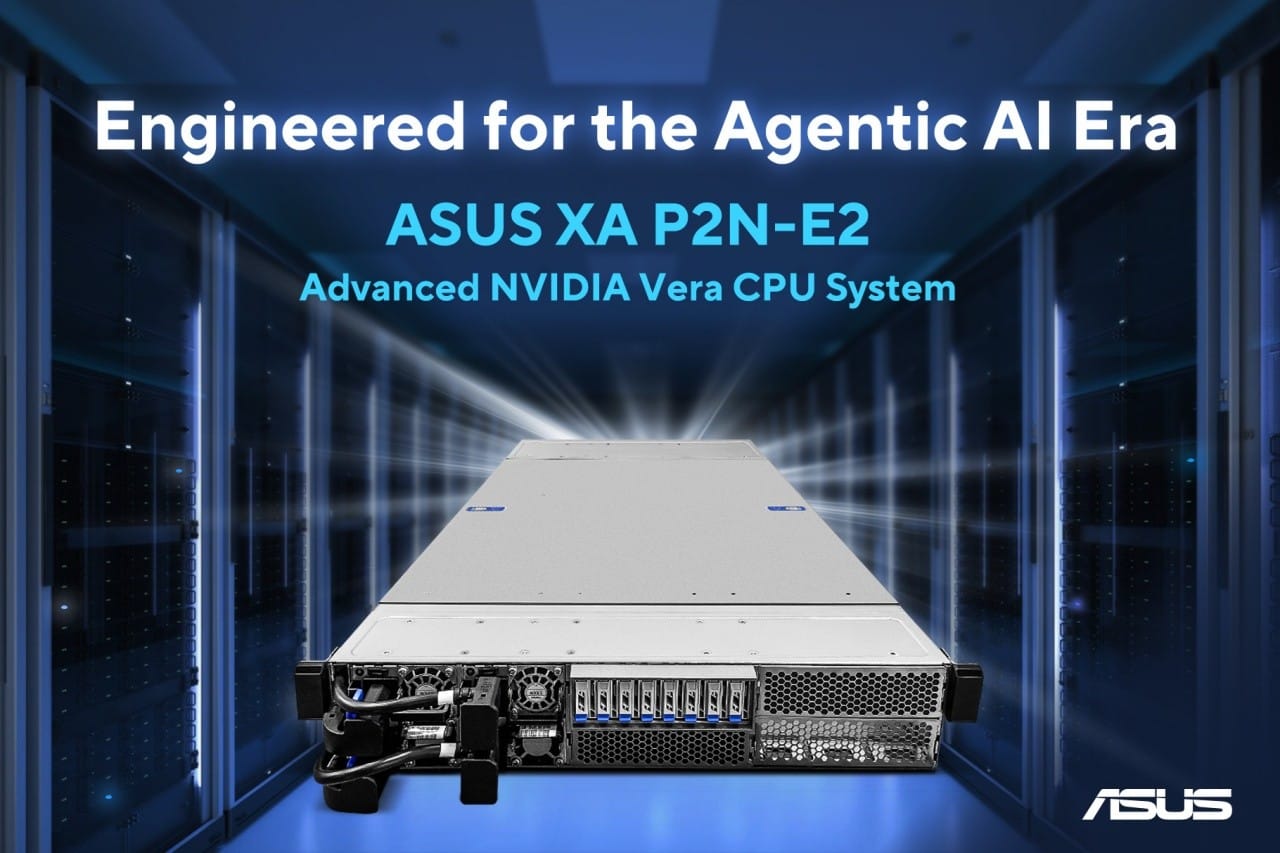
The cooling approach was a notable feature of the exhibition. The XR R1I12B-M1BHFS uses direct liquid cooling, circulating coolant through pipes directly to GPU components to remove heat. This approach can remove heat more efficiently than air cooling and is increasingly being used for AI chips that generate substantial heat. The CPU, meanwhile, retains conventional air cooling, providing greater configuration flexibility. The article interprets this as a practical choice that takes both installation conditions and costs into account.
Does efficiency mean savings?
Power industry observers point out that securing electricity is becoming a new constraint as AI data centers proliferate. How little electricity a server can use has therefore become a factor determining commercial viability. However, even if servers become more efficient, total electricity consumption could increase if AI use grows rapidly. Whether efficiency improvements translate into actual energy savings depends on operating practices and demand management.
ASUS said it plans to supply its major new products, including the XA P2N-E2, worldwide. Addressing electricity challenges in the AI era requires both efforts to secure power from generating plants and designs that save electricity within servers.
Original Korean article: esnews.kr
English brief by Korea Wind Intelligence, koreawindintel.com

















