

A new uncertainty has emerged in Destin Power's bid for an initial public offering (IPO), as uncertainty over data center regulation has increased following the US midterm elections. The company had projected that more than half of its estimated revenue would come from business serving US data centers. Since policy changes could affect its growth prospects, investors are expected to apply more demanding standards.
Growth plans focus on US data centers as midterms introduce regulatory uncertainty
According to investment banking industry sources on November 9, Destin Power filed a securities registration statement in late October and began preparations for its public offering. Using power electronics technology, the company designs and manufactures products for hydrogen production and use, and for energy storage, including inverters for power-generating fuel cells, power conversion systems (PCS) for energy storage system (ESS) applications, and water electrolysis rectifiers.
Its financial performance has fluctuated. Destin Power posted consolidated revenue of 29.8 billion won and operating profit of 1.6 billion won in 2025. These were down 7.9% and 16.5%, respectively, from 2023. Revenue in the first half of 2026 was 14.8 billion won, down more than 9% year on year. The company swung to an operating loss of 1.4 billion won. This reflected the end of inverter supplies for the high-margin hydrogen-only model, 5CSA.
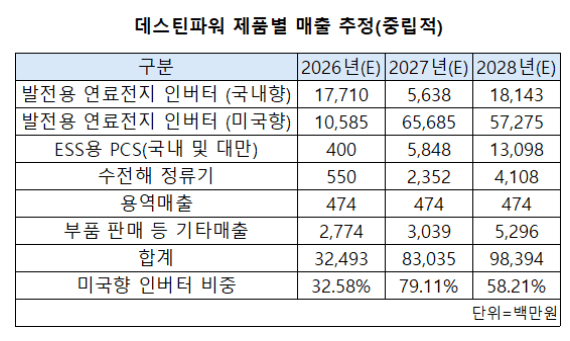
Ahead of the offering, Destin Power has expressed confidence in revenue growth. The company projected that revenue from inverters for power-generating fuel cells serving US data centers would rise from 10.6 billion won in 2026 to 65.7 billion won in 2027. Their share of total projected revenue would increase from 32.6% to 79.1%. It also forecast US-bound revenue of 57.3 billion won, or 58.32% of the total, in 2028.
However, Destin Power's business environment is changing rapidly. In the US midterm elections held on November 3, the Democratic Party won majorities in both the Senate and the House of Representatives. Concern about the industry increased as numerous candidates advocating development restrictions and tighter regulation won in data center hubs including Texas.
During the Texas gubernatorial election campaign, Democratic candidate Gina Hinojosa advocated temporarily suspending data center development and examining the burden on power and water resources. After winning the election, Hinojosa also said legislation would be prepared to protect residents from electricity costs and water-resource burdens caused by data centers.
Stock markets also reacted sharply. Shares of data center operators and companies supplying power and equipment fell substantially immediately after the US midterm elections. South Korean stocks were also affected. Although some expect that a structural contraction in data center investment is unlikely, even short-term regulatory changes or potential project delays could pose a burden for Destin Power.
Valuation based on 2028 earnings depends on US growth assumptions materializing
The issue is that Destin Power based its valuation on 2028 earnings. Multiplying the present value of that year's estimated net profit, 9.9 billion won against projected net profit of 15.5 billion won, by a peer-company price-to-earnings ratio of 22.84 produced a pre-discount valuation of 225.4 billion won and an assessed value of 15,378 won per share. Applying a discount of 47.98% to 28.47%, the company proposed an IPO price range of 8,000 to 11,000 won.
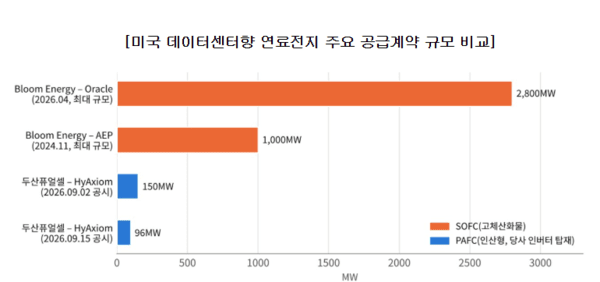
The earnings projections are also based on business linked to US data centers. In October, Destin Power signed an ESM supply and unit-price agreement with its key customer, Doosan Fuel Cell, covering 587 inverters for US data centers. For 2026 and 2027, the company calculated projected revenue by applying the contractual unit price of approximately 145 million won to the planned contractual deliveries of 73 and 453 units, respectively.
Volumes after the first quarter of 2028, when the existing contract expires, were estimated on the assumption that Doosan Fuel Cell's 2 PAFC production lines would operate at 95% of capacity. The premise is that all remaining output after domestic allocations would be supplied to US data centers, and that Destin Power would supply all the inverters required.
The key factor is orders secured by Doosan Fuel Cell subsidiary HyAxiom. Under the business structure, when HyAxiom secures a data center project, Doosan Fuel Cell produces the fuel-cell systems and orders the required inverters from Destin Power. In other words, HyAxiom's orders and the pace of project execution affect the issuer's earnings.
However, HyAxiom's revenue in the first half of 2026 was 16.1 billion won, down 82.7% from 93.3 billion won in the same period of 2025. It recorded a net loss of 19.8 billion won over the same period. It only began building a substantial record of large-scale deliveries in the US data center market in 2026. As calls for data center regulation spread in major regions, this poses a burden for securing subsequent projects and meeting schedules.
Moreover, Destin Power allocated 15.6 billion won, or 90% of its 17.1 billion won in net offering proceeds, to capital investment including a new factory in Iksan. The factory expansion also assumes increased supplies to US data centers. If the US business proceeds more slowly than planned, it could affect not only earnings but also utilization of the new production capacity and recovery of investment costs.
Ultimately, Destin Power faces two variables: increased regulatory uncertainty following the US midterm elections, and the pace of HyAxiom's subsequent orders and project execution. The appropriateness of the valuation based on future earnings also depends on whether its assumptions materialize. Given the high dependence on the United States and uncontracted volumes for 2028, observers suggest that establishing a persuasive case for the offering price will not be easy.
Meanwhile, questions concerning data center regulation and projected earnings were sent to Destin Power, but the company did not respond.
Original Korean article: the-stock.kr
English brief by Korea Wind Intelligence, koreawindintel.com

















