

As the AI data center market expands, competition is intensifying to secure the cooling and power infrastructure that supports high-performance servers. Companies are expanding their businesses, from supplying large-scale cooling solutions and developing immersion cooling technology to expanding overseas HVAC equipment manufacturing bases and building modular power infrastructure.
According to industry sources on October 25, companies involved in AI data centers have recently been upgrading power supply and thermal management technologies for high-density computing environments while responding to market demand by securing large projects and expanding production capacity.
LG Electronics secures cooling supply agreement for 5 GW in North America and pursues immersion cooling development
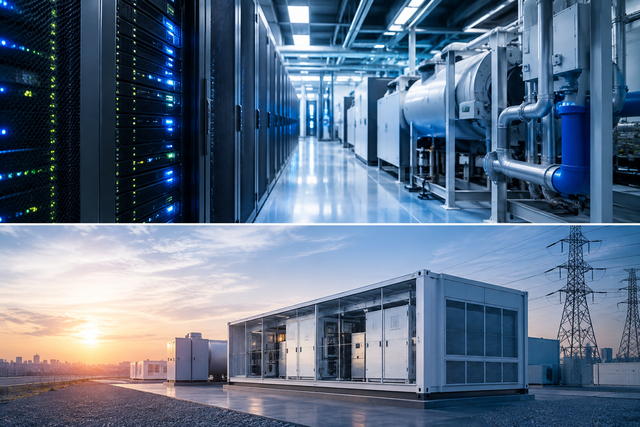
LG Electronics has signed a large-scale AI data center cooling supply agreement in North America and begun developing immersion cooling technology. It plans to expand supplies of high-efficiency chillers while establishing a product lineup covering air cooling, liquid cooling and immersion cooling.
LG Electronics' US subsidiary signed a definitive long-term agreement with North American infrastructure platform company AIR Control Concept to supply cooling solutions for AI data centers totaling 5 GW. It plans to supply high-efficiency chillers and other equipment in stages.
AIR oversees data center design, construction, procurement and services in the United States and Canada, carrying out projects through its subsidiary AIR Mission Critical, or AMC. Its principal customers include global data center developers, and it handles the full range of infrastructure businesses required to build AI data centers.
LG Electronics' orders for AI data center cooling solutions exceeded 600 billion won in the first half, and cumulative orders are expected to reach several trillion won by year-end. The company also expects to reach its target of 1 trillion won in chiller sales earlier than its original deadline of the end of 2027. It is also discussing expanded supplies of coolant distribution units, or CDUs, with AIR. The aim is to respond to data center cooling demand by broadening cooperation from chiller-focused supplies to liquid cooling equipment.
In immersion cooling, LG Electronics signed a memorandum of understanding with GS Engineering & Construction and US specialist GRC, or Green Revolution Cooling, for technology development and standardization. Immersion cooling removes heat by submerging electronic devices such as GPUs and CPUs directly in a special nonconductive cooling fluid. Applying it to actual data centers requires consideration not only of equipment but also building structures, piping, electrical connections and maintenance space.
LG Electronics will provide air, liquid and immersion cooling technologies and operating data, and will be responsible for implementing cooling solutions tailored to standardized designs. GS Engineering & Construction will develop standardized architectural designs and operate a proof-of-concept test bed, verifying equipment layouts, structural loads, piping and electrical connections.
GRC will provide immersion tanks and control technology and improve system performance using installation, operation and maintenance data. The three companies plan to apply their technologies and equipment in actual data center environments and use operating data to improve the reliability of their integrated solutions.
LG Electronics has supplied high-efficiency chillers and fan wall units, or FWUs, for air cooling, as well as CDUs and cold plates for liquid cooling. Chillers produce chilled water, while FWUs circulate air and manage heat inside data centers. CDUs distribute coolant, and cold plates directly absorb heat generated by chips. The company plans to add immersion cooling technology to expand its product lineup across cooling methods.
LG Electronics has accumulated 60 years of engineering experience in heating, ventilation and air conditioning, or HVAC, for facilities requiring high reliability, including nuclear power plants and large hospitals.
It is supplying and installing cooling solutions for large AI data center projects in North America and has also secured data center supply references in the Middle East and Indonesia. It plans to expand its data center cooling business through its One LG integrated infrastructure solutions, which combine capabilities across the group.
Samsung Electronics expands HVAC manufacturing in India, with annual capacity of 6,500 units
Samsung Electronics has established a new FläktGroup HVAC production line in Pune, Maharashtra, India. Following its existing production facility in Noida, the new line will serve customers in India and the Asia-Pacific region and can produce up to 6,500 units of equipment annually at full operation.
The facility covers 13,826 square meters and became ready for mass production about six months after installation of facilities and equipment began. Pune is a growing center for data centers and industrial infrastructure, and its proximity to Mumbai's port provides a favorable location for supply chain operations. Samsung Electronics plans to use the new production line to strengthen its HVAC equipment supply base for customers in the Asia-Pacific region as well as meet demand within India.
The products manufactured are air handling units, or AHUs, FWUs and computer room air handlers, or CRAHs. AHUs cool air and manage air quality in data centers and large commercial buildings, while FWUs are wall-mounted air-moving equipment. CRAHs precisely regulate server room air to help IT equipment operate under suitable conditions. The facility therefore produces products ranging from data center HVAC equipment to equipment needed for air management in large buildings.
Samsung Electronics plans to expand the business by combining its AI and platform technologies with FläktGroup's HVAC technology.
Autech Carrier pursues cooling equipment supply for 200 MW AI data center
After securing an order to supply cooling solutions for a 48 MW hyperscale data center in the Seoul metropolitan area, Autech Carrier is also pursuing cooling equipment supplies for a 200 MW data center project in Gumi. For the metropolitan-area project, it will supply oil-free inverter centrifugal chillers and provide maintenance during operation.
The company was selected as the preferred bidder for cooling equipment supplies for the Gumi AI Cluster Data Center Development Project, which has an IT capacity of 200 MW in Gumi, North Gyeongsang Province. It is pursuing the supply of 160 AquaForce 30XFZ inverter screw chillers to meet computing demand based on Nvidia's next-generation Rubin AI computing platform. Supply volumes and the contract value will be finalized through negotiations. If the contract is concluded, it would be the company's largest-ever chiller supply for a single project.
It is also expanding supplies of liquid cooling equipment. Carrier's 65LL CDU, rated at up to 1.3 MW, has completed Nvidia quality certification, while a 2.6 MW product is undergoing testing with the aim of securing certification. In addition to supplying chillers, Autech Carrier is broadening its data center cooling equipment offering by securing a lineup of high-capacity CDUs.
Autech Carrier signed a memorandum of understanding with BeLAB, a specialist in AI and AI transformation, or AX, systems integration, to cooperate on cooling solution supplies. The cooperation covers data center cooling equipment that Autech Carrier manufactures directly in South Korea or holds distribution rights for, including chillers, air handling units and CDUs. It also covers installation, commissioning, operating services and technical support for maintenance, in addition to equipment supplies.
BeLAB will share cooling equipment quantities, specifications and installation schedules for data center projects, and Autech Carrier will coordinate production and delivery schedules accordingly. The companies agreed to respond jointly if project schedule changes or supply delays are expected. Specific quantities, prices and delivery dates will be set through separate supply contracts. They agreed to share equipment supply and installation schedules from the initial specification review stage and cooperate in line with project progress.
BeLAB specializes in supporting cloud-based AI transformation, GPU supplies and AI development. It carries out cloud and AI infrastructure deployment and AX projects for a range of customers, including public institutions.
Schneider Electric offers AI data center power infrastructure deployment in as little as six months
Schneider Electric introduced its modular Prefabricated Power Modules and Power Skids for AI data centers. Factory prefabrication reduces power infrastructure deployment time to as little as six months and provides power capacity for GPU-intensive environments such as high-performance computing and AI training clusters.
The new products are based on a reference design for the GB300 NVL72 jointly developed with Nvidia. They support power densities of up to 142 kW per rack and integrate power management and liquid cooling control. Their design considers both power and cooling control to address data center environments with concentrations of high-density computing equipment.
The products use the Galaxy VXL uninterruptible power supply and come in three capacities: 2 MW, 2.25 MW and 2.5 MW. The 2.5 MW model has the largest capacity among the company's single-container prefabricated power solutions. Capacity can be expanded by adding modules, allowing equipment configurations to match data center size and demand.
Target applications include hyperscale data centers, neoclouds and colocation data centers. The new products are designed, manufactured and tested at the company's production facility in Sant Boi de Llobregat near Barcelona, Spain, before delivery. Schneider Electric has expanded the facility and plans to extend supplies beyond Europe to North America and the Asia-Pacific region. Its plan is to proceed with supplies to North America before expanding globally.
Schneider Electric plans to use standardized designs and factory prefabrication to help data center developers deploy power infrastructure quickly and expand equipment capacity as needed.
The recent series of hacking incidents in the financial sector focused on peripheral access points, such as loan sales agent lookup pages and employee work support systems, rather than core transaction networks. Weak authentication allowed sensitive information to be stolen, and some financial companies took as long as two weeks just to detect a breach. According to financial authorities on October 25, breaches had been confirmed at 16 financial companies as of October 14, including banks such as Shinhan Bank, KB Kookmin Bank, Hana Bank and BNK Busan Bank, as well as savings banks and capital companies. At Shinhan Bank, an attacker bypassed a simplified authentication process on a mobile webpage for loan sales agents and stole personal information on about 25,000 customers. At KDB Capital, a development test page that could be accessed without separate authentication remained available after the official system launched, resulting in the exposure of 848 customer records. At BNK Busan Bank, personal information on 11 outsourced development staff was exposed through a webpage with inadequate session validation. At Hyundai Capital, an attacker targeted a mortgage sales agent lookup page accessible without logging in, exposing personal information on 146 agents. At KB Kookmin Bank, an employee mobile work support system was attacked, resulting in the theft of personal credit information on 119 customers. The damage increased because pages accessible from outside also allowed access to sensitive information that should have been protected separately. Information leaked from Hyundai Capital included names, mobile phone numbers, email addresses and Credit Finance Association registration numbers, as well as nonpublic internal agent numbers and resident registration numbers. At Shinhan Bank, the leaked information included financial details such as annual income and calculated loan limits, in addition to customer names and phone numbers. Detection was also delayed. Hyundai Capital was attacked for about 24 minutes from around 6:37 a.m. on September 27, but did not identify the breach until October 2, five days later. A Hyundai Capital representative explained: “While conducting our own checks in connection with security incidents at other financial companies, we received information on the attacking IP address from the Financial Security Institute and discovered the incident during our inspection.” At Yegaram Savings Bank, where information on 43,246 customers was leaked, an attacker accessed the customer information server on September 16, but the bank did not recognize the possibility of a leak until September 30, 14 days later. Its internally operated system, identified as the entry point, used a version of Redis more than 10 years old for data processing and had not received security patches. At Hana Bank, abnormal access to its sales support system, or ODS, continued for 10 hours and 36 minutes from 12:16 p.m. on September 30, exposing personal information on 89 customers. The bank did not block external access until 12:05 p.m. the following day, about 13 hours after the attack ended, and identified signs of customer information leakage at 6 a.m. on October 2. Meanwhile, in emergency security self-inspections covering 555 financial companies through October 8, 130 reported management shortcomings, including failure to apply the latest security patches, continued use of systems whose technical support had ended, failure to establish round-the-clock security monitoring and missing authentication on externally exposed systems. Although the possibility that AI attack tools were used in the series of hacks has been raised, a Financial Supervisory Service official said that at the current investigation stage, attention should focus on weaknesses in existing security systems rather than new AI-enabled intrusion techniques. The official explained: “There is an area where AI finds financial companies' security vulnerabilities faster than people, and an area where it automates large volumes of attacks. We need to focus on the latter in examining these incidents.” The official added: “That does not mean it has been confirmed that AI carried out all the attacks,” and said: “Much of the damage in these incidents came from inadequate basic security, and a substantial share could have been prevented with measures such as multifactor authentication.”
South Korea's nuclear power industry has entered the US domestic market, where the industry originated. Under a South Korea-US nuclear power framework worth up to $120 billion, two of eight large nuclear reactors to be built in the United States will use South Korea's APR1400 design. This would be the first time a foreign reactor design is built on US soil. Having secured a position in the market through the framework, South Korea is also targeting the small modular reactor, or SMR, market. However, significant hurdles remain before actual construction can begin, including site selection and equity negotiations. According to the government and industry sources on October 18, South Korea and the United States announced Project Power, a bilateral nuclear power framework to build and operate eight large nuclear reactors in the United States. Two will be APR1400 units, and the remaining six will use the AP1000 design from US nuclear company Westinghouse. Funding will comprise $120 billion from a $200 billion strategic investment fund for the United States, consisting of $100 billion in construction costs and $20 billion in contingency funds. The two governments, Korea Electric Power Corporation, Korea Hydro & Nuclear Power and Westinghouse will participate as signatories. The project aligns with US President Donald Trump's goal, announced in May 2025, of starting construction on 10 large nuclear reactors by 2030. Bilateral cooperation would account for 80% of that target. The United States is the world's largest nuclear power country, operating 94 reactors, but its construction capabilities and supply chain weakened substantially during a prolonged interruption in new construction following the Three Mile Island accident in 1979. Meanwhile, energy security crises linked to the Russia-Ukraine war and the war in the Middle East coincided with a surge in electricity demand from AI data centers. The article interprets the partnership as the United States, which has the underlying technology but lacks sufficient construction capacity, joining with South Korea, which has construction and manufacturing capabilities. The project originated in a proposal from the South Korean government. The United States initially proposed a liquefied natural gas terminal project in Louisiana, but the South Korean government counterproposed nuclear power plant construction instead. It persuaded the United States by highlighting its record of completing construction in the United Arab Emirates on budget and on schedule. The project will proceed in three phases, beginning with two AP1000 units. The two APR1400 units are included in the second phase. The countries agreed that $10 billion in advance payments would be sent before year-end to secure long-lead items early, because manufacturing key equipment for large nuclear power plants alone takes four to six years. Construction of South Korean nuclear plants would also help the country's next effort to compete in SMRs. Experience building nuclear plants and supplying equipment in the United States would strengthen its position in competition for SMR orders. The US Nuclear Regulatory Commission has issued successive approvals for SMR construction, and Bill Gates' TerraPower has begun construction. Hyundai Engineering & Construction has been assigned engineering, procurement and construction for up to eight subsequent units of TerraPower's Natrium SMR, while Doosan Enerbility has signed a contract with TerraPower to manufacture key SMR equipment. Development of an independent reactor design is under way in South Korea. The government-led innovative SMR, or i-SMR, has applied to the Nuclear Safety and Security Commission for standard design approval. The goal is to obtain approval in 2028 and begin construction in 2030. The commission also plans to establish a legal framework by 2030 that can license various SMRs, including marine applications. Experts described the entry into the US market as symbolically significant, coming half a century after South Korea began by importing US nuclear technology. Dankook University professor Moon Joo-hyun said: “We were able to negotiate with the United States because we had technological and workforce capabilities in areas such as semiconductors, shipbuilding and nuclear power,” adding: “Nuclear power technology enhances a country's standing.” Moon also expected South Korea to gain an advantage in negotiations with other countries, given the number seeking nuclear technology cooperation.
“When students come to a semiconductor exhibition and talk with people from actual companies, I think they end up studying even more.” Students from Meister high schools across South Korea, preparing to become the semiconductor industry's future workforce, gathered together. The event gave them a practical learning opportunity to see how semiconductor technologies learned in the classroom are used in industry. A teacher from a semiconductor Meister high school, interviewed at SEDEX 2026, described the significance of the field trip in those terms. This was the first time five South Korean semiconductor-related Meister high schools had gathered to attend a semiconductor exhibition together. Chungbuk Semiconductor High School, Chungnam Semiconductor Meister High School, Korea Semiconductor Meister High School in Gyeongju, Daegu Semiconductor Meister High School and Korea Nano Meister High School in Miryang participated in SEDEX 2026, South Korea's largest semiconductor exhibition, held through October 16 at COEX in Gangnam, Seoul. Organized by the Korea Semiconductor Industry Association, SEDEX is the country's largest semiconductor exhibition. This year, about 300 companies from across the semiconductor ecosystem, including memory, system semiconductors, materials, components and equipment, set up booths. The gathering of leading semiconductor companies and their major products was clearly a special experience for students. Gu Hyeon-hoe, a first-year student at Chungbuk Semiconductor High School, said excitedly: “I saw the actual chips displayed at the booths, and they were really fascinating.” For schools, it was an important opportunity to expand contact with companies. A teacher at Daegu Semiconductor Meister High School said: “Many companies have shown interest and visited our booth,” adding: “It is useful because we can also obtain employment-related information, such as which qualifications are needed and which fields would be good to work in.” A company representative visiting the school's booth expressed interest, saying: “I work for a company supplying semiconductor wafers in Gumi, North Gyeongsang Province. We are in the same region, and I came because I was curious about the curriculum the students follow.” The most eye-catching exhibits were the students' own practical work and educational materials. Daegu Semiconductor Meister High School displayed wafers produced using processes learned in practical classes and the activity reports written afterward. The reports contained detailed reflections on practical work, including photolithography and observation of wafer patterns. Chungbuk Semiconductor High School exhibited work in which students had used photolithography to inscribe circuits on wafers. Pointing to a wafer bearing a rabbit shape, a third-year student said: “This is the result of carrying out photolithography ourselves using the equipment at school,” explaining: “We inscribed circuits in various forms, including rabbit shapes and letters, on wafers to create display pieces.” Some students had already secured jobs before graduation through practical experience at school and participation in various outside activities. Park Seung-yun, a third-year student at Chungbuk Semiconductor High School, passed Samsung Electronics' special recruitment process in the first year of high school and is due to join its DS division in the first half of 2027. Park said: “I think diligently following the school curriculum and actively participating in qualifications, activities inside and outside school, and external training programs led to a good result.” Opportunities to meet industry professionals also helped students consolidate what they had studied. When experts visiting the exhibition asked students which processes they had learned and what results they obtained, the students readily reviewed their learning. A Korea Semiconductor Meister High School representative explained: “Experts ask specific questions such as, ‘Have you tried this process?’ and ‘What results did you get?’ The students recall what they have learned, which serves as revision.” “The students really do study hard.” The teachers gathered at the exhibition shared the same hope: that their students would join leading South Korean semiconductor companies and help strengthen the industry's competitiveness. They hope the exhibition will lead to agreements with companies or recruitment opportunities, allowing more students to become part of South Korea's semiconductor industry.
As AI agents rapidly become part of everyday life, personal information protection and platform security are also becoming increasingly important. AI agents log in with users' permissions to access messages, schedules and payment methods, but AI companies have not explained in detail how they will manage the user information obtained this way. For example, Meta says Muse's login information goes directly to a secure vault, while also saying Meta may access the data when necessary for service operation and security. It also acknowledged that it has not yet resolved prompt injection, a type of cyberattack in which attackers enter malicious instructions into a generative AI system to induce unwanted responses or actions by bypassing its original security rules or purpose. Platforms, too, could end up handing customer information and purchasing data to AI developers if they provide external AI with broad access to product, pricing, inventory and delivery information. Another risk is that a hacking incident at a large platform offering everyday services, such as Coupang or Naver, could simultaneously affect millions to tens of millions of users. A personal information leak could cause damage extending beyond shopping to everyday services such as payments, delivery and messaging. Kim Byung-pil, a professor at KAIST's School of Business and Technology Management, identified prompt injection and excessive permissions granted to AI as major risks. In response, the Personal Information Protection Commission convened a public-private policy council on September 23 to discuss standards for agentic AI's processing of personal information. Issues included the boundary between tasks AI can handle independently and those requiring human approval, responsibility between developers and adopting companies, and retention and deletion periods for conversation and work records. Proposals at the meeting included separating permissions so that scheduling AI cannot access medical records, and requiring human confirmation for high-impact actions such as payments. The commission plans to release guidance on personal information processing by agentic AI before year-end. At the Global AI Privacy Forum on September 29, commission chair Song Kyung-hee emphasized that as the authority entrusted to AI grows, the amount of information and authority that can safely be delegated must also be considered, and that companies must continually monitor and demonstrate how permissions are used. The Korea Internet & Security Agency, or KISA, is also investigating various causes, including hacking, insider carelessness and system configuration errors. However, concerns have been raised that existing security systems alone may be insufficient as AI agents become more deeply involved in shopping. This is because clear controls are needed over how personal and payment information is processed as AI agents exchange data with external services, and the extent of the permissions they can access. A security industry representative said: “Discussions on legislating safeguards such as a ‘kill switch’ that can immediately physically disconnect a system in the event of a critical error or hacking attempt need to be accelerated.” Another AI security industry representative said: “In South Korea, everyday services are concentrated on a small number of large platforms, creating a structure in which an incident can quickly spread nationwide,” emphasizing: “As AI shopping agents become more widespread, it is important to secure not only convenience but also security and control.” Ultimately, the pace of AI agent adoption depends less on technological capability than on trust in what can safely be delegated. The article expects the way platform access controls and personal information protection standards are established to determine the rules of competition in the AI agent era.
Original Korean article: Bridge Economy
English brief by Korea Wind Intelligence, koreawindintel.com

















