

Power supply and floating data centers
The rapid growth of the artificial intelligence (AI) industry is increasing data centers' electricity consumption and water use for cooling, spurring the development of new technologies to reduce both. Solutions are emerging that range from floating data centers installed at sea to AI-assisted geothermal exploration, liquid cooling that supplies coolant directly to semiconductors, and technologies that use waste heat from servers to heat buildings.
In an article by Sharon Kimathi published on October 15, 2026, titled 'The climate tech that's cutting data center energy use,' Reuters described efforts by technology companies and startups to reduce the environmental burden of data centers. Microsoft, in particular, said it had contracted about 40 GW of clean power for data center operations, of which 19 GW was already operating.
The 40 GW figure represents generating capacity, not actual data center electricity consumption or annual electricity generation. Contracted power must also be distinguished from power that is actually operating. These efforts to secure power on a large scale show that electricity supply for AI data centers has become a central management issue for technology companies.
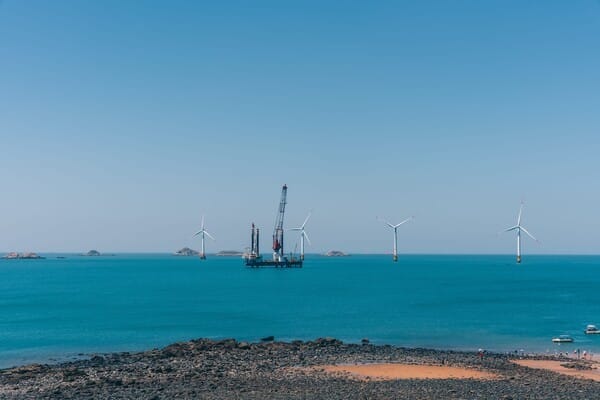
US startup Aikido Technologies is developing floating facilities that combine offshore wind power generation with data centers. The concept involves placing offshore wind facilities and computing equipment close together so that the electricity generated can be used for data processing. Another feature is the potential to use the surrounding sea for cooling.
Conventional data centers require buildings to house servers, communications equipment and electrical infrastructure, as well as cooling facilities. By using offshore space, floating data centers could reduce some of the burden of securing land. That does not, however, mean offshore data centers are necessarily more economical or environmentally friendly than those on land. Issues to address include the construction and maintenance costs of offshore structures, salt corrosion, communications connections and the reliability of electricity supply.
Wind power output, in particular, varies with wind conditions. Since data centers require a continuous electricity supply, reliable supply arrangements, such as energy storage or connections to an external power grid, are important. These offshore data centers are currently at the stage of testing new designs and business models, making it difficult to conclude that their economic and environmental performance is already better than that of large commercial data centers.
Geothermal exploration, cooling and waste heat
US geothermal technology company Zanskar is using AI to search for areas suitable for geothermal energy development. Geothermal power generation uses underground heat to produce electricity. Unlike solar or wind power, it can provide electricity that is relatively less affected by weather changes when underground heat sources and generating facilities meet the necessary conditions. However, finding underground heat sources that can be developed is one of geothermal power's greatest challenges. Geological structures, underground temperatures and fluid movement must be investigated, and drilling entails substantial costs.
Zanskar is developing technology that uses AI to analyze geological information, surface observations and exploration data to identify promising geothermal resource areas. The aim is to make better use of information during exploration and screen potential development sites. Using AI does not automatically establish that geothermal resources exist. Confirming the potential for actual power generation requires field investigations, drilling, and measurements of flow rates and temperatures. Geothermal power is an option for supplying the reliable, low-carbon electricity needed by AI data centers, but local geological conditions, development costs, water use and the risk of induced earthquakes must also be assessed.
As the computing performance of AI semiconductors increases, efficiently removing the heat generated by servers becomes more important. Conventional data centers have widely used air cooling, which circulates air to remove heat from servers. However, the high power density of high-performance AI servers can make them difficult to cool with air alone.
HT Materials Science, featured by Reuters, is developing technology to improve the heat transfer performance of coolants. Direct liquid cooling, which removes heat close to semiconductors, is attracting particular attention. This method circulates coolant through cold plates attached to semiconductors or other components that generate substantial heat. Liquids can offer greater heat capacity and effective heat transfer, making them suitable for cooling high-density servers.
However, liquid cooling also requires pumps, heat exchangers, piping and facilities to manage cooling water. Actual energy savings therefore vary depending on the heat generated by servers, the overall cooling system design and external climatic conditions. Introducing liquid cooling also does not automatically reduce a data center's water use. Water consumption can vary depending on how heat is ultimately discharged to the outside.
A substantial share of the electricity consumed by data centers is ultimately converted into heat. This heat is generally released outside through cooling facilities. EnergiRaven is developing technology to recover data center waste heat for uses such as residential heating. The approach combines heat recovered from servers with heat exchangers or heat pumps for building heating and hot water supply. It could improve energy efficiency by reusing some of the energy already consumed in data center operations.
However, data center waste heat can be relatively low in temperature, requiring additional equipment such as heat pumps before it can be used to heat buildings. The distance between a data center and the buildings using the heat is also an important economic factor. Waste heat recovery has greater potential in areas with nearby heat demand, such as urban areas or industrial complexes. For data centers without nearby heating demand, using recovered heat economically may be difficult.
Technology investment and electricity demand
Large technology companies are also investing in securing electricity supplies and improving energy efficiency for data centers. Microsoft told Reuters that it had secured clean power supply contracts totaling about 40 GW, of which 19 GW was operating. This is part of its strategy to meet future electricity demand from AI and cloud services. However, the volume of clean power contracted does not mean that all actual data center electricity consumption is supplied by carbon-free power. Actual supply arrangements can vary depending on when electricity is generated and consumed, and where generating facilities and data centers are located.
Microsoft is also pursuing a program to support emerging climate technology companies. Amazon likewise invests in climate technology companies through its Climate Pledge Fund. These investments show that the expansion of AI data centers is creating new industrial demand not only for power generation but also for cooling equipment, energy management and waste heat recovery.
In its 'Energy and AI' report published in 2025, the International Energy Agency (IEA) projected that global data center electricity consumption, which was about 415 TWh in 2024, could more than double to about 945 TWh in 2030. This was a projection under the base scenario presented at the time, not a confirmed figure for actual consumption in 2030.
Even if data center energy efficiency improves, total electricity consumption could continue to rise if the use of AI services and the scale of server installations grow rapidly. Assessments must also consider environmental impacts beyond electricity consumption, including cooling water use, construction of generating facilities, semiconductor manufacturing and production of data center equipment.
In South Korea, AI data centers, power grids and semiconductor cooling technologies are also closely interconnected industries. Cooling systems and power conversion technologies could become increasingly important as the power density of high-performance semiconductors and server equipment rises. The floating data centers, AI-assisted geothermal exploration, liquid cooling and waste heat recovery technologies described here address different problems. No single technology can therefore eliminate all of the environmental burden of data centers. Future assessments of data center sustainability will need to verify not only whether new technologies have been introduced but also actual electricity consumption, cooling efficiency, water use, carbon emissions and operating costs. It is also important to distinguish technologies' commercialization status from demonstration results.
Original Korean article: efn.co.kr
English brief by Korea Wind Intelligence, koreawindintel.com

















