

Industry competition is intensifying to develop technologies that efficiently handle heat generated by high-performance servers in artificial intelligence (AI) data centers.
As graphics processing units (GPUs) used for AI computing become more powerful and servers consume more electricity, increasing cooling capacity while reducing energy consumption has become a key challenge.
Competition in high-efficiency technology is consequently expanding across data center cooling infrastructure, from chillers and liquid-cooling equipment to pumps that circulate coolant and digital solutions that manage equipment operating conditions.
Data Center Korea 2026, a specialist data center exhibition jointly hosted and organized by the Korean Association of Facilities Convergence and Messe Esang, opened at the aT Center in Yangjae-dong, Seoul, on November 4. Now in its second year, Data Center Korea runs through November 6.
Under the theme “A look at data centers attracting global attention in the AI era,” the event presents technologies and solutions needed to build and operate data centers, including cooling systems, power and energy equipment, network and IT infrastructure, data center infrastructure management (DCIM), disaster prevention and security, and operations and maintenance.
The accompanying 2026 Data Center Korea Global Conference discusses cooling and power technologies for high-density AI data centers, energy efficiency improvements, design and operating strategies, and related policy and investment trends.
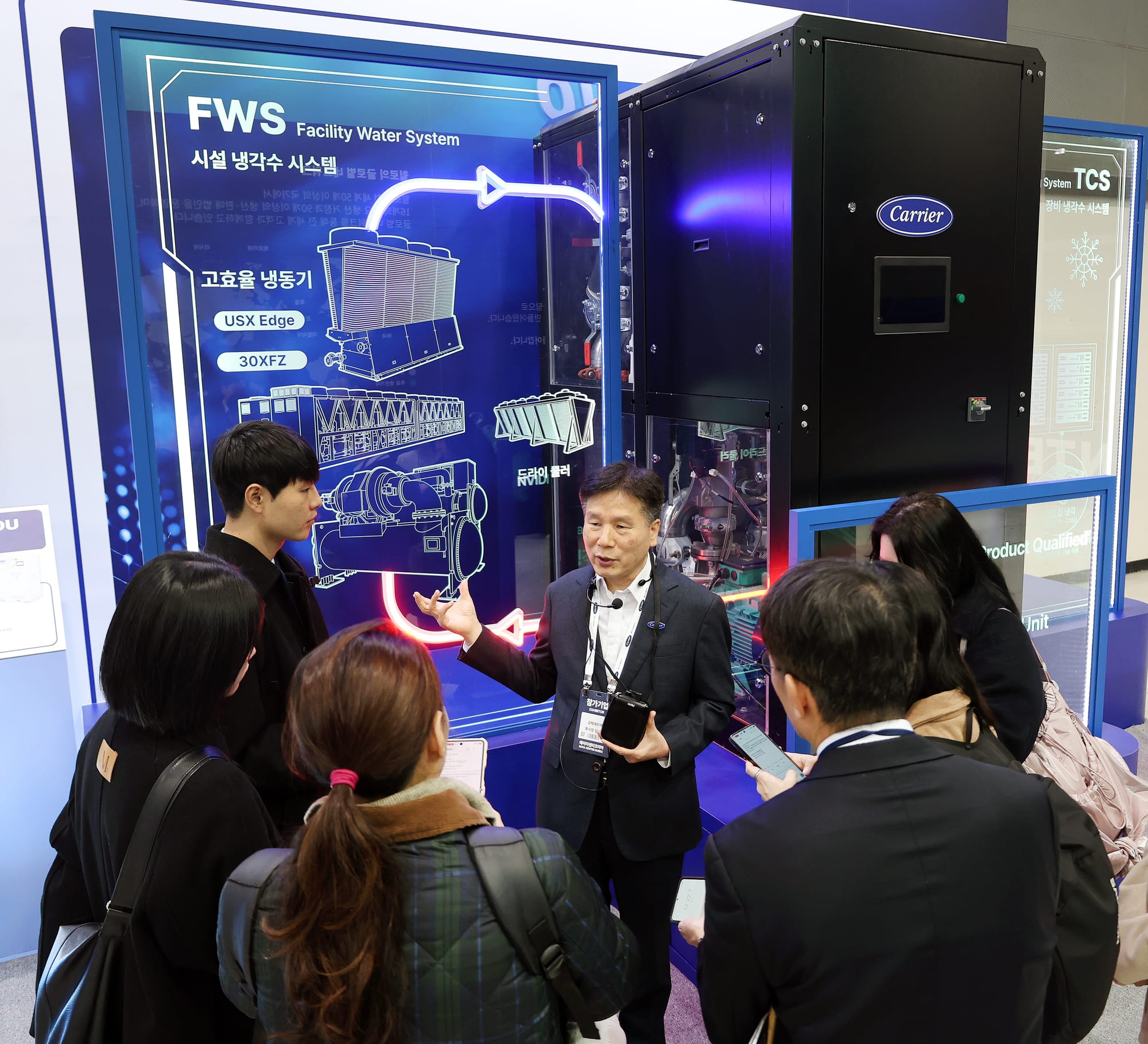
Autech Carrier, an environmentally friendly energy solutions company, presented high-capacity liquid-cooling technology and integrated management solutions, led by a coolant distribution unit (CDU) that has received Nvidia product qualification.
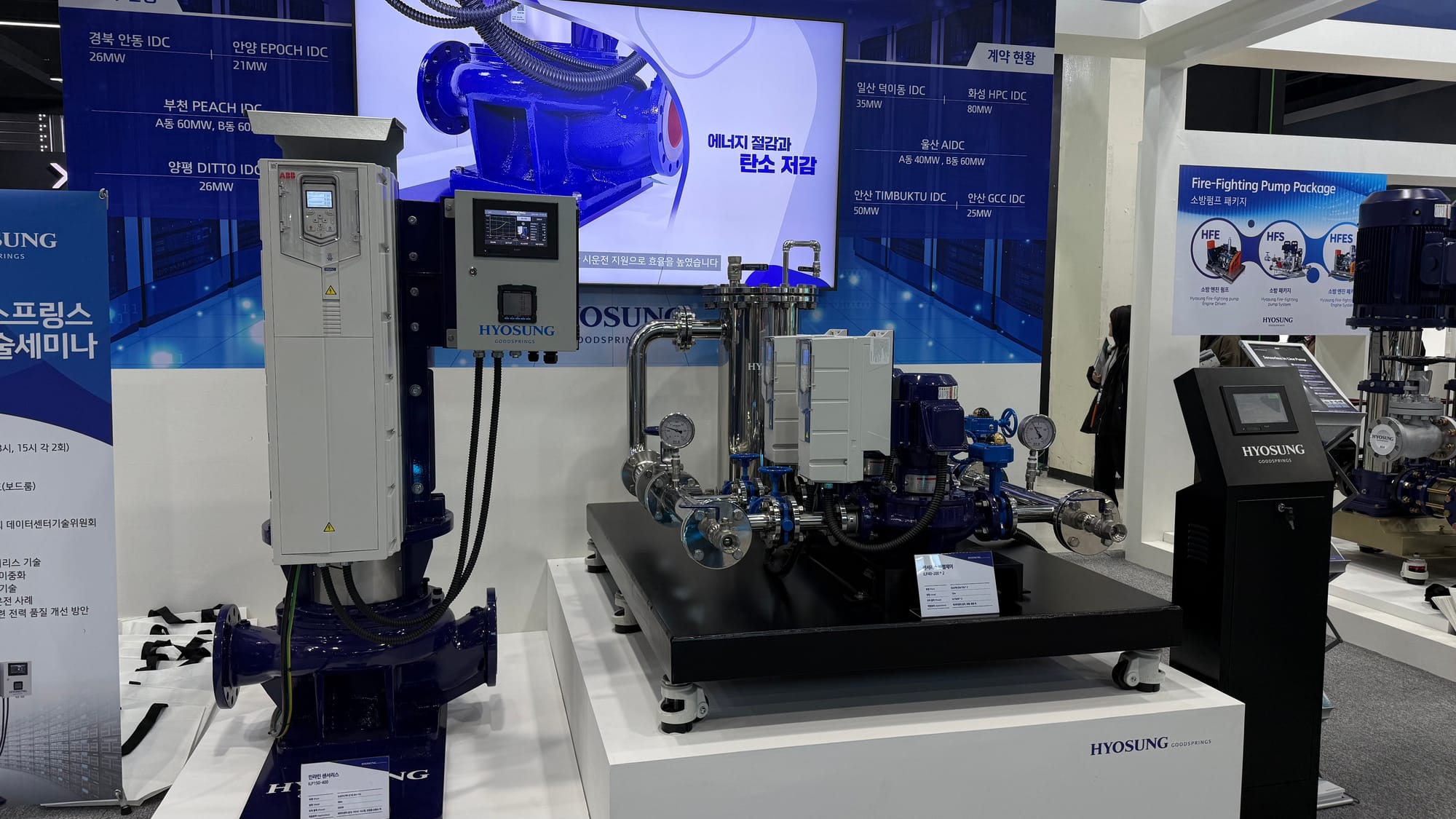
Hyosung Goodsprings, Hyosung Group’s pump specialist affiliate, unveiled a high-efficiency pump system designed to reduce energy losses during coolant circulation and manage power quality.
Both companies emphasized stable data center operations and long-term energy cost savings as competitive strengths beyond the performance of individual equipment.
This technological competition comes amid rapidly rising data center electricity demand. According to the International Energy Agency’s (IEA) “Key Questions on Energy and AI” report, released in April 2026, annual global data center electricity consumption is expected to approximately double from 485TWh in 2025 to 950TWh in 2030.
Electricity consumption at AI-focused data centers in particular is expected to triple over the same period. As AI server power density rises, cooling equipment’s energy efficiency and operational reliability are becoming more important because the heat generated must be handled reliably.
Autech Carrier expands CDU capacity to handle GPU heat, with operating cost savings also a priority
The main equipment featured at Autech Carrier’s booth was the 65LL CDU, a key component of liquid cooling. A CDU exchanges heat between coolant that has absorbed heat from servers and coolant supplied by facility-side equipment such as chillers, while also distributing coolant.
Conventional air cooling cools the air around servers, whereas liquid cooling uses coolant to remove heat directly from high-performance semiconductors. As GPU heat output and server rack power density rise, liquid cooling is becoming increasingly important for handling heat from high-density AI servers.
The 65LL presented by Autech Carrier has a cooling capacity of 1.3MW and has obtained “Product Qualified” certification on the Nvidia Marketplace.
At the exhibition, Autech Carrier Vice President Im Seung-cheol emphasized heat exchange efficiency as a strength. “We have reduced the approach temperature, which indicates the temperature difference arising during heat exchange between facility-side and server-side coolant, from around 4°C for typical products to 2°C,” Im explained.
A smaller temperature difference reduces the need for chillers to produce coolant at excessively low temperatures, helping save energy.
Autech Carrier estimates that its proprietary heat exchange technology can reduce chiller energy use by approximately 10% to 15%. This company estimate refers to chiller energy use, not total data center electricity consumption.
The company is also pursuing larger products. Building on its current 1.3MW product, Autech Carrier is working to introduce a 2.6MW CDU and plans to expand cooling capacity to 5MW. The company considers greater cooling capacity necessary as the power density of server racks containing high-performance GPUs increases.
During an on-site question-and-answer session, Im identified energy efficiency and cooling capacity as the key competitive factors for CDUs. “As GPU heat density and rack power density increase, the key is how far capacity can be expanded,” Im said. “We are increasing CDU capacity while continuing to reduce approach temperatures to improve efficiency.”
The company also identified integrated solutions that manage overall operations, beyond improvements in cooling equipment performance, as central to business expansion.
Autech Carrier connects chillers, CDUs, digital controls and maintenance services through global Carrier’s integrated QuantumLeap solution.
It uses the WebCTRL building automation system and Nlyte data center infrastructure management system to monitor equipment operating conditions and power and cooling capacity. Through the BluEdge digital maintenance platform, AI and specialist engineers jointly analyze equipment operating data to detect early signs of abnormalities.
“Initial investment matters in data centers, but the most important issue is how much operating costs can be reduced over the entire life cycle, in other words, how much total cost of ownership, or TCO, can be reduced,” Im emphasized. This means considering not only cooling equipment installation costs but also electricity bills and maintenance costs incurred over extended operation.
The company is also expanding its business results. Autech Carrier was selected in August 2026 as the cooling solutions supplier for a 48MW hyperscale data center in the Seoul metropolitan area. In October 2026, it was selected as the preferred bidder to supply cooling equipment for a 200MW AI cluster data center being pursued in Gumi, North Gyeongsang Province.
For the Gumi project, it is pursuing the supply of 160 AquaForce 30XFZ high-efficiency air-cooled inverter chillers from global Carrier. Whether a final supply contract will be signed, and its scale, have not been confirmed.
“We are currently preparing negotiations concerning multiple data center projects, but it is difficult to disclose specific project names and sizes,” Im said.
Hyosung Goodsprings improves coolant circulation efficiency and manages power quality
Hyosung Goodsprings is also stepping up its efforts in the data center cooling market. At the exhibition, it presented solutions focused on improving the efficiency and ease of operation of pumps that reliably circulate coolant.
Even high-performance cooling equipment cannot effectively handle heat from servers unless coolant is supplied appropriately where it is needed.
Hyosung Goodsprings introduced a sensorless inline pump for data center cooling at its booth. The product combines a pump and an inverter in a single unit and uses sensorless control technology.
An inverter adjusts the rotational speed of the pump motor. By controlling the pump according to the operating conditions needed to supply coolant, it reduces unnecessary energy consumption.
A Hyosung Goodsprings representative explained that integrating the pump, inverter and harmonic mitigation filter reduced the installation footprint.
Harmonics are distortion components in voltage and current waveforms that can arise from power conversion equipment such as inverters and can affect power quality and equipment operation. Separate filters are sometimes installed to reduce these effects. Hyosung Goodsprings said it had made installation easier by integrating the relevant components into a single product.
At this exhibition, the company particularly emphasized its newly introduced harmonic distortion monitoring function, developed in response to customer requirements. Harmonic distortion indicates how far a voltage or current waveform deviates from its fundamental waveform.
Previously, separate measuring equipment was needed to check this value. The new product allows operators to check electrical waveform distortion in real time during operation through a display mounted on the pump. The company explained that this makes equipment inspections more convenient and makes signs of power quality problems easier to identify.
“We reduced the installation footprint by integrating the pump, inverter and filter into a single unit,” a Hyosung Goodsprings representative said. “Previously, a separate instrument was needed to check harmonic distortion, but operators can now check it directly on the display.”
“We developed it into a product because customers asked for this function,” the representative added. The explanation was that the product improvements reflected equipment management difficulties raised by customers during data center operations.
In addition to the sensorless inline pump, Hyosung Goodsprings exhibited an IE5 booster pump for water supply equipped with an ultra-high-efficiency motor, a fire pump package and a dry-installed sewage and drainage pump package.
Its strategy is to strengthen its position as a comprehensive pump solutions supplier by offering not only server cooling pumps but also water supply, firefighting and drainage equipment essential to data center operations.
The company has established a supply record primarily at domestic data centers, but expanding overseas remains a task ahead.
“We supply products to domestic data centers, but have not yet entered the overseas data center market,” a Hyosung Goodsprings representative said.
Whether it can demonstrate competitiveness overseas based on the technology and supply experience acquired in domestic projects is expected to be a key factor in its future business expansion.
Meanwhile, as AI data centers become larger and more densely equipped, cooling infrastructure companies’ competitiveness would depend not only on individual equipment performance but also on their ability to ensure long-term operating efficiency and reliability.
This is because effectively removing heat from servers, reliably circulating coolant and minimizing equipment failures and energy losses directly affect data center operating costs.
Competition in the cooling equipment market is therefore expected to expand beyond larger, more efficient equipment to include digital controls, predictive maintenance and customer-specific operating technologies.
Original Korean article: ER Economic Review
English brief by Korea Wind Intelligence, koreawindintel.com

















