Battery thermal runaway and data center outages highlight fire risks in emerging industries
The Fire Insurers Laboratories of Korea reported that automatic fire suppression systems stopped thermal runaway propagation and reignition in full-scale comparative tests involving pouch and cylindrical batteries for energy storage systems. Without the suppression systems, all the batteri
Battery thermal runaway and cascading fires emerge as new risks
Flexible responses through private-sector standards that supplement regulation
A firefighter moves a burned lithium-ion battery into a water tank for extinguishing fires at the National Information Resources Service in Yuseong District, Daejeon, where a fire broke out.
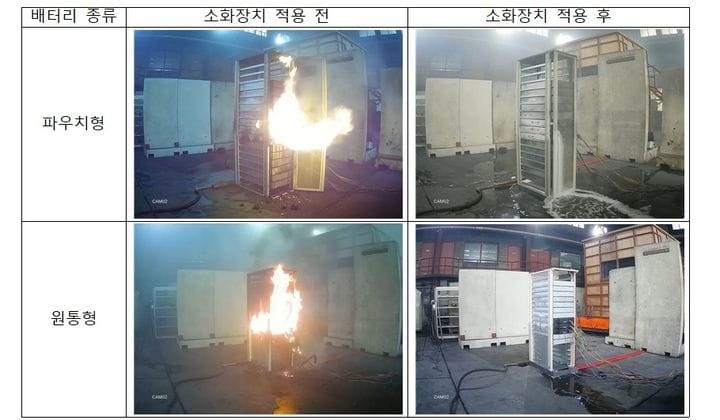
The Fire Insurers Laboratories of Korea conducted full-scale comparative fire tests under identical conditions to verify the actual extinguishing performance of automatic fire suppression systems on pouch and cylindrical batteries used in energy storage systems (ESS). The tests found that all the batteries burned completely without the suppression systems. With automatic fire suppression systems installed, however, the systems activated immediately after thermal runaway occurred, releasing extinguishing agent onto the fire, providing cooling, preventing thermal runaway propagation and completely preventing reignition. November 8, 2026. · Photo: Newsis
The Fire Insurers Laboratories of Korea conducted full-scale comparative fire tests under identical conditions to verify the actual extinguishing performance of automatic fire suppression systems on pouch and cylindrical batteries used in energy storage systems (ESS). The tests found that all the batteries burned completely without the suppression systems. With automatic fire suppression systems installed, however, the systems activated immediately after thermal runaway occurred, releasing extinguishing agent onto the fire, providing cooling, preventing thermal runaway propagation and completely preventing reignition.
South Korea's government has decided to consolidate five state-owned power generators (Korea East-West Power, Korea Midwestern Power, Korea Western Power, Korea Southern Power, and Korea Southeastern Power) into a single entity called 'Korea Generation' after 25 years of operating separately.
Korea's five state-owned generators become one in October 2027. They hold 14.0 GW of offshore wind, a third of the national pipeline. What the merger case rests on, and what it leaves unanswered.
Each report takes a project from wind and site to an optimised turbine layout, net energy after wake, the grid connection route, capital cost and levelised cost of energy (LCOE), with sensitivities to wind, wake and cost. Group reports analyse neighbouring projects together, including the wake between them.