

A Democratic victory in both chambers of Congress in the US midterm elections could bring short-term benefits to solar and rechargeable battery stocks in South Korea, according to an analyst's outlook.
By contrast, potentially tighter regulation of AI data centers could increase pressure on the power equipment sector, according to the analysis. The medium- to long-term impact on sectors such as semiconductors was expected to be limited.
At a press briefing at the Korea Exchange on October 27, Hyundai Motor Securities analyst Kim Jae-seung analyzed the implications of the US midterm elections for Korean stocks, saying: “If Democrats win both chambers, there could be moves in the opposite direction to the previous Trump trade.”
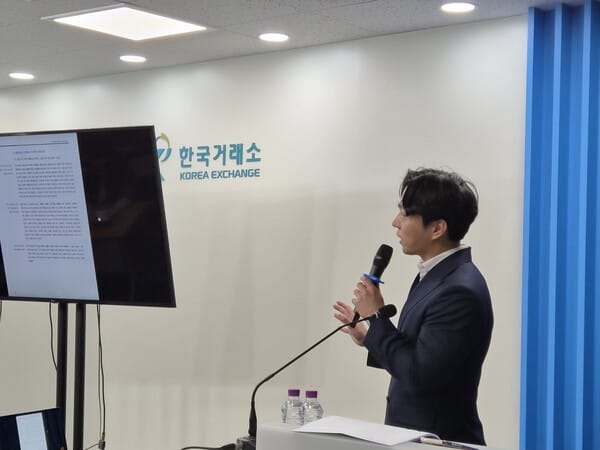
Kim explained that if Democrats win both the Senate and the House in the November 3 US midterm elections, President Donald Trump's ability to advance policies could weaken, potentially shifting investor attention toward sectors that had previously been overlooked.
Solar, rechargeable batteries and the energy storage system (ESS) sector were identified as leading potential beneficiaries. The analysis suggested that sectors where investor sentiment had weakened because of the Trump administration's fossil fuel-focused energy policy and reduced support for clean industries could be reassessed following a Democratic takeover of Congress.
However, Kim stressed that such a trend would likely amount to only a short-term rebound. Even if Democrats control Congress, Trump would retain veto power, making it difficult to reverse existing policies or pass new legislation.
Kim explained: “Even with the previous Trump trade, gains in beneficiary stocks did not last more than a month. Although it would be positive for investor sentiment, passing actual legislation takes time, so investors need to approach this from a short-term trading perspective.”
Diverging prospects within AI: resilient semiconductors, short-term fluctuations for power equipment
The possibility was raised that semiconductor and power equipment shares could perform differently within AI-related sectors. A Democratic takeover of Congress could lead to tighter regulation and oversight of data center construction in the United States.
The analysis suggested that rising electricity prices and water shortages associated with AI data center expansion are becoming political issues as they intersect with cost-of-living pressures in the United States.
This could be particularly negative for Korean power equipment suppliers that have grown largely through the US market. Delays to data center construction starts or completion could reduce short-term demand for power facilities.
Kim said: “The recent weakness in Korean AI power equipment stocks reflects concerns that data center construction could slow. If Democrats take control of Congress, tighter data center regulation could weigh on investor sentiment toward related companies.”
By contrast, Kim maintained a relatively positive view of the semiconductor sector. The reasoning was that even if data center construction is delayed in the United States, global big tech companies would be more likely to shift investment overseas than reduce AI investment.
Kim explained: “AI data center construction would be delayed within the United States, not outside it. The longer construction is delayed in the United States, the more data centers big tech companies will seek to secure overseas.”
Kim added: “Semiconductor demand is expected to remain resilient because data center investment could expand in regions outside the United States, including Australia, Japan and South Korea. I do not expect a significant impact on Korea's semiconductor or materials, components and equipment sectors.”
Uncertainty would remain after a Democratic sweep: budget and debt ceiling negotiations
It was also noted that US policy uncertainty would be difficult to eliminate entirely even if Democrats take control of Congress.
Hyundai Motor Securities analyst Choi Je-min said: “A Democratic sweep could reduce the risk of additional fiscal expansion by the Trump administration, but it would not mean a reduction in existing fiscal policies. Policies over which the president has substantial authority, such as tariffs and war, are likely to remain in place for the time being.”
Choi saw congressional budget negotiations and the debt ceiling as potential new sources of uncertainty. Budget negotiations ahead of the expiration of the temporary funding measure on December 11 and debt ceiling negotiations in 2027 were cited as key variables.
Choi stressed: “If Democrats take control of Congress, constraints on additional fiscal expansion would increase, but uncertainty over government debt and spending could actually rise. Attention should also be paid to the possibility that the Trump administration could pursue foreign affairs, national security and tariff policies more aggressively.”
Original Korean article: ebn.co.kr
English brief by Korea Wind Intelligence, koreawindintel.com

















