

Concerns about data center construction regulation after the US midterm elections
Major technology companies respond with on-site generation and adjustments to electricity use
Investment delays rather than cancellations; HBM demand expected to face limited impact
Smart chatbot answers are welcome, but public attitudes can change if the enormous data centers behind them raise household electricity bills. Opposition to data centers that emerged during the US midterm elections reflects this concern: whether residents should share the costs when electricity-intensive artificial intelligence (AI) data centers are built. The solution proposed by major technology companies is relatively straightforward. They plan to secure their own electricity and temporarily reduce consumption when other users need more.
Mirae Asset Securities' research center expects future regulation of major technology companies to require designs that place less strain on electricity grids. Grid connections were already a major obstacle to data center construction before the election. Its analysis suggests that the on-site generation and electricity-use management technologies companies have been preparing could also help them respond to regulation.
The first approach is to place a dedicated power plant beside a data center. Instead of waiting for access to the local grid, companies procure the electricity they need separately. Microsoft signed a 20-year agreement with Chevron to receive electricity for a Texas data center, involving the joint development of dedicated gas-fired generation facilities. The aim is to reduce the additional strain on the grid used by local residents.
The second approach is to change when electricity is used. Google has signed demand-management agreements totaling 1 gigawatt (GW) with US utilities. During electricity shortages, it reduces some AI training workloads or shifts them to other times. Deferring non-urgent tasks reduces pressure on the grid during its busiest periods. Google said this flexibility helps bring forward grid connections for data centers.
Another approach is to distribute locations. Rather than concentrating GPUs at a single site, companies could install them across several regions where electricity is available and connect them through high-speed telecommunications networks. This would allow work to continue elsewhere even if a large construction project in a particular region is blocked. The analysis also raised the possibility that this trend could accelerate data center investment outside the United States, including in South Korea and Japan.
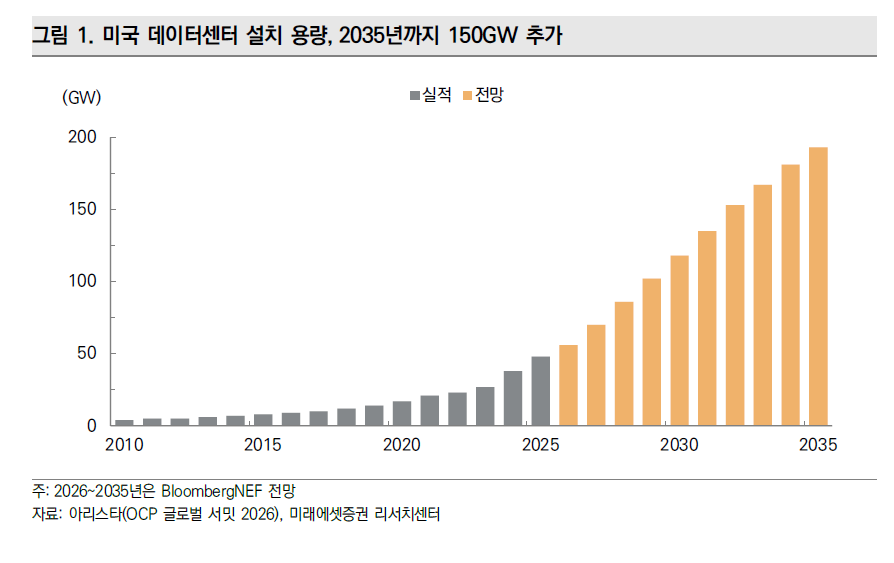
The report estimated that regulation could affect up to 13GW of capacity, approximately 9% of the 150GW in additional capacity expected by 2035. On this basis, it considered delays in AI investment more likely than its disappearance. Deferring some capital expenditure could restore free cash flow (FCF) and ease the burden of raising funds through bonds. However, the report argued that companies cannot keep postponing capital expenditure given their cloud order backlogs and rapidly growing revenue.
It also emphasized the need to distinguish between products when assessing the impact on South Korean semiconductor stocks. Mirae Asset Securities analysts Kwon Young-bae and Kim Young-geon said, "High-bandwidth memory (HBM), with demand secured through long-term agreements (LTAs), is expected to remain relatively stable." They added, "Conventional DRAM and SSDs used alongside CPUs could be more sensitive to construction delays, but this is not a cause for concern considering that the shift to HBM is further tightening conventional DRAM supply."
Original Korean article: core.asiae.co.kr
English brief by Korea Wind Intelligence, koreawindintel.com

















