

Industry and company analysis | AI infrastructure, data center cooling and energy efficiency
As demand for AI computing changes data center design criteria, the efficiency and operational reliability of facility infrastructure, including cooling, water supply, firefighting and drainage, are emerging as new competitive factors alongside servers and semiconductors. This is because managing the heat generated alongside power consumption becomes more important as data centers perform higher-density computing. Pumps, which control fluid flow through cooling equipment, are also considered equipment that affects data center power consumption and operational reliability.
Hyosung Goodsprings, Hyosung Group's pump specialist affiliate, will participate in Data Center Korea 2026, held in Yangjae-dong, Seoul, from November 4 to November 6, 2026, to showcase data center pump solutions, including a sensorless inline pump. In particular, this year it has added a harmonic distortion monitoring function that allows users to check electrical waveform distortion in real time, making equipment condition checks more convenient.
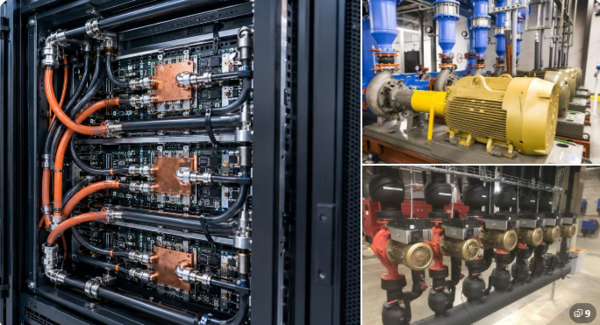
The industrial significance of this exhibition lies less in the introduction of new products itself than in how the role of pumps is changing in the data center market. AI data centers require integrated design not only of server computing performance but also of power supply, thermal management, equipment controls and maintenance arrangements. Accordingly, pump manufacturers are also required to go beyond simply supplying equipment and respond at the system level, considering both energy efficiency and operational reliability.
However, growth in the data center market does not automatically translate into increased revenue or improved profitability for individual pump companies. Assessing actual business performance requires specific verification of product adoption, the value of project orders, installation records, maintenance revenue and energy savings compared with competing products.
Part 1. AI data center constraints shift from computing capacity to thermal management and power efficiency
Rising data center electricity demand changes the market for equipment suppliers
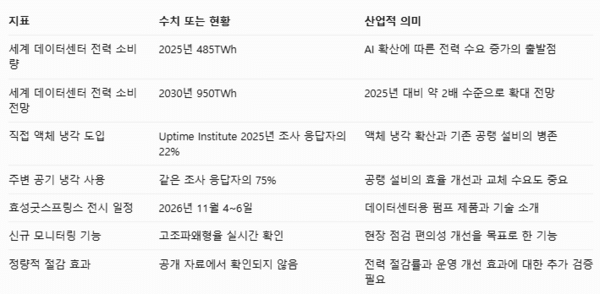
In material published in 2026, the International Energy Agency (IEA) projected that global data center electricity consumption would nearly double from approximately 485 TWh in 2025 to approximately 950 TWh in 2030. Its analysis suggests that data centers could account for approximately 3% of global electricity consumption in 2030. Electricity consumption at AI-focused data centers, in particular, was expected to grow faster than that of data centers overall.
As electricity demand increases, energy management inside the data centers consuming that electricity becomes important alongside generation, transmission and distribution equipment. A substantial portion of the electricity supplied to servers is converted into heat. If this heat is not removed properly, server operating temperatures rise, potentially leading to reduced performance or operating restrictions to protect equipment.
Cooling equipment plays a central role in this process. Cooling towers, chillers, heat exchangers, air-conditioning units, piping and pumps work together to transfer heat generated by servers and electrical equipment outside the facility. Among these components, pumps circulate cooling water or heat-transfer fluids at the required flow rate and pressure.
This is also why the growing importance of pumps as data centers expand is not simply a matter of larger equipment. Cooling systems must adjust flow rates in response to changes in server loads while reducing unnecessary circulation and excessive pressure losses. Functions that continuously check equipment operating conditions and detect potential failures early are also needed.
However, an increase in data center electricity consumption does not mean that the pump market will grow at the same rate. The number and specifications of pumps vary depending on the data center's cooling method, design capacity, cooling-water circuit configuration and equipment redundancy requirements. Assessing the actual market size requires consideration not only of new construction but also of demand to replace and expand cooling equipment at existing facilities.
From air cooling to liquid cooling, the technical role of pumps expands
Air cooling uses air to remove heat generated by servers. It offers the advantages of extensive operating experience accumulated over time and the ability to use existing equipment, but increasing server rack power density places greater demands on airflow and heat-exchange capacity. Adjusting the operating conditions of air-conditioning units and fans alone may become insufficient to manage heat in high-density computing environments.
Liquid cooling uses a liquid as the heat-transfer medium. In direct-to-chip cooling, cold plates connected to server CPUs or GPUs absorb heat, which is then transferred outside through coolant distribution units and piping. Other configurations, such as rear-door heat exchangers and immersion cooling, are also used.
In its thermal management guidance for AI data centers, the American Society of Heating, Refrigerating and Air-Conditioning Engineers (ASHRAE) emphasizes the integrated design of liquid cooling systems, coolant distribution units, pumps, valves, piping and control systems suited to high-density server environments. The intent is to consider the efficiency and reliability of the entire thermal management system rather than evaluate cooling equipment solely on the performance of individual components.
These changes create new technical requirements for pump manufacturers. They must consider the equipment's required flow rate and head, cooling-water temperature and pressure, piping resistance and operating range, while also ensuring prolonged continuous operation and ease of maintenance. Pump materials, sealing arrangements and control methods may also need to differ depending on the properties of the cooling water and the system configuration.
An important point here is that not every data center is switching to liquid cooling. General-purpose business servers and high-density AI servers have different thermal loads, and cooling methods may be combined within the same facility. When installing new equipment, existing data centers must consider space, piping, electrical capacity and compatibility with existing cooling systems.
In Uptime Institute's 2025 cooling systems survey, 22% of respondents said they used direct liquid cooling. Air cooling using ambient air was reported by 75%. Because the survey allowed multiple responses, the two percentages are not mutually exclusive market shares. The findings indicate both the potential for liquid cooling to spread and the continued widespread use of existing air-cooling equipment.
The sensorless inline pump being presented by Hyosung Goodsprings is a product that could be considered in this cooling infrastructure market. However, the information disclosed in the press release alone makes it difficult to establish the extent to which the product can be applied to specific liquid cooling methods, such as direct-to-chip cooling or immersion cooling. Its actual range of applications and track record of integration into cooling systems require separate verification.
The significance of sensorless control and an integrated inverter design
Hyosung Goodsprings said it had incorporated an integrated inverter design and sensorless control technology into its sensorless inline pump. It has also added harmonic distortion monitoring for this year's exhibition.
An inverter controls rotational speed by adjusting factors such as the frequency of the power supplied to a motor. Adjusting pump speed to actual flow demand can reduce operation that supplies more flow than necessary or restricts flow using valves. Under suitable system conditions, this can help reduce pump electricity consumption.
Pump power consumption varies with rotational speed, operating point and piping system resistance, among other factors. Under the ideal affinity laws for centrifugal pumps, when rotational speed decreases, flow is proportional to speed, head to the square of speed and power to the cube of speed. In actual equipment, however, static head, changes in efficiency, minimum flow requirements and control methods also have an influence, so this relationship alone cannot establish the savings achievable at a particular site.
Sensorless control generally refers to technology that estimates or controls the required operating information through a motor's electrical characteristics or control algorithms, rather than relying on separate mechanical sensors. The specific variables measured and control methods used differ by product. Detailed technical specifications and test results are therefore needed to assess the control accuracy and application range of Hyosung Goodsprings' product.
An integrated inverter design may help reduce the space and wiring required to install and connect a separate inverter. However, data centers must comprehensively assess not only whether equipment can be installed but also heat generation, electromagnetic compatibility, power quality, maintenance access and replacement procedures in the event of a failure.
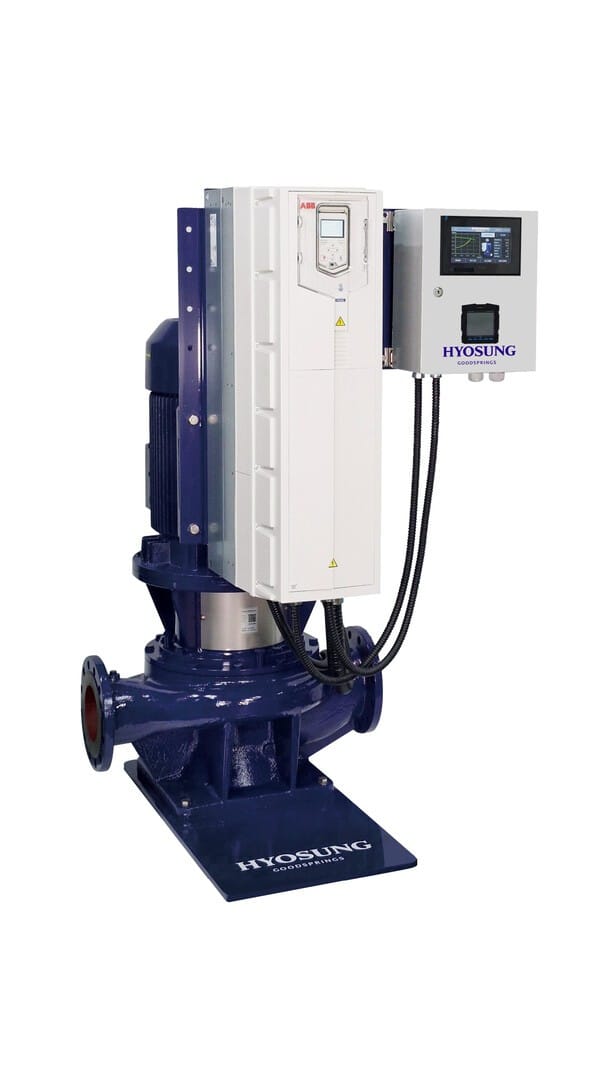
Improvements in efficiency are also difficult to assess solely from the rated efficiency of a single pump. Electricity consumption must be compared across the entire system, including actual operating hours and load changes, the number of pumps running, piping pressure losses and the cooling system's control strategy.
Harmonic distortion monitoring as a diagnostic function for failure prevention
Harmonics relate to the presence in voltage or current waveforms of frequency components at integer multiples of the ideal fundamental frequency. Power conversion equipment such as inverters can generate harmonics in the power network, with their levels and effects varying according to equipment configuration and power supply conditions.
Harmonic distortion generally indicates the magnitude of harmonic components in a waveform relative to the fundamental component. Voltage distortion and current distortion are different metrics, and the quantities measured and calculation methods must also be distinguished.
High harmonic levels can cause additional losses, overheating or protective device malfunctions, depending on equipment configuration. However, harmonic distortion alone cannot establish whether a pump has failed or predict the service life of a particular component. It must be assessed alongside other operating information, including power quality, load conditions, motor temperature, vibration, pressure and flow rate.
Hyosung Goodsprings explained that the new function allows users to check electrical waveform distortion in real time on the pump's built-in display. The company said it simplifies inspection procedures by making information that previously required separate measuring equipment available directly on the equipment.
If the function becomes established in field use, it may help maintenance personnel identify signs of abnormal operation and determine when additional measurements or inspections are needed. In data centers, where multiple pieces of equipment operate continuously, improving inspection access is itself meaningful for operational management.
However, real-time monitoring does not automatically mean failure prediction. The published material did not provide thresholds for automatically identifying abnormal conditions, methods of linking alarms, remote monitoring functions or actual reductions in failures. The improvement currently established is therefore limited to making electrical waveform distortion information directly available on site.
Demonstrating the product's competitiveness in the future will require the accumulation of data from normal and abnormal operation, along with verification of measurement accuracy and repeatability, alarm criteria and actual reductions in maintenance time.
Part 2. From cooling to water supply, firefighting and drainage, the scope of equipment supply influences competitiveness
Expanding from individual pumps to system supply
The product range Hyosung Goodsprings is presenting at this exhibition is not limited to sensorless inline pumps for cooling. It will also showcase IE5 booster pumps for water supply, fire pump packages and dry-installed wastewater and drainage pump packages. Offering products that cover major data center facility functions can be interpreted as a strategy to expand beyond supplying individual items of equipment and become a provider of integrated pump solutions.
Data centers are facilities in which power supply, cooling, water supply, firefighting, drainage and other equipment must operate simultaneously alongside servers and network equipment. Although each system has different functions and operating criteria, a problem in any one area may affect the reliability of the entire facility.
Cooling pumps circulate fluid in thermal management systems, while booster pumps supply water at the required pressure. Fire pumps must supply firefighting water under the specified design conditions in the event of a fire, while drainage equipment handles water resulting from leaks or drainage processes. Although all these types of equipment are based on pumps, their required performance and design conditions differ.
The ability to supply multiple products therefore does not, by itself, establish an ability to operate all the equipment on an integrated basis. Data center developers require not only a diverse product range but also technical support during design, on-site installation and commissioning, coordination between systems, spare parts availability and arrangements for responding to failures.
For Hyosung Goodsprings to turn its total pump solution strategy into actual business results, it must demonstrate not only delivery records for individual products but also its project-level scope of supply and maintenance capabilities. The role a pump supplier takes among designers, construction contractors, cooling system integrators and data center operators is also directly linked to business profitability.
In large-scale data center projects in particular, equipment selection may begin at an early design stage. If a product is incorporated into the design criteria, it may be selected again for subsequent expansions or the construction of similar facilities. Conversely, exclusion during design may make it difficult to secure supply opportunities even if the product is price-competitive.
IE5 booster pump efficiency must be verified under actual operating conditions
Among the products disclosed by Hyosung Goodsprings, the IE5 booster pump warrants examination from an energy-efficiency perspective.
IE5 is a designation used in an international classification system for electric motor efficiency. However, the efficiency of a motor rated IE5 must be distinguished from the efficiency of the entire pump system. This is because pump hydraulic efficiency, motor efficiency, inverter losses, piping resistance and the actual operating point together determine total energy consumption.
For example, even with a high-efficiency motor, system-level savings may be limited if a pump is oversized relative to actual demand or operates at unnecessarily high pressure. Conversely, adjusting rotational speed to load changes and reducing piping losses can be expected to deliver benefits from improving equipment and control systems together.
Data center water supply systems must also be distinguished from cooling-water circulation systems. Depending on a facility's purpose and design, water supply can serve various needs, including domestic water and makeup water, whereas cooling water operates in separate circuits according to the cooling method and heat-exchange configuration. Not all data centers have the same water supply demand or cooling-water consumption.
The commercial value of an IE5 booster pump is therefore not determined by its rating alone. It is necessary to establish how much it reduces electricity consumption compared with existing products under the site's flow and pressure conditions, how flexibly it responds to load changes, and how much it reduces life-cycle costs, including maintenance expenses.
As such verification results accumulate, Hyosung Goodsprings could discuss costs with customers on the basis of the entire operating period rather than just the initial equipment price. As energy costs become a major component of data center operating expenses, long-term operating efficiency may have a greater influence on equipment selection than the purchase price.
Data center reliability cannot be secured through cooling equipment alone
Unlike typical industrial facilities, service interruptions at data centers directly affect customers' work and information processing. Because data centers handle financial transactions, cloud services, enterprise applications and AI inference workloads, a cooling equipment failure can become more than a simple mechanical breakdown.
For this reason, data center design considers redundancy in major equipment, standby equipment availability, isolation of failed sections and the ability to maintain service during maintenance. Even when multiple pumps are installed in a cooling system, a problem in shared piping, power supplies or controls can affect the entire system. The effectiveness of a redundant design depends less on equipment quantities than on a configuration that can independently contain failures.
ASHRAE's integrated design principles for AI data centers likewise indicate that power, cooling and facility structures should be considered at the overall system level rather than designed separately. Liquid cooling systems require joint consideration of leak detection, zonal isolation, fluid distribution and control arrangements.
Hyosung Goodsprings' pump solutions will also be evaluated within this design environment. In addition to pump performance, actual purchasing decisions may be influenced by the effect of maintenance on other equipment, the time required to replace spare parts, the convenience of checking operating conditions and the availability of alternative operation following a failure.
Fire pumps are also equipment that must meet separate safety standards and design requirements. Even when cooling pumps and fire pumps are installed in the same data center, their operating purposes and conditions differ. An integrated supply strategy must therefore be designed to meet each type of equipment's specific certification, inspection and design requirements while reducing procurement and maintenance burdens for the project as a whole.
Market expansion offers opportunities alongside price competition and technological change risks
The data center market's growth outlook offers pump manufacturers new business opportunities, but growth rates do not automatically translate into profitability.
The first variable is the equipment investment schedule. Data center construction involves interconnected requirements for grid connections, land acquisition, permitting, server procurement and cooling design. Delays in power supply or changes to a developer's investment plans may also postpone orders for related equipment. In its data center electricity demand outlook, the IEA likewise assessed that constraints in energy equipment and semiconductor supply chains could affect the short-term growth trajectory.
The second variable is the competitive landscape. Competition in the pump market may come not only from existing industrial pump manufacturers but also from companies supplying motors, inverters and cooling systems together. Suppliers' bargaining power also varies depending on whether a data center developer procures individual items of equipment directly or purchases a package through a cooling system integrator.
The third variable is technological change. AI server power density and cooling methods may continue to change. Demand to improve existing air-cooling equipment and demand for new liquid cooling systems may coexist, but products that depend too heavily on particular operating conditions may struggle to respond to market changes. Cooling-water distribution methods, fluid properties and compatibility with control systems are also factors to consider during product development.
The fourth variable is actual profitability. High-efficiency products may incur technology development and validation costs, while project-level supply also entails costs related to delivery schedules, on-site response and quality assurance. Even if revenue increases, intense price competition or rising maintenance costs may limit improvements in profit.
Finally, evidence is needed to demonstrate objectively the technical advantages of products for data centers. Disclosure of electricity consumption, operating efficiency, failure rates, maintenance time and the number of actual project applications compared with existing products would make it easier for the market to assess product competitiveness. The currently available press release does not include such quantitative comparisons.
Future business performance depends on orders and operating data
When assessing Hyosung Goodsprings' data center business, it is necessary to track subsequent business developments rather than focus on exhibition participation itself.
First, it is necessary to establish whether the company receives orders directly from data center developers or supplies products through designers, construction contractors or cooling system integrators. The supply channel affects the scope of project participation and the earnings structure.
Second, operating performance must be verified after products have been installed in actual data centers. Important evidence includes whether harmonic distortion monitoring reduced inspection time, whether it contributed to early detection of abnormal conditions and how much pump electricity consumption was reduced.
Third, it is necessary to examine whether the company secures a recurring revenue base. If new equipment supply leads to spare parts sales, periodic inspections, maintenance contracts and efficiency improvements to existing equipment, dependence on one-off orders could be reduced.
Fourth, the ability to expand supply into overseas data center markets is also an assessment criterion. Overseas business requires local certifications, technical support, parts supply chains and partnerships. Whether the company can extend its domestic application record to meet overseas market requirements is a variable in medium- to long-term business growth.
Through this exhibition, Hyosung Goodsprings is presenting a product range covering cooling, water supply, firefighting and drainage, along with improved monitoring functions. Additional evidence, such as order disclosures, business results and product-specific application examples, will be needed to determine whether this strategy translates into actual revenue and profit.
Data analysis: Key indicators for data center growth and the pump industry
Reporter's view: Verifying results takes priority over technical descriptions when assessing benefits from AI infrastructure
As investment in AI data centers expands, the scope of industry competition is extending from semiconductors and servers to power, cooling and facility management. Pumps are not highly visible equipment, but their role in fluid circulation and thermal management makes them a component of data center operating efficiency. Hyosung Goodsprings' presentation of sensorless control and harmonic distortion monitoring alongside water supply, firefighting and drainage products can be viewed as a strategy to respond to this demand. However, the data center industry's growth outlook should not be directly equated with growth in an individual company's business performance. Business competitiveness can be assessed objectively only after actual order volumes and application records, system-wide electricity savings, maintenance costs and overseas supply capabilities have been verified. Companies must likewise go beyond explaining technical advantages and accumulate verifiable operating data and customer application examples. Long-term competitiveness in the AI infrastructure market is determined not by product presentations at exhibitions but by efficiency and reliability demonstrated in the field.
Original Korean article: newsvalue.kr
English brief by Korea Wind Intelligence, koreawindintel.com

















