

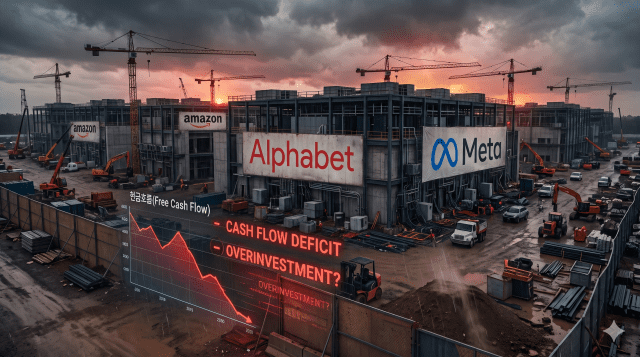
Major technology companies including Alphabet, Amazon and Meta are experiencing deteriorating cash flow as they commit vast sums to artificial intelligence (AI) data centers.
Although their cloud businesses are growing rapidly, some companies are spending more on capital investment than they generate in operating cash flow, raising concerns about recovering investment costs and profitability.
With three of the four major hyperscalers reporting negative free cash flow (FCF) in the third quarter, market attention appears to be shifting from the scale of AI investment and revenue growth to actual investment results and cash generation.
According to Bloomberg on October 31, local time, market caution over the burden of AI investment increased after major US technology companies released their third-quarter results. The technology-heavy Nasdaq 100 index fell 6.7% in October, its largest monthly decline since March last year.
The companies' cloud businesses continued to record strong growth. Third-quarter revenue rose 103% year on year at Google Cloud, 39% at Amazon Web Services (AWS) and 48% at Microsoft's Azure. This indicates that demand for AI infrastructure remains strong.
However, cash flow deteriorated as vast sums were spent on building data centers and securing equipment such as GPUs.
In the third quarter, Alphabet reported a free cash flow deficit of about $9.1 billion, Amazon about $33.5 billion and Meta about $2.1 billion. Free cash flow measures the cash a company generates from operating activities after subtracting capital expenditure.
Amazon, in particular, generated $42.4 billion in third-quarter operating cash flow but spent $77.3 billion on equipment purchases. Its free cash flow swung from a surplus of about $1.3 billion a year earlier to a substantial deficit. Free cash flow for the latest 12 months also showed a deficit of about $42.4 billion.
Alphabet likewise recorded negative free cash flow for a second consecutive quarter as third-quarter capital expenditure more than doubled year on year to $51.4 billion. In addition, slowing growth in conventional search advertising revenue despite increased use of AI search raised concerns about the company's ability to monetize AI services.
Meta also raised its capital expenditure forecast for this year to between $135 billion and $145 billion. As the investment burden increased, international credit rating agency S&P Global lowered Meta's credit rating outlook from stable to negative, citing uncertainty about when returns would exceed the substantial investment costs.
Microsoft, the only one of the four major hyperscalers to maintain positive free cash flow, also faced market concerns. It recorded a third-quarter free cash flow surplus of $18.6 billion, but capital expenditure including finance leases reached $45.2 billion. Its shares fell 1.6% on October 30 as the company signaled further increases in capital spending.
The investment burden on big technology companies is also affecting how they raise funds. Companies that previously financed large investments through their own cash flow are increasing external borrowing to expand AI data centers.
According to financial information provider FactSet, the annual increase in debt at five companies, Alphabet, Amazon, Meta, Microsoft and Oracle, rose from 9% of capital expenditure in fiscal 2024 to 32% over the latest 12 months as of the middle of this year. This indicates that financing burdens are increasing alongside the scale of investment.
These changes are expected to affect the criteria used to assess AI business profitability. Even if cloud revenue increases, continued growth in data center construction costs and financing burdens could mean it takes longer to realize investment returns in cash.
However, major technology companies plan to continue investing in data centers to meet growing AI demand. This is expected to support demand for AI memory, including high-bandwidth memory (HBM) from South Korean semiconductor manufacturers, for the time being. Conversely, prolonged pressure to recover investment costs could affect the pace of future capital expenditure and cost-efficiency strategies.
Related articles
Market observers say the ability to demonstrate returns on AI investment is becoming more important than the investment itself. While securing large-scale data center capacity and increasing cloud revenue have supported growth expectations, they argue that how efficiently invested funds are converted into earnings and cash flow will become a key determinant of corporate value.
Anthony Saglimbene, chief market strategist at Ameriprise, said, "The next stage of AI will be about proving results," adding, "Expectations for the companies building the infrastructure are very high, so each quarter's earnings will show whether those expectations are justified."
Original Korean article: ZDNet Korea
English brief by Korea Wind Intelligence, koreawindintel.com

















