

Data centers become an election issue
With one day to go before the US midterm elections, artificial intelligence (AI) data centers have emerged as an issue in major races across five states: Ohio, Texas, Pennsylvania, Georgia and Tennessee. Opposition over electricity bills, water use, air pollution and tax breaks has spread from progressive environmental groups to Republican-leaning rural voters.
US political news outlet Politico reported on November 2, local time, that tax and permitting policies for the US AI industry, as well as messaging for the 2028 presidential election, could change depending on how clearly voters' views on data centers are reflected in the November 3 elections.
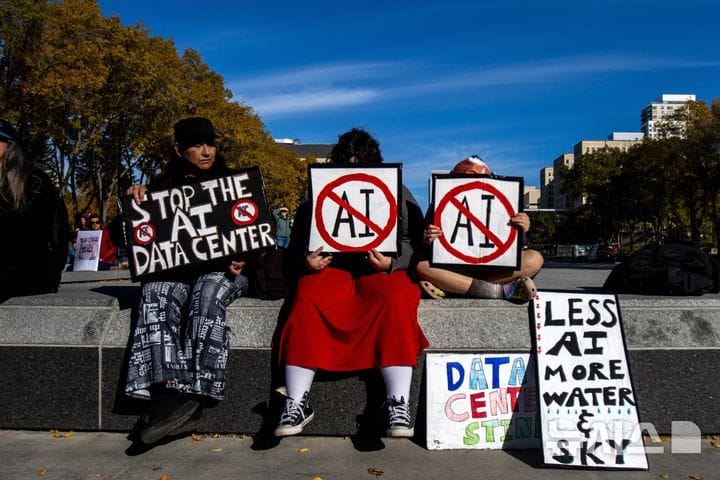
In a Politico poll, the share of respondents supporting an AI data center within 3 miles, or about 4.8 kilometers, of their home fell from 36% in January to 22% in October. Half of those surveyed opposed building a data center nearby.
Depending on the election results, states could change policies on eliminating data center tax breaks, imposing moratoriums on new construction, allocating electricity and water costs, and granting local governments approval authority.
State races and proposed restrictions
The US Senate race in Ohio is where the data center issue could most directly affect the outcome. Former Democratic Senator Sherrod Brown has attacked Republican incumbent Senator Jon Husted, describing Husted as the “face of data centers.”
In a recent campaign advertisement, Brown claimed that Husted had handed $2.5 billion in Ohio tax money to out-of-state companies, including Meta, and billionaires. The attack targeted Husted's record of actively promoting data center projects that received state tax support.
Husted responded with a “Ratepayer Protection Act” intended to encourage state action to prevent data centers from raising electricity bills for ordinary consumers. However, the bill failed to pass the Senate in October, and further action was postponed until after the midterm elections.
In the Texas gubernatorial race, the key question is whether opposition in rural areas, a traditional Republican support base, will translate into lost votes. Republican Governor Greg Abbott called Texas a “hub of AI development” less than a year ago but effectively halted data center permitting in October. The governor said new projects would not receive permits until investigations into power grid and water use issues were completed.
Democratic candidate Gina Hinojosa, a state representative, said, “It is not that we dislike data centers themselves. We dislike data centers taking advantage of Texans, especially rural residents, and Governor Abbott allowing it to happen.” Hinojosa has made the data center issue a central concern affecting residents' lives in the closing stages of the campaign.
In Pennsylvania, the industry's focus is not the gubernatorial race but whether control of the state Senate will change. Democratic Governor Josh Shapiro sought to attract technology companies last year but has recently shifted toward tighter regulation, criticizing developers that increase burdens on residents.
Democrats are concentrating on four Republican-held state Senate seats. If Democrats gain a state Senate majority for the first time in about 50 years, bills that have passed the state House could gain momentum, including proposals to eliminate data center tax breaks, limit electricity and water use, and strengthen local governments' authority to reject construction. Some Democratic lawmakers are also calling for a statewide moratorium on new construction.
In Georgia's closely contested gubernatorial race, Democratic candidate Keisha Lance Bottoms and Republican candidate Rick Jackson have each attacked the other as more vulnerable on data centers. Jackson, a billionaire businessman, has previously invested in a Texas data center opposed by local residents. Bottoms also supported a university-linked data center while serving as Atlanta mayor. Currently, however, Bottoms supports a statewide moratorium on new construction, while Jackson says decisions should be left to local governments.
The US House race in Tennessee's 9th District will provide a test of whether opposition to data centers can narrow the gap between candidates even in a Republican stronghold. President Trump won the district by more than 21 percentage points in the 2024 presidential election. A September poll commissioned by a Democratic-leaning political action committee showed Democratic state Representative Justin Pearson trailing Republican state Senator Brent Taylor by 4 percentage points. Democrats subsequently included Pearson among the candidates receiving concentrated support.
Pearson has made the dispute over gas turbines and air pollution around Memphis, where Elon Musk's xAI data center is located, central to the campaign and is calling for a nationwide moratorium on data center construction. Taylor supports data centers but emphasizes having authored a state law requiring facilities to pay the costs they impose on the power grid or generate their own electricity.
Local ballot measures and wider policy effects
Residents' efforts across party lines will also be tested in Ohio. A conservative who served as a delegate supporting President Trump's nomination at the 2024 Republican National Convention has joined forces with a progressive independent activist in a campaign to ban or restrict very large data centers.
After failing to collect enough signatures to put a statewide construction ban to a referendum, they shifted their focus to local votes. As a result, proposals to ban data centers, limit their size or require residents' consent will go to a vote in several Ohio communities on November 3.
The issues and regulatory tools differ across the five states. Tax breaks and legislative control are central in Ohio and Pennsylvania; electricity, water and construction moratoriums dominate in Texas and Georgia; and disputes over pollution and power grid costs are the main issues in Tennessee.
Politico analyzed the elections as a test of whether dissatisfaction with data centers has grown strong enough to influence actual voting decisions. It also expected the results to affect not only tax and permitting policies for AI data centers, once seen as symbols of investment and growth, but also the responses of candidates in the 2028 presidential election.
Original Korean article: Newsis
English brief by Korea Wind Intelligence, koreawindintel.com

















