

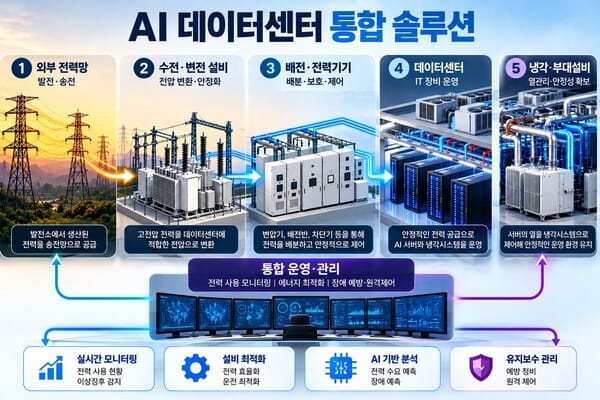
The focus of competition is changing in the artificial intelligence (AI) data center power infrastructure market. The business is expanding beyond supplying individual pieces of equipment, such as transformers and switchgear, into integrated solutions that combine design, construction, power control and operational technology.
As cooperation expands between power equipment manufacturers and companies that build and operate data centers, specialist power equipment suppliers are also becoming more important. Stable supplies of large amounts of electricity require technologies in areas such as transformers, circuit breakers and cables to work together.
AI data centers place greater demands on power supplies than conventional information processing facilities because they operate high-density servers. Unstable power supplies can disrupt computing tasks and cooling systems. The ability to manage supply reliability and energy efficiency, as well as secure sufficient power, is therefore becoming increasingly important.
HD Hyundai Electric and LG CNS combine equipment and operational technology
HD Hyundai Electric signed a memorandum of understanding with LG CNS on day 16 to develop data center power infrastructure and smart factories. The companies agreed to jointly target domestic and international markets by combining HD Hyundai Electric's power and distribution equipment with LG CNS's data center design, construction and operations capabilities.
They will establish a system for supplying power equipment as a package and explore ways to improve operational efficiency by incorporating LG CNS technology into a power monitoring platform. This is an attempt by a manufacturer and a systems implementation company to expand their business scope from equipment supply to management.
This cooperation differs from simple product sales. Instead of selecting suppliers separately for each type of equipment, the companies can propose power system configurations and operational efficiency measures together. This could also reduce customers' equipment procurement and management burdens.
However, the memorandum is a starting point for identifying joint business opportunities. It should not be interpreted as evidence that an integrated solution contract has actually been signed or that operational performance has been demonstrated. Future joint orders and the allocation of responsibilities for individual projects are expected to provide a basis for assessing competitiveness.
LS ELECTRIC and Hyosung Heavy Industries expand power system capabilities
LS ELECTRIC has transformers, switchgear, circuit breakers and power management systems, enabling it to propose solutions covering the overall power supply system. It is also moving beyond equipment supply into technologies that improve power efficiency, including pursuing the development of 800 V direct-current power infrastructure for AI data centers with LG Uplus.
Direct-current distribution could reduce losses by cutting the number of power conversion stages, but compatibility with existing equipment and safety require verification. Technology development agreements should be assessed separately from commercial supply records involving actual data center applications.
Hyosung Heavy Industries has strengths in extra-high-voltage transformers, circuit breakers and substation equipment. Its capabilities in receiving and transforming large amounts of electricity position it to serve the data center power infrastructure market. However, the ability to supply power equipment does not mean that it undertakes the design and operation of an entire data center on a turnkey basis.
The three companies also differ in their business approaches. HD Hyundai Electric is exploring an integrated supply system through cooperation with LG CNS, while LS ELECTRIC is developing power equipment and control technology together. Hyosung Heavy Industries pursues business opportunities based on its technology for large-capacity power equipment.
Iljin Electric, Sanil Electric and LS Cable & System supply specialist equipment
The spread of competition in integrated solutions does not eliminate the role of specialist companies. Iljin Electric focuses on extra-high-voltage transformers and power cables, Sanil Electric on power and distribution transformers, and Cheryong Electric on distribution transformers.
LS Cable & System, Taihan Cable & Solution and Gaon Cable have supply capabilities in cables connecting external grids with data centers. In particular, LS Cable & System is developing next-generation transmission technologies, including superconducting cables, drawing attention to their potential use at facilities with concentrated electricity demand.
These companies can participate as suppliers of core components and equipment even without directly managing integrated solutions. However, supply records for general transmission and distribution networks should not be treated as delivery records for domestic AI data centers. Contracts and applications must be verified separately for each project.
The expansion of integrated supply systems could open new sales channels for specialist power equipment companies. Cooperation with systems implementation companies creates opportunities to participate in large projects based on the competitiveness of individual products. Conversely, if integrated developers gain greater purchasing influence, suppliers could face pressure in price negotiations and delivery terms.
Cooperation and demonstrated profitability are key to integrated supply competition
Data center construction companies and developers, including Samsung C&T and SK ecoplant, also cooperate with power equipment manufacturers. When building, electrical and cooling systems are designed together, compatibility between systems and operational reliability become important alongside equipment performance.
Integrated solutions can expand revenue opportunities beyond equipment sales to design, construction, maintenance and power management services. Customers also gain scope to manage fault response and energy efficiency comprehensively. However, integrated supply does not necessarily guarantee high profits, because developers may face greater construction responsibilities and upfront costs.
The change in the domestic market does not mean that competition in individual power equipment has ended. Rather, the market is developing into a structure in which companies leading integrated projects and specialist suppliers of core equipment, such as transformers and cables, both depend on and compete with one another.
The key will be to demonstrate integration capabilities through actual orders and operational performance, rather than the number of agreements. Companies able to take responsibility for the efficiency of an entire installation while maintaining equipment quality and supply capabilities are expected to gain a competitive position in the new market.
Original Korean article: datasom.co.kr
English brief by Korea Wind Intelligence, koreawindintel.com

















