

Demand for AI data centers is surging, but concerns about investment profitability are also growing. Vacancy rates in major North American markets have fallen to 1.4%, yet Gartner warned that more than $3.5 trillion in AI infrastructure investment could be exposed to asset impairment risk by 2030. Despite high leasing rates, actual AI revenue, financial debt, access to electricity and the economic life of semiconductors will determine investment performance.
AI data centers, a core infrastructure component of the global artificial intelligence industry, are receiving contrasting assessments in investment markets.
Global technology companies are competing to secure data centers and advanced semiconductors, but questions are also growing about whether they can generate sufficient returns to recover their enormous capital expenditure.
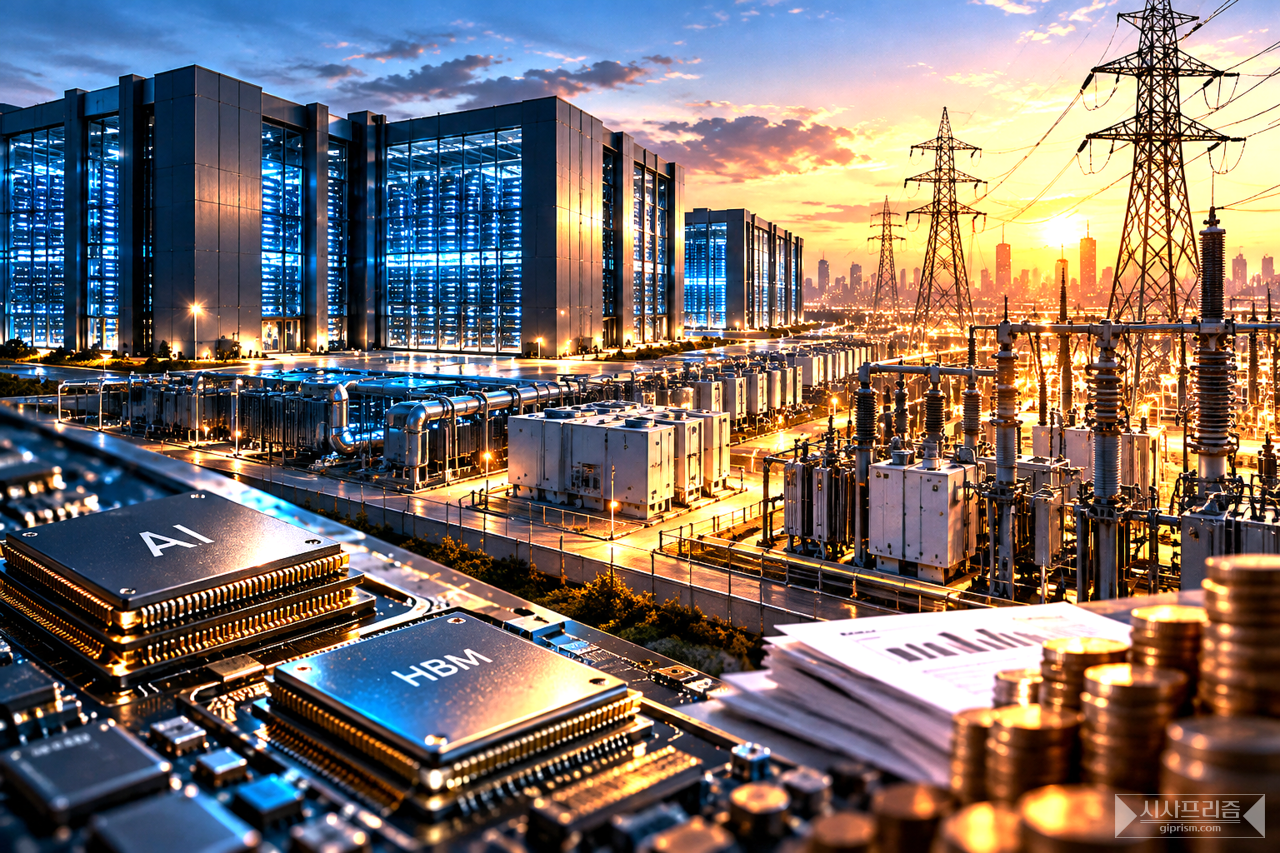
According to global real estate services company CBRE, vacancy rates across eight major North American data center markets reached a record low of 1.4% in the first half of 2026. Preleasing agreements had also been signed for 80.4% of capacity under construction.
By contrast, market research firm Gartner warned on October 14 that more than $3.5 trillion in investment could be exposed to asset impairment risk by the end of 2030 if the current expansion in AI infrastructure investment continues.
However, CBRE's figures cover major North American markets and include demand for general cloud and enterprise data centers, not just dedicated AI facilities. They do not represent vacancy rates or GPU utilization across all AI data centers worldwide.
Strong current demand for facilities thus coexists with the prospect that investments may not be recovered in the future.
Understanding these contrasting assessments requires distinguishing data center leases from actual AI revenue, semiconductor computing efficiency from investment returns, and financial debt from power infrastructure.
A 1.4% vacancy rate and $3.5 trillion at risk: contrasting signals in AI investment
According to a report CBRE released in August, total supply across eight major North American data center markets reached 10,903 megawatts (MW) in the first half of 2026, up 33.7% from the same period a year earlier.
Capacity under construction also increased 24.8% to 7,481 MW, of which 80.4% was already leased.
The vacancy rate remaining at 1.4% despite expanding supply shows that AI and cloud demand is translating into actual facility contracts. However, high leasing rates do not guarantee that investors will achieve their required returns.
Gartner estimated that AI data center owners would need cumulative revenue of $8.5 trillion by 2030 to cover capital expenditure and financing costs and achieve an annual return on invested capital (ROIC) of 12%.
By contrast, it projected that enterprise and consumer AI revenue attributable to data centers over the same period would total no more than $3.6 trillion.
The annual 12% return is an analytical assumption set by Gartner, and both revenue figures are estimates based on an industry-level model allocating investment and revenue.
The likelihood of individual developers recovering their investments may vary depending on cash flow from existing cloud businesses, the economic life of each asset and contract structures.
The $4.9 trillion difference between the two figures therefore does not directly represent investment losses.
Gartner's $3.5 trillion figure likewise represents not confirmed losses but the amount potentially exposed to asset impairment risk if the current investment expansion continues.
Data center owners can secure rental income through long-term leases, but tenant companies must use those facilities to generate sufficient AI service revenue.
If customers' businesses grow and contracts remain stable, initial investment costs can be recovered.
Conversely, deteriorating customer cash flow could affect contract performance, renewals and future rental levels.
Ultimately, vacancy rates show the current balance of facility supply and demand, while asset impairment risk reflects the potential to recover invested capital through future cash flow.
The current shortage of data centers does not contradict the possibility that some investments could incur losses over the long term.
Misunderstanding 40% GPU utilization: computing efficiency and asset impairment are different issues
A frequently cited metric in analyzing AI data center economics is graphics processing unit (GPU) model FLOPs utilization (MFU).
MFU compares the useful computation required for model training with an AI accelerator's theoretical peak computing performance.
However, an MFU of 40% does not mean that GPUs are inactive for the remaining 60% of the time or that 60% of data center resources are wasted.
A paper on the large language model PaLM, published by Google researchers in 2023, reported MFU of 46.2% and hardware FLOPs utilization (HFU) of 57.8% during training using 6,144 TPU v4 accelerators.
This experiment used Google's tensor processing units (TPUs), rather than GPUs, and shows that computation contributing usefully to a model and computation actually performed by hardware can be measured differently.
MFU is primarily a measure of model training efficiency, not overall data center utilization or return on invested capital.
AI data center economics also vary with the balance between training and inference. Large-scale training connects numerous accelerators to perform computations.
Inference, however, is the process of answering users' questions or generating content and is directly connected to actual service delivery.
For inference, it is important not only to utilize hardware but also to reduce computing costs per unit of service while managing response latency.
The developers of vLLM, including researchers at the University of California, Berkeley, reported that improved memory management delivered throughput two to four times higher than existing systems under some experimental conditions.
Software optimization can enable the same hardware to perform more work, but higher throughput does not guarantee a proportionate increase in revenue or profit.
Falling AI service prices can reduce revenue per unit, while lower prices could also create new demand and expand total computing demand.
The International Energy Agency (IEA) has likewise found that improved efficiency per task does not guarantee lower overall data center electricity consumption. The economic life of AI semiconductors also becomes important here.
Companies depreciate GPU acquisition costs over their estimated useful lives, but new semiconductor releases and falling service prices can cause existing equipment's future profitability to deteriorate faster than expected.
If an asset's recoverable amount falls below its carrying value, an impairment loss may have to be recognized under the applicable accounting standards.
However, the actual approach to impairment testing differs between International Financial Reporting Standards (IFRS), US generally accepted accounting principles (US GAAP) and other standards.
GPUs that are no longer competitive for training the latest models can still be used for relatively smaller-scale inference, so a generational transition does not immediately mean a loss of asset value.
The key is not GPU computing utilization itself, but whether the semiconductors can generate cash flow exceeding operating and investment costs while they remain economically competitive.
Debt and electricity pressures on AI infrastructure: differences between big tech and neocloud companies
The financial risks of AI data center investment vary with financing structures.
Global big tech companies such as Microsoft, Amazon and Alphabet can use cash flow from existing cloud, software and advertising businesses to invest in AI infrastructure.
By contrast, neocloud companies specializing in AI computing resources often depend on external borrowing and new capital raising to fund GPU purchases and data center construction.
Examples include CoreWeave and Nebius.
According to Reuters, shares in Nebius and CoreWeave fell 15.1% and 9.5%, respectively, in the US stock market on October 14.
Growing concerns about rising interest rates drew attention to the profitability of heavily indebted AI infrastructure business models.
On October 16, reports also said that market yields on some CoreWeave bonds had risen to approximately 15% to 16%.
These are secondary-market yields reflecting declines in the bonds' market prices and concerns about credit risk. They do not mean that the same interest rate applies to all the company's borrowings.
They nevertheless show market concerns that financing costs could increase when the company takes on new debt or refinances existing borrowing.
Data center businesses incur capital expenditure and financing costs before actual revenue begins.
Even with long-term contracts secured, delays in completion or electricity supply can postpone revenue receipts.
Credit rating agency S&P Global also warned on October 19 that publicly disclosed financial information might not fully capture major technology companies' AI-related financial obligations.
This is because financial obligations are distributed across multiple companies and projects through long-term purchase agreements, project financing and guarantees.
However, S&P Global did not judge at the time that these concerns alone warranted changes to major companies' credit ratings.
Citing capital-intensive business structures and intensifying competition, Gartner projected that more than 80% of neocloud developers could cease operating independently by 2030.
This is a forecast of potential industry restructuring, including mergers and acquisitions, not a determination that individual companies will go bankrupt. Alongside financial risk, access to electricity also determines profitability.
The IEA projected that annual global data center electricity consumption would increase from approximately 485 terawatt-hours (TWh) in 2025 to approximately 950 TWh in 2030.
Over the same period, electricity consumption at AI-focused data centers is expected to roughly triple.
Even with GPUs and sites secured, data centers struggle to generate substantial revenue until grid connections, cooling systems and permitting are in place.
If electricity supply is delayed, financing costs associated with facility investment accumulate, while semiconductors that cannot be installed or fully utilized may also become less technologically competitive.
Conversely, facilities with grid access and permits can be used over long periods by replacing their GPUs with newer models and may be valued as scarce assets.
The economic lives of data center buildings and power infrastructure thus differ from those of GPUs. This explains why facilities facing power supply delays and those with stable operating conditions cannot readily be assigned the same investment value.
AI infrastructure investment risks do not arise only when demand falls. Even when demand increases, mismatches between debt repayment dates, electricity supply and the start of actual revenue can weaken cash flow and profitability.
Different revenue structures in Korea's AI industry: varying effects on telecoms, HBM and power equipment
The expansion of global AI data center investment and the possibility of a correction also affect Korean companies. However, the effects reach earnings through different channels depending on each company's industry role and contract structure.
For telecommunications companies operating or expanding data center businesses, including SK Telecom, KT and LG Uplus, important factors include long-term customer contracts, electricity costs, facility investment costs and operating cash flow.
Long-term customer contracts can provide a degree of revenue stability, but delays in completing new facilities, rising electricity costs and customers' ability to fulfill contracts affect profitability.
High-bandwidth memory (HBM) suppliers such as Samsung Electronics and SK hynix are affected more by AI semiconductor production and investment, memory selling prices, supply volumes, product competitiveness and customer concentration than by data center vacancy rates.
If AI infrastructure investment slows, growth in new memory demand could also weaken. However, increasing memory capacity and bandwidth requirements for next-generation semiconductors could raise the value added per product.
Manufacturers of power equipment, including transformers and transmission and distribution equipment, can expect opportunities from expanding data center construction and grid development. However, existing order backlogs must be distinguished from future new orders.
Even if existing contracts support revenue for a period, project cancellations or delays could affect new orders and production plans over the long term.
For cooling equipment companies, demand to manage heat from increasingly dense AI accelerators also presents opportunities. Actual profitability, however, depends on technology adoption, the pace of commercialization, customer acquisition, and installation and maintenance costs.
AI service companies have a different business structure. For these companies, acquiring and retaining paying customers, inference costs and profitability by service matter more than the number of GPUs owned.
If competition among infrastructure suppliers lowers AI computing prices, companies purchasing services could instead gain opportunities to reduce costs.
If the expansion of AI infrastructure investment slows, semiconductor manufacturers could therefore be affected through new orders, data center operators through facility operations and contract renewals, power equipment companies through new orders, and AI service companies through infrastructure procurement costs.
In the Korean stock market, too, there is a need to distinguish where individual companies generate revenue and cash flow rather than treating all AI-related companies as belonging to the same growth industry.
Even if the AI industry grows rapidly, profits will not increase for every participating company. The key is which companies receive the benefits of expanding investment and how sustainable those profits are.
The AI data center bubble debate centers on investment recovery and cash flow
Actual demand growth and the possibility of excessive investment coexist in the AI data center market.
Low vacancy rates and high preleasing rates in major North American markets show that current demand for facilities is strong.
Whether that demand will generate enough future cash flow to meet every developer's required return is a separate question.
Gartner's warning about $3.5 trillion in asset impairment risk is not a definitive loss forecast predicting failure across the entire AI industry.
It is an analysis of risks that could arise if the current expansion in investment continues. GPU model FLOPs utilization likewise does not directly explain investment performance.
Actual economics are determined by the combined effects of paid usage, service prices, operating costs, financial debt, access to electricity, and semiconductor depreciation and economic life.
In particular, big tech companies using their own cash flow and neocloud companies heavily reliant on external borrowing face different financial risks even amid the same increase in AI demand.
The revenue structures of data center owners, AI computing service providers, semiconductor manufacturers and AI service companies must also be distinguished.
Facilities with grid access and permits can retain their value over long periods, but a particular generation of GPUs installed inside them may lose economic competitiveness faster than expected because of technological change.
Conversely, falling AI infrastructure prices could create new growth opportunities for companies purchasing services.
Investors need to examine not only data center leasing rates and GPU holdings but also actual revenue and free cash flow, debt repayment capacity, the stability of customer contracts, electricity supply schedules and additional capital expenditure requirements.
The central issue in the AI data center bubble debate is not whether facilities are vacant, but whether the electricity capacity and GPUs secured at enormous expense can generate sufficient cash flow within their economic lives.
Even as the overall AI industry grows, asset impairments at some developers, mergers and acquisitions, and industry restructuring could occur simultaneously.
Technological progress and the success of individual investments are not the same thing. Nor is the outcome of competition in the AI infrastructure market determined by who secures the most GPUs.
Ultimately, outcomes will depend on how efficiently companies operate the assets they have secured and convert them into sustainable revenue and profit.
Key references
Gartner (October 14, 2026): AI infrastructure asset impairment risk and investment return scenarios.
CBRE (August 27, 2026): North American data center vacancy rates, supply and leasing conditions.
International Energy Agency, IEA (2026): Data center electricity consumption outlook.
Reuters (October 19, 2026): Big tech's AI-related financial obligations.
PaLM research (2023): TPU-based model and hardware FLOPs utilization.
vLLM research (2023): Optimizing AI inference throughput.
Original Korean article: giprism.com
English brief by Korea Wind Intelligence, koreawindintel.com

















