Nowhere for the Power to Go: Korea's Transmission Grid and the Offshore Wind Bottleneck-Gens
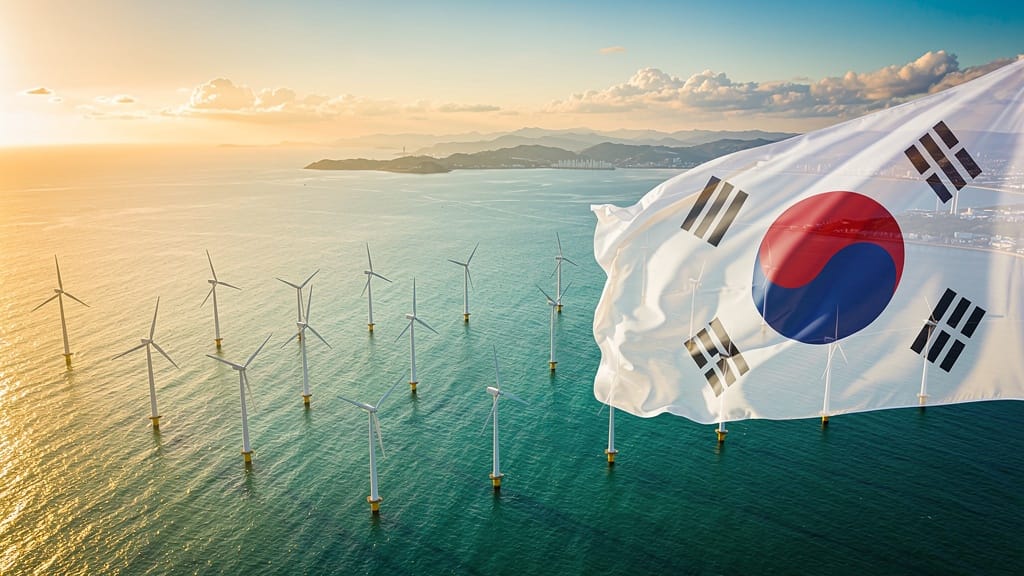
Korea has designated 14.4 GW of offshore wind zones. It has 0.35 GW connected to the grid. The gap is not turbines, permits, or capital — it is transmission infrastructure, and the timeline to fix it is longer than the industry wants to admit.
Nowhere for the Power to Go
Korea has a world-class wind permitting framework. What it doesn’t have is a grid that can absorb the result — and the timeline to fix that is longer than the industry wants to admit.
Korea just designated 14.4 GW of offshore wind. The grid can absorb 0.35 GW.
On March 26, South Korea took what looked like a defining step forward: the official designation of 14.4 GW of offshore wind zones across 10 sites, backed by a newly enacted Special Act designed to cut permitting timelines from a decade to five years. By almost every policy metric, this is progress. Real, substantive, hard-won progress.
So here is the uncomfortable question no one is loudly asking: where does the power actually go?
Korea’s national grid currently has 0.35 GW of offshore wind connected. The government’s target for 2030 is 10.5 GW under construction. That means adding roughly 10 GW of transmission capacity in six years — in a country where high-voltage grid projects routinely take seven to ten years to complete, even under ideal conditions.
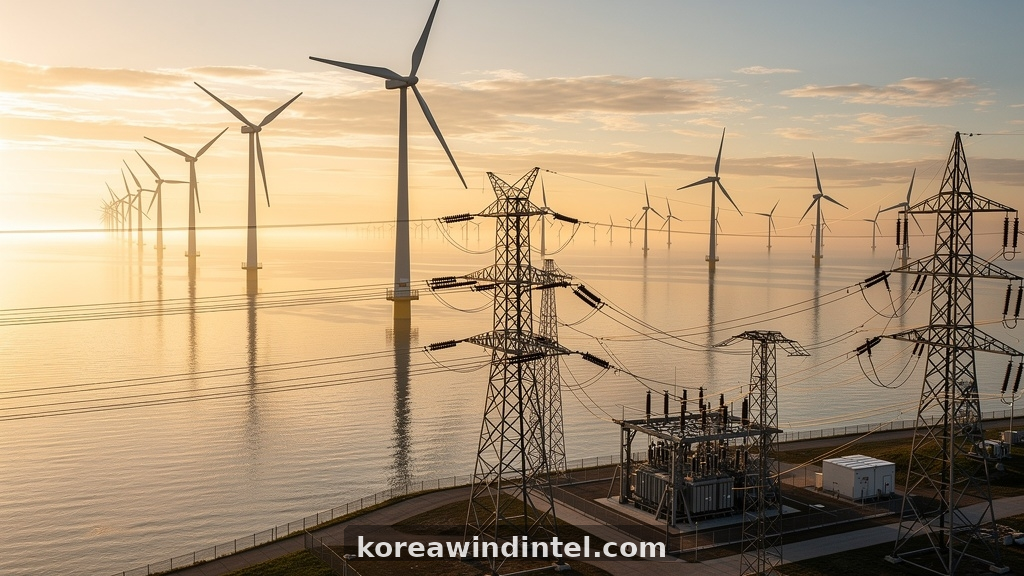
The turbines are not the bottleneck. The cables are. And this distinction matters enormously for anyone who is financing, building, or investing in Korean offshore wind right now.
KEPCO has an answer. Three HVDC corridors, 7.3 GW of new capacity. Here is the problem.
KEPCO’s response to the grid constraint is technically the right one: three offshore HVDC (High-Voltage Direct Current) corridors that would add 7.3 GW of new transmission capacity by 2029–2031. HVDC is a proven technology — Japan, Scandinavia, and China all use it to move bulk renewable power across distance. Korea knows how to build this infrastructure.
The problem is not whether HVDC works. The problem is whether it can be done fast enough. A 500 kV HVDC line, in a country with Korea’s coastal geography and regulatory environment, takes five to seven years from environmental review to commissioning under ideal conditions. Korea says it will complete three of them in six years — simultaneously.
(Saemangeum → Seoul Metro)
(Sinhanam → Dangjin)
(Sinhanam → Seo-Incheon)
Even if all three corridors are delivered on schedule with zero slippage, the combined 8.0 GW is still 2.5 GW short of the 10.5 GW 2030 target. And that is the optimistic scenario. Historical precedent — Germany’s HVDC delays, Taiwan’s grid bottlenecks, the US Atlantic interconnection queue — suggests that at least one of these corridors will run late.
“The windiest zones in Korea are where the grid is weakest. That is not a coincidence. It is a legacy of a grid built around coal plants, not coastlines.”
— KEPCO transmission planner (anonymized)
Continue Reading
This analysis continues with four more sections — covering the three structural constraints KEPCO's timeline doesn't acknowledge, the developer's dilemma, four levers Korea hasn't pulled, and five signals to watch in the next 18 months.
Why can’t KEPCO just build faster? Three structural constraints that schedules don’t acknowledge.
The honest answer to this question is that KEPCO faces three interlocking constraints that cannot be solved through willpower or political announcement — and all three are systematically underweighted in the official timeline.
KEPCO carries 205.7 trillion KRW (~$149B) in total debt — a record high as of end-2024. The HVDC capex programme (1.87T KRW through 2031) is modest relative to that balance sheet — but Korea’s tariff policy constrains the utility’s ability to generate the equity returns needed to take on additional leverage. Every yen of HVDC acceleration requires either a tariff increase (politically difficult) or government-backed financing (not yet committed).
HVDC converter stations and submarine cables are globally scarce. Prysmian, Nexans, and the handful of other suppliers capable of delivering GW-scale subsea cable have order books stretching 18–24 months. Korea’s domestic supplier, Hyosung, is still in prototype stage. If KEPCO wants to run all three corridors in parallel, it must compete with Germany, the UK, Taiwan, and Australia for the same hardware — right now.
The southwest HVDC corridor must cross hundreds of kilometers of active fishing grounds. There is no standardised compensation framework for affected communities. The process is negotiated zone by zone, household by household. This cannot be rushed without generating the same kind of community-led legal challenges that have derailed offshore wind projects in Jeonnam and Jeonbuk for years.
None of this means the 2029–2031 timeline is impossible. It means it is achievable only if everything goes right at once — procurement, permitting, fisheries negotiation, and financing all converge on schedule. That is not a base case. That is a best case.
Build fast, connect late. Korea is setting developers up to fail a race no one told them they were running.
Consider this scenario: a developer wins a zone in 2025 and moves quickly — financial close by early 2026, turbine manufacturing underway, installation vessel booked for 2027. By late 2027 or early 2028, they have a working offshore wind farm generating electricity.
And nowhere to send it.
The HVDC Southeast Corridor — the earliest of the three — is not scheduled for commissioning until 2029. The Southwest Corridor, which serves the Jeonnam cluster where much of Korea’s largest wind capacity sits, is a 2031 target. A developer who builds on schedule may be sitting on an idle turbine fleet for two to four years, with debt service running and zero revenue coming in. This is not a hypothetical risk. It is the base case for early movers.
The government’s response to this problem has been silence. There are no binding grid connection queue guarantees. No time-adjusted tariff mechanisms. No compensation framework for curtailment-caused revenue delays. The Korea Offshore Wind Industry Association (KWEIA) has formally requested connection guarantees; MCEE has not granted them.
“Korea’s offshore wind sector will not be constrained by turbines, capital, or policy. It will be constrained by cables. And by the silence around the question of who bears the cost of waiting.”
— KWI Analysis, March 2026
Four levers Korea hasn’t fully pulled — and one that would change the conversation overnight.
Korea is not out of options. The gap between the current trajectory and a workable outcome is not enormous — but closing it requires acknowledging the constraint explicitly rather than assuming the grid will solve itself. Here are four moves that could materially improve the situation:
KEPCO commits to a formal schedule showing which zones connect in which quarters through 2032. This alone would unlock project financing for dozens of stalled developments — developers can structure debt around a known revenue start date rather than guessing.
Consolidate environmental assessments into a 9-month government-backed fast-track that runs concurrently with procurement. Denmark reduced HVDC permitting timelines by 40% this way. Korea has the institutional machinery to do the same through the Special Act’s integrated review framework.
Create a legal pathway for project developers to finance, build, and transfer grid connection infrastructure to KEPCO — distributing the capital requirement beyond KEPCO’s constrained balance sheet. This model has been used in the UK and Australia with strong results.
Allow early-stage connections with pre-agreed curtailment limits until full HVDC capacity is available. A project operating at 80% of capacity is vastly better than one sitting dark for two years. Curtailment contracts are bankable — revenue uncertainty is not.
The lever that would change the conversation most immediately is the first one. A published, binding connection queue is not expensive. It does not require new infrastructure. It requires political commitment to transparency — and it would signal to the global investment community that Korea understands the gap between its wind ambitions and its grid reality.
Five signals in the next 18 months that will tell you whether the grid constraint gets resolved or deepens.
A 2030 commissioning for the 430 km Southwest Corridor requires breaking ground this year. A formal Notice to Proceed or completed EIA by Q4 2026 is the key confirmatory signal. “Scope optimization” announcements are a warning sign — it is the industry term for descoping.
KEPCO must select contractors. Any delay here cascades directly into the 2031 commissioning date. Watch also for whether the contract includes domestic or international cable suppliers — a choice with significant supply chain implications.
MCEE or KEPCO may announce conditional grid access restrictions for the Jeonnam/Jeonbuk region as the Honam corridor approaches saturation. When this announcement comes — and it will — watch carefully for whether conditional curtailment contracts are offered alongside the restriction. That will signal whether Korea is managing the constraint or simply acknowledging it.
The 7.9 trillion KRW HVDC programme has been announced but not financed. When the capital structure is disclosed — who is providing equity, what government guarantees are in place, what tariff mechanism backs the investment — the market will have a much clearer view of how firm the 2029–2031 dates actually are.
The upcoming auction round under the Special Act will reveal whether grid connection feasibility has been incorporated into zone selection criteria. If it has not, Korea will continue designating zones it cannot connect — and the gap between ambition and infrastructure will widen further.
Korea built the station. Now it needs to lay the track.
Korea’s offshore wind policy framework is — genuinely — more coherent than it has ever been. The Special Act is a real achievement. The 10-zone OWIZ structure gives the market a pipeline. The HVDC plan, if delivered, would resolve the fundamental constraint for most of the southwest coast projects.
But for anyone making a commitment in the 2025–2030 window, the binding constraint is not permitting, not community acceptance, not auction design. It is transmission capacity. Until that constraint is resolved zone by zone, the 10.5 GW 2030 target will remain a planning number rather than a bankable outcome.
The fix is not complicated. It starts with honesty: the government acknowledges the gap between wind capacity and grid capacity explicitly, rather than leaving developers to price in the uncertainty themselves. It continues with a binding connection queue, accelerated permitting, and a financing structure for HVDC that does not depend entirely on KEPCO’s constrained balance sheet.
Korea has 14.4 GW of designated offshore wind zones and 350 MW in operation. That gap is not a rounding error — and the grid is the reason it will be difficult to close on the timelines currently being advertised. Developers and investors who treat the 2030 connection timeline as firm are mispricing risk. Those who build that uncertainty into their structures — through curtailment-ready contracts, grid guarantees, and conservative revenue-start assumptions — will be better positioned when the grid reality eventually catches up with the policy ambition.
“Korea has 14.4 GW of designated offshore wind zones and 350 MW in operation. That gap is not a rounding error — and the transmission grid is the reason it will be difficult to close.”
— KWI Analysis, March 2026
Related Reading on koreawindintel.com
Korea Offshore Wind Intelligence (KWI) — Commentary | March 2026
Views expressed represent analytical interpretation of publicly available information. This commentary is not investment advice. Sources: MCEE · KEPCO Long-Term Transmission & Substation Plans · 11th Basic Plan for Electricity Supply and Demand · KWI Grid Constraints Report (March 2026) · LS Cable & System HVDC announcements.
insights@koreawindintel.com · koreawindintel.com