Source article — Park Yoonseok, Electric Power Journal (epj.co.kr), 30 June 2026 → epj.co.kr/articleView?idxno=38877
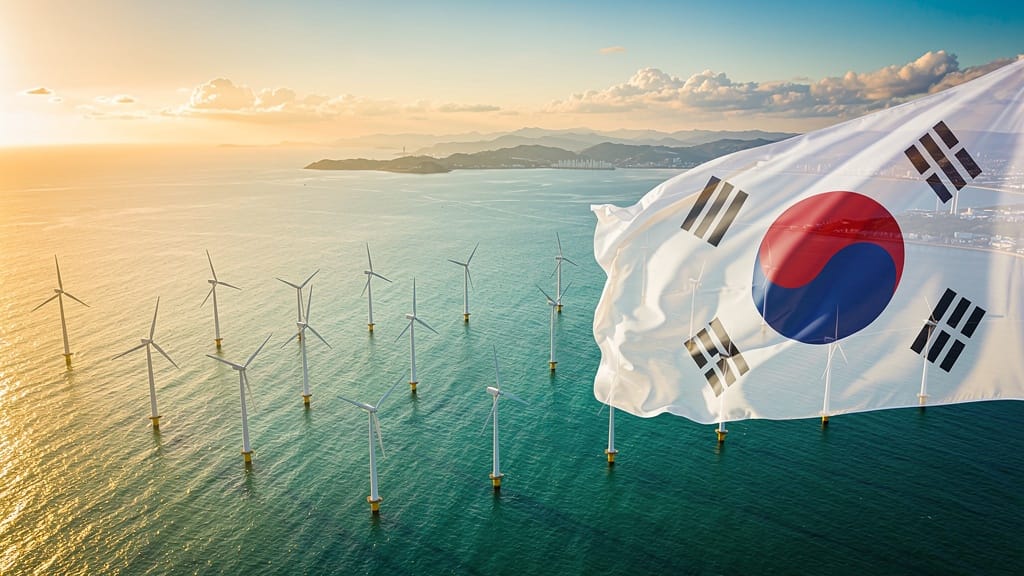
On 30 June, Korea's Ministry of Climate, Energy and Environment announced the outcome of the first-half 2026 fixed-price competitive auction for wind power. Five offshore wind projects totalling 1,786 MW were selected — the second-largest single round since the auction regime was introduced in 2022. Across the five auctions held to date, this was both the largest notified volume and the round with the highest average bid-to-award ratio (above 2:1), Electric Power Journal reports.
A total of 3,656 MW had been submitted to the auction across three tracks — fixed-bottom (four projects, 1,598 MW), floating (three projects, 1,498 MW) and public-led (two projects, 560 MW) — against the Ministry's notified target of approximately 1,800 MW (fixed ~1,000 MW, floating ~400 MW, public-led ~400 MW). The five awarded projects break down as follows.
The five awarded projects
- Fixed-bottom · Gulupdo (굴업도) — 250 MW · C&I Leisure Industry · SK Eternix · Daewoo E&C · Doosan Enerbility 10 MW class
- Fixed-bottom · Hanbit (한빛) — 340 MW · Myungwoon Industry Development · B.Grimm Power · Unison 13.6 MW class (license production)
- Fixed-bottom · Haesong-3 (해송3) — 504 MW · CIP · Siemens Gamesa 14 MW class (Korean production)
- Floating · Haewoori 2 (해울이2) — 532 MW · CIP · Siemens Gamesa 14 MW class (Korean production)
- Public-led · Geumodo (금오도) — 160 MW · DL Energy · KOMIPO · Doosan Enerbility 10 MW class
CIP takes both a fixed and a floating award
CIP submitted two fixed-bottom projects this round — Haesong-1 and Haesong-3 — and only Haesong-3 was selected. Because CIP intends to develop the two projects in parallel for efficiency, the developer is expected to focus heavily on the second-half auction to bring Haesong-1 in alongside the awarded sites, the article reports.
On the floating side, Haewoori 2 (532 MW) was the only project selected — as widely expected against a ~400 MW notified slot. EPJ notes that Haewoori 2 built up qualitative evaluation scores in part through commitments on turbine localisation and supply-chain cooperation. The floating ceiling price was lowered to KRW 175.1/kWh, down about KRW 1.465 from the prior round, leaving the project a tight cost stack on the road to FID. CIP is therefore considering Haewoori 2 and Haewoori 3 as a packaged development to spread cost.
For the round, EPJ also notes a technical detail relevant to the third-place fixed bidder: because the total awarded volume slightly exceeded the notified envelope, the third-place bidder's contracted unit price for the excess capacity is calculated as a weighted average using the next bidder's price — meaning the developer's effective revenue on the excess portion may be materially lower than its own bid price.
Public-led: only Geumodo cleared the evaluation
On the public-led track, only Geumodo (160 MW) was selected against a 400 MW notified slot. Industry had broadly expected Jangbogo (400 MW) — with majority public-utility equity and all-domestic participants — to also clear on qualitative grounds. According to EPJ, the project fell short on the Ministry's industry/economic effect criteria (domestic investment, job creation, supply-chain contribution), which can lead to non-selection regardless of the notified volume.
The article reads the outcome as a sharpening of the public-led track's evaluation direction: Korean-supplied wind turbines are now treated as the first-priority criterion, and projects using foreign turbines need explicit localisation cooperation with domestic firms to clear the minimum bar.
Hanbit re-opens the China supply-chain debate
The single most-watched question in this round was whether Hanbit (340 MW) would be selected, EPJ writes. Hanbit will install Unison's 13.6 MW class turbine (GWH252), assembled at the Sacheon plant under a license agreement with Vensys. Vensys is a German company that Goldwind — China's leading wind turbine OEM — acquired in 2008 and in which Goldwind currently holds a roughly 70% stake. EPJ quotes a Unison representative explaining that the firm uses the Vensys brand to deliver Goldwind models in Europe as well, depending on local market conditions.
EPJ notes that since the auction regime began in 2022, only the 2023 round had previously selected projects carrying Chinese-origin turbines — Gochang (76.2 MW, Mingyang 6.35 MW class) and Nakwol (364.8 MW, Vensys 5.7 MW class). Across the two rounds held in the two years since, bids carrying Chinese-origin turbines were eliminated at the evaluation stage. The article reports that the industry had read that pattern as an implicit policy signal against Chinese supply-chain use, and that developers had structured their bids accordingly. Today's Hanbit award is therefore interpreted as a visible inflection.
An industry source quoted in the article frames the unease as one of process rather than policy substance:
The frustration in the industry is not that Chinese supply-chain use was permitted, but that the evaluators applied a framework different from the one bidders had been preparing against — and that the change in direction was not pre-shared. In a setting where developers are asked to use domestic supply chains and bring costs down at the same time, no developer would object if the government openly allowed Chinese supply-chain use. From the H2 round onwards, more developers will look seriously at Chinese turbines. With Hanbit, there is now a template for bringing Chinese turbines into the Korean market via license production — and Shanghai Electric and Mingyang, both with sustained Korean-market intent, will watch this result closely. — Industry source quoted in Electric Power Journal, 30 June 2026
Solar precedent and the localisation question
EPJ raises the broader concern that today's outcome could trigger a shift in Korea's wind ecosystem. As ceiling prices continue to decline and bid price accounts for roughly half of total evaluation scoring, price competitiveness becomes the dominant determinant of selection — and Chinese supply-chain capacity may take a growing share of the Korean market. The article notes that Korea's domestic solar industry has already gone through a similar contraction under Chinese supply-chain dominance, and that some in the wind industry see the same trajectory as a real risk for offshore wind.
A second voice cited in the article frames the same question more constructively:
What matters in domestic license-production of a foreign wind turbine is not whether the underlying technology is Chinese or European, but how much of it can be internalised — raising domestic content of core components and securing maintenance capability. A licensing agreement has to translate into accumulated know-how and stronger domestic parts industry, not stop at re-badged assembly. If that virtuous cycle is actually built, concerns about Chinese market capture can be addressed naturally. — Industry source quoted in Electric Power Journal, 30 June 2026
The article concludes that while Korea's broader policy direction — lowering generation costs through scale economies in offshore wind — is widely accepted in the industry, the approach needs a clearer policy rationale and stronger industry consensus alongside it.