South Jeolla Taps Doosan to Accelerate Korea Offshore Wind Supply Chain
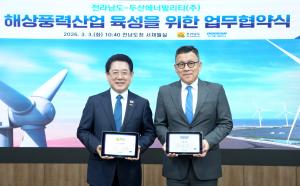
South Jeolla Province and Doosan Enerbility signed an MOU to boost offshore wind projects and local manufacturing. The pact signals tighter public–private coordination in Korea’s wind buildout.
Executive Insight
South Jeolla Province’s memorandum of understanding with Doosan Enerbility underscores a practical shift in Korea’s offshore wind market: regional governments are moving beyond permitting and site promotion toward active industrial policy, partnering with major manufacturers to improve execution certainty. For developers, the key message is that provincial administrations—especially in the southwest where much of Korea’s offshore wind pipeline is concentrated—want tighter coordination across project development, grid and port readiness, and the domestic supply chain. That can reduce some of the chronic bottlenecks seen in Korea, where complex stakeholder alignment and procurement uncertainty have slowed financial close and construction starts despite ambitious national targets.
The involvement of Doosan Enerbility is strategically material for two reasons. First, it signals a push to localize higher-value components and services (manufacturing, assembly, O&M capabilities, and potentially integration of foundations, substations, or related balance-of-plant) rather than relying solely on imported turbines and offshore construction capacity. Second, closer public–private coordination can help Korea reconcile two competing objectives: (1) accelerating buildout to meet renewable energy and industrial decarbonization goals, and (2) ensuring domestic value creation that is politically salient and increasingly reflected in procurement expectations. For international OEMs, EPCI contractors, and equity investors, this creates both opportunities (joint ventures, localized production, port-side assembly investments, service partnerships) and new diligence requirements around local content, workforce development, and provincial-level stakeholder commitments.
Commercially, the MOU also reinforces the importance of regional “ecosystem building” as a de-risking lever in Korea. Investors should track whether South Jeolla translates the agreement into bankable measures: faster permitting workflows, clearer local benefit-sharing frameworks, port upgrades suited for next-generation turbines, and coordinated supplier qualification. If these follow, projects in the province may gain an advantage in schedule credibility and cost control—two variables that strongly influence bid competitiveness and financing terms in a high-rate environment. In short, the deal points to a maturing market where the winners will be those who can align policy, industrial capacity, and project delivery at the provincial level, not just secure sea area and offtake narratives.